
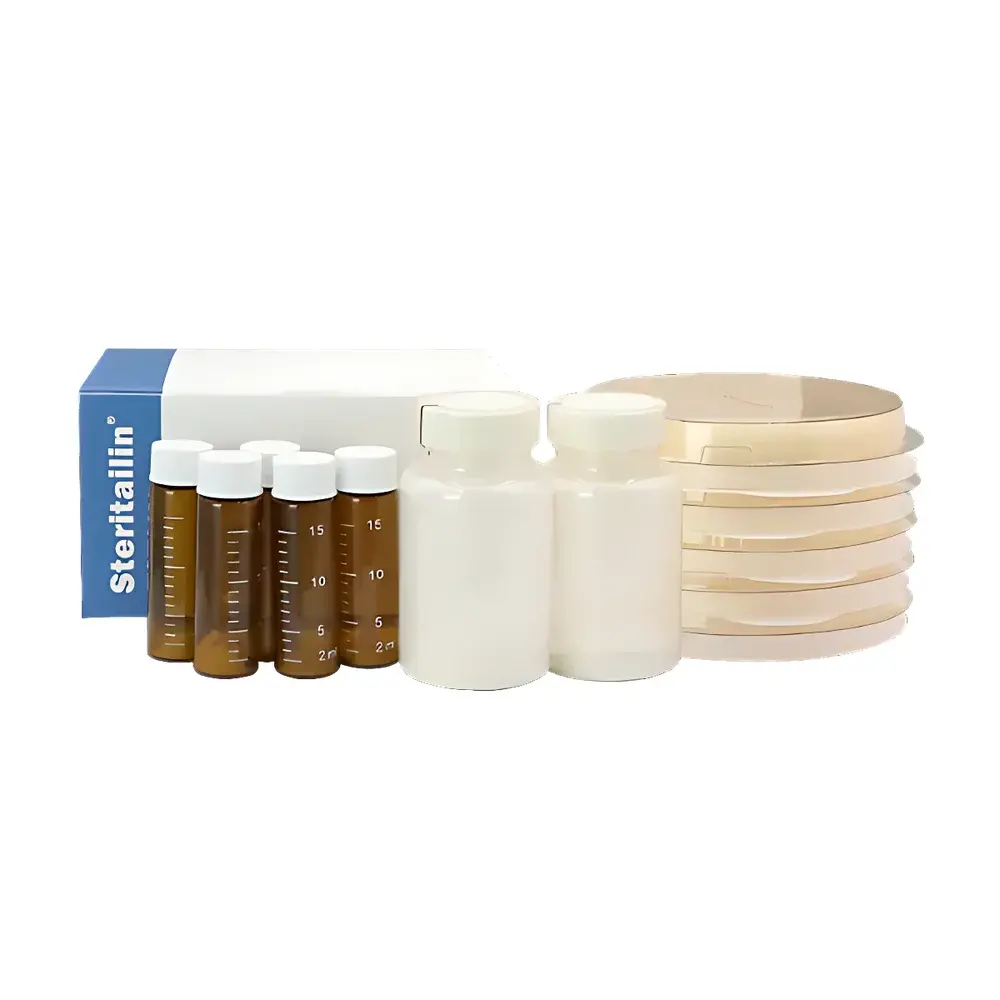
Tailin Enzyme-Substrate-Based Total Colony Count Detection Kit
| Brand | Tailin |
|---|---|
| Origin | Zhejiang, China |
| Manufacturer Type | Manufacturer |
| Product Category | Domestic |
| Model | Enzyme-Substrate-Based Total Colony Count Detection Kit |
| Pricing | Available Upon Request |
Overview
The Tailin Enzyme-Substrate-Based Total Colony Count Detection Kit is a standardized, membrane-free, quantitative microbiological assay system engineered for rapid and reliable enumeration of total viable heterotrophic bacteria in drinking water. It operates on the principle of enzymatic hydrolysis of chromogenic and fluorogenic substrates by conserved intracellular enzymes—primarily β-galactosidase and β-glucuronidase—present across a broad spectrum of culturable microorganisms. Upon substrate cleavage, a fluorescent signal is generated under UV illumination (365 nm), enabling unambiguous detection of colony-forming units (CFUs) without reliance on morphological colony development. This method conforms to the conceptual framework of presence/absence and most probable number (MPN) quantification, delivering results within 48 hours—significantly accelerating turnaround time compared to traditional pour-plate or spread-plate methods requiring 48–72 h incubation and subjective colony interpretation.
Key Features
- Integrated 84-well Quanti-Tray®-style quantification plate pre-filled with dual-enzyme substrate medium, eliminating agar preparation, sterilization, and pouring steps
- Hands-on operation time under 60 seconds per sample, minimizing technician exposure and cross-contamination risk
- Quantitative MPN range spanning 1 to 738 MPN/mL—broader than conventional plate count agar (PCA) methods limited by overcrowding and colony fusion at >300 CFU/plate
- Universal enzyme substrate formulation targets metabolically active cells across diverse Gram-positive and Gram-negative heterotrophs, including slow-growing or stressed organisms that may fail to form visible colonies on standard media
- Fluorescence-based endpoint detection provides objective, binary positive/negative readout; eliminates inter-operator variability associated with colony morphology assessment
- Stable fluorescence signal persists for up to 72 hours post-incubation, supporting flexible reading schedules and reducing overtime labor requirements
- Validated correlation coefficient (r = 0.974) against standard plate count methodology per ISO 9308-1 and APHA Standard Methods 9215B, confirming statistical equivalence in routine monitoring applications
Sample Compatibility & Compliance
The kit is validated for use with potable water samples meeting regulatory definitions under WHO Guidelines for Drinking-water Quality, US EPA Method 1603, and China’s GB/T 5750.12-2023. It accommodates raw, filtered, chlorinated, and low-turbidity (<5 NTU) water matrices without dilution or pretreatment. Sample filtration is not required; direct inoculation of 100 mL water into the tray enables detection at the regulatory action level of 1 MPN/mL. The assay satisfies GLP-aligned documentation requirements, supports audit-ready record retention, and is compatible with laboratory information management systems (LIMS) via manual entry or barcode-scanned result logging. While not certified under FDA 21 CFR Part 11 out-of-the-box, the workflow supports electronic signature implementation when integrated with compliant LIMS infrastructure.
Software & Data Management
No proprietary software is embedded in the kit; however, the MPN table and result interpretation protocol are provided in bilingual (English/Chinese) technical documentation aligned with ISO/IEC 17025 clause 7.7 on reporting. Quantification uses a standardized 84-well MPN table derived from probability theory (Thomas equation), with digital lookup tools available as Excel-based calculators or web-accessible public-domain utilities. Laboratories may integrate result entries into validated LIMS platforms using structured CSV templates. All calibration, lot-specific performance data, and shelf-life validation reports (including accelerated stability testing per ICH Q1A) are supplied with each production batch.
Applications
- Routine compliance monitoring of municipal and bottled drinking water supplies
- Validation and verification of point-of-use (POU) and point-of-entry (POE) disinfection systems
- Environmental surveillance in pharmaceutical water systems (PW, WFI) per USP and EU GMP Annex 1
- Field-deployable testing for emergency response and disaster recovery water safety assessments
- Quality control of packaged water products during manufacturing release testing
- Research applications requiring high-throughput, reproducible enumeration of heterotrophic plate count (HPC) organisms
FAQ
Is this method recognized by international regulatory agencies?
Yes—the enzyme-substrate MPN approach aligns with principles outlined in US EPA Method 1603, ISO 9308-1:2018, and APHA Standard Methods 9215B for total coliform and heterotrophic plate count estimation.
Can the kit be used for wastewater or seawater analysis?
It is specifically validated for drinking water matrices. High turbidity, organic load, or salinity may interfere with fluorescence detection or enzyme kinetics; alternative methods such as membrane filtration are recommended for non-potable waters.
What is the shelf life and storage requirement?
Unopened kits retain performance for 12 months when stored at 2–8 °C; avoid freezing or prolonged exposure to ambient light.
Does the kit include incubation equipment?
No—standard BOD incubators set at 35 ± 0.5 °C are required; no specialized hardware beyond UV transilluminator (365 nm) is needed for result reading.
How is quality control implemented during daily use?
Each test run includes a negative control (sterile water) and a positive control (certified reference suspension); acceptance criteria follow ISO 8199:2018 for microbiological method validation.







