
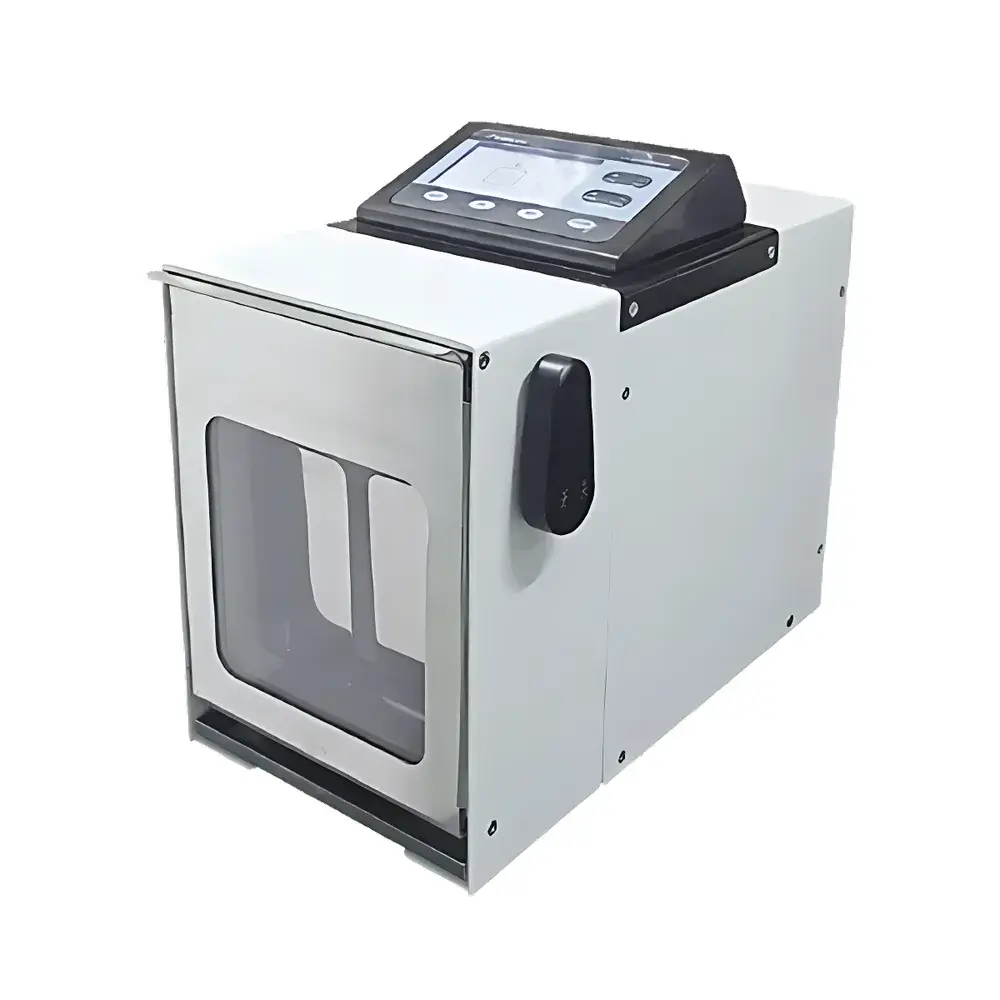
Taylor Scientific HTY-BM02 Paddle-Blade Homogenizer
| Brand | Taylor Scientific |
|---|---|
| Origin | Zhejiang, China |
| Manufacturer Type | Direct Manufacturer |
| Model | HTY-BM02 |
| Power Supply | AC 220 V / 50 Hz |
| Rated Power | ≤480 W |
| Dimensions (W×D×H) | 44.5 × 24.0 × 36.0 cm |
| Weight | 26.0 kg |
| Pulsing Frequency | 1–12 strokes/sec |
| Timer Range | 1 s to 60 min (or continuous mode) |
| Paddle Material | Stainless Steel (AISI 304) |
| Display | Full-color LCD interface with parameter programming |
| Safety Features | Interlocked door switch (auto-stop on door opening), UV disinfection auto-disable upon opening, integrated drip tray |
| Chamber Design | Fully opening front door, removable paddles, zero-contact sample processing |
| Illumination & Disinfection | Built-in LED chamber lighting and UV-C germicidal lamp (254 nm) |
| Thermal Function | Adjustable heating plate (ambient to 45 °C, ±1 °C accuracy) |
| Compliance | Designed per ISO 6887-1:2017, EN ISO 11290-1, and FDA Bacteriological Analytical Manual (BAM) Chapter 3 requirements for microbiological sample homogenization |
Overview
The Taylor Scientific HTY-BM02 Paddle-Blade Homogenizer is a precision-engineered, non-invasive sample preparation instrument designed specifically for microbiological analysis in regulated food, pharmaceutical, and environmental laboratories. Unlike rotor-stator or probe-based systems, the HTY-BM02 employs a controlled mechanical pulsing principle—referred to as paddle-blade impact homogenization—where sterile sample bags are subjected to reproducible, bidirectional percussive forces generated by opposing stainless-steel paddles. This method ensures uniform dispersion of microorganisms from solid or semi-solid matrices (e.g., meat, dairy, produce, pet food) without generating excessive heat, foaming, or shear-induced cell lysis that could compromise viability or colony-forming unit (CFU) quantification. The device operates within the framework of standardized microbiological enumeration protocols, supporting ISO 6887-1:2017 (preparation of microbiological samples), EN ISO 11290-1 (Listeria detection), and FDA BAM Chapter 3 (microbial recovery from foods). Its closed-bag architecture eliminates direct contact between sample and instrument surfaces, thereby eliminating cross-contamination risk and obviating post-run sterilization of internal components.
Key Features
- Programmable pulsing frequency (1–12 strokes/sec) enables optimization for diverse sample viscosities and microbial load profiles—low-frequency settings preserve fragile cells; higher frequencies enhance particle disintegration in fibrous or fatty matrices.
- Full-color LCD interface supports independent configuration of homogenization time (1 s–60 min or continuous), pre-homogenization bag warming (ambient to 45 °C), UV disinfection cycle duration (0–30 min), and post-cycle illumination timing.
- Zero-contact operation: All sample interaction occurs exclusively within certified sterile, single-use polyethylene homogenization bags (ISO 7405-compliant); no internal wetted parts require cleaning or calibration.
- Integrated safety architecture includes dual interlock sensors—mechanical door switch and optical position verification—that halt both paddle motion and UV irradiation immediately upon door actuation, meeting IEC 61000-6-2 EMC immunity and IEC 60335-1 general safety requirements.
- Removable, autoclavable stainless-steel paddles (AISI 304) allow for periodic verification of surface integrity and dimensional stability; paddle alignment is maintained via precision-machined guide rails ensuring consistent stroke amplitude across >10,000 operational cycles.
- Built-in condensate management system features a sloped, seamless stainless-steel drip tray beneath the homogenization chamber, capturing residual moisture and preventing leakage onto benchtops or floor surfaces.
Sample Compatibility & Compliance
The HTY-BM02 accommodates standard ISO-compliant homogenization bags (up to 400 mL volume) and is validated for use with common microbiological media—including buffered peptone water (BPW), tryptic soy broth (TSB), and modified Trypticase soy broth (mTSB). It supports regulatory workflows under ISO/IEC 17025-accredited laboratories, with traceable performance verification achievable through daily operational checks (e.g., paddle stroke consistency, timer accuracy ±0.5%, temperature uniformity mapping). Device firmware logs all user-initiated parameters and cycle completions, providing audit-ready metadata compatible with GLP/GMP documentation practices. While not a medical device, its design aligns with principles outlined in USP and , and its UV-C disinfection module meets ISO 15858:2016 criteria for low-pressure mercury lamp efficacy against vegetative bacteria and spores.
Software & Data Management
The HTY-BM02 operates via embedded real-time firmware (v3.2+) with no external PC dependency. All operational parameters—including date/time stamp, selected program ID, actual stroke count, elapsed homogenization duration, and UV exposure time—are stored in non-volatile memory with overwrite protection. Internal log capacity retains ≥500 complete cycle records, exportable via USB-C port in CSV format for integration into LIMS or electronic lab notebook (ELN) platforms. Firmware updates are performed offline using signed binary files to maintain data integrity and comply with FDA 21 CFR Part 11 requirements for electronic records and signatures where enabled by institutional policy.
Applications
- Routine enumeration of aerobic mesophilic counts, coliforms, E. coli, Salmonella, and Listeria monocytogenes in food safety testing labs.
- Preparation of suspension samples for membrane filtration, pour plating, and spiral plating methodologies per ISO 7218 and AOAC Official Methods.
- Homogenization of environmental swab eluates and rinse waters in pharmaceutical cleanroom monitoring programs.
- Standardized dispersion of biofilm fragments or particulate-laden clinical specimens prior to MALDI-TOF MS identification.
- Supporting ISO 13408-1 validation studies for aseptic processing equipment, where reproducible microbial recovery from simulated product contact surfaces is required.
FAQ
What types of homogenization bags are compatible with the HTY-BM02?
The instrument accepts standard ISO 7405-compliant, 100–400 mL sterile polyethylene homogenization bags with reinforced sealing edges. Taylor Scientific recommends using bags certified for use with paddle-blade systems to ensure consistent mechanical coupling and avoid premature rupture.
Does the HTY-BM02 require routine calibration?
No scheduled calibration is mandated; however, users must perform daily operational verification of timer accuracy, stroke consistency (via visual inspection and audible feedback), and UV lamp intensity using a NIST-traceable radiometer every 100 hours of UV usage.
Can the heating function be disabled during homogenization?
Yes—the thermal plate is independently programmable and may be set to “OFF” or held at ambient temperature while maintaining full control over pulsing and timing parameters.
Is the UV-C disinfection cycle validated for specific pathogens?
UV-C output (254 nm, nominal 15 mW/cm² at 1 cm) is validated per ISO 15858:2016 for ≥3-log reduction of Bacillus atrophaeus spores on stainless-steel surfaces under clean conditions; efficacy against biofilms or organic load requires site-specific validation.
How is data integrity ensured during power interruption?
All active cycle parameters are written to flash memory before execution begins; in the event of unexpected power loss, the device resumes the last saved configuration upon reboot but does not auto-restart interrupted cycles—requiring manual reinitiation to maintain procedural accountability.
Related Products



