
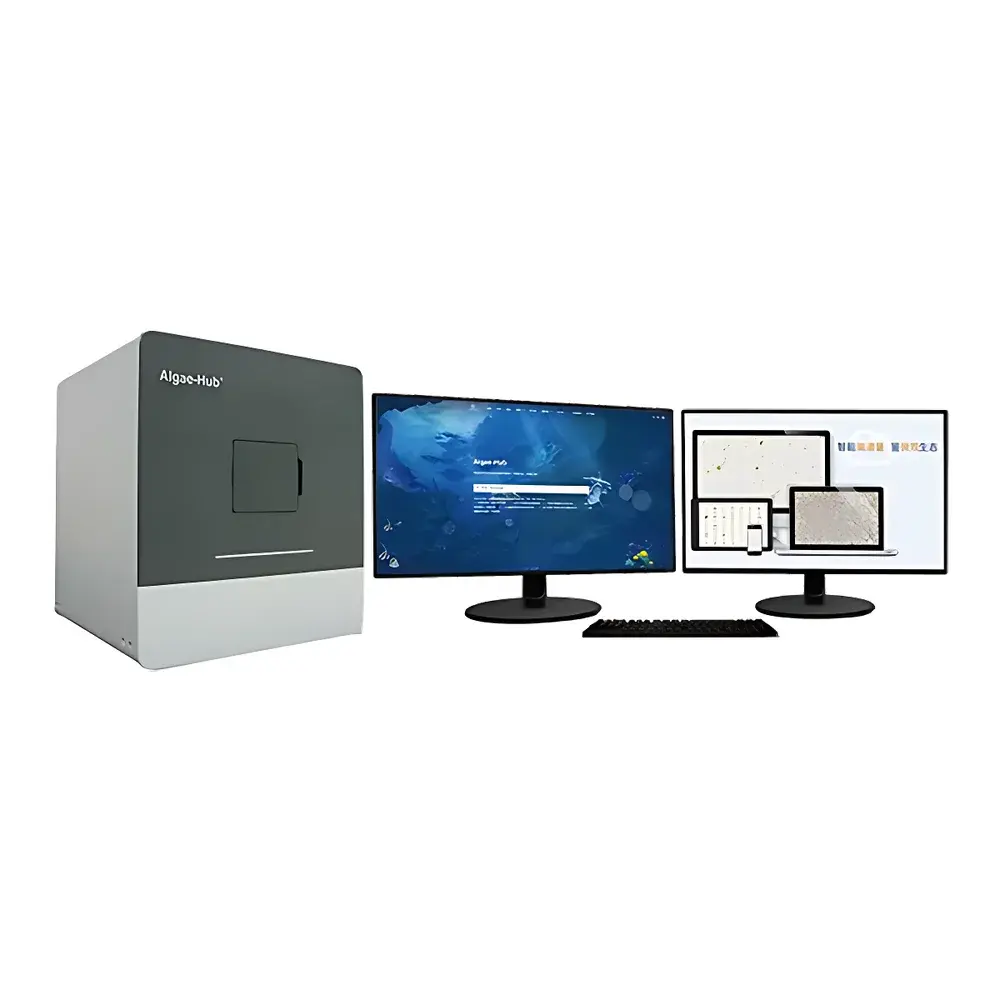
Tailin Biotech AH-22-T Algal Artificial Intelligence Analyzer
| Brand | Tailin Biotech |
|---|---|
| Origin | Zhejiang, China |
| Manufacturer Type | Manufacturer |
| Origin Category | Domestic |
| Model | AH-22-T |
| Pricing | Upon Request |
| Sample Chamber Volume | 0.1 mL |
| Throughput | 3 samples per run |
| Focusing Method | Auto-focus / Manual focus |
| Identifiable Taxa | ≥80 common algal genera and species |
| Imaging Sensor | 5 MP CMOS camera |
| Species Recognition Accuracy | ≥90% |
| Pixel Resolution | < 0.3 µm/pixel |
| Full-field Scan Mosaic Imaging | Supported |
| Compliance | HJ 1295–2023, HJ 1296–2023, HJ 1216–2021, HJ 1215–2021, SL 733–2016, and related freshwater periphyton & phytoplankton monitoring technical specifications |
Overview
The Tailin Biotech AH-22-T Algal Artificial Intelligence Analyzer is a dedicated digital microscopy platform engineered for standardized, high-throughput phytoplankton analysis in freshwater, estuarine, and inland aquatic ecosystems. It operates on the principle of automated brightfield microscopic imaging coupled with deep learning–based morphological classification—leveraging convolutional neural networks (CNNs) trained on curated, taxonomically validated algal image datasets. Unlike conventional manual enumeration under compound microscopes, the AH-22-T digitizes the entire sample volume within a fixed 0.1 mL chamber, acquires multi-plane z-stack images via programmable motorized stage and objective lens control, and reconstructs extended-depth-of-field (EDF) composites to resolve cells distributed across vertical strata. This eliminates focal plane bias inherent in single-layer manual counts and ensures representative quantification of motile and non-motile taxa—including diatoms, cyanobacteria, chlorophytes, and dinoflagellates—under ambient or preserved conditions.
Key Features
- Integrated auto-focus and manual focus modes for adaptive optical alignment across diverse sample turbidity and cell density conditions
- High-fidelity 5 MP CMOS imaging system calibrated to deliver sub-0.3 µm/pixel spatial resolution—enabling reliable discrimination of critical morphological features (e.g., frustule ornamentation, trichome sheaths, flagellar insertion points)
- Multi-z-axis scanning with depth fusion algorithm to generate artifact-free extended-depth-of-field panoramas; supports both full-chamber mosaic acquisition and region-of-interest (ROI) targeting
- Pre-trained AI model covering ≥80 taxonomically significant algal genera and species, validated against reference collections and field-collected specimens per ISO 17025–aligned verification protocols
- On-device inference engine enabling real-time identification and counting without cloud dependency—critical for secure deployment in regulated environments (e.g., water utility QA/QC labs)
- Compliance-ready reporting framework aligned with Chinese national environmental monitoring standards: HJ 1295–2023, HJ 1296–2023, HJ 1215–2021, HJ 1216–2021, and SL 733–2016
Sample Compatibility & Compliance
The AH-22-T accepts standard 0.1 mL sedimentation chambers used in routine phytoplankton enumeration workflows—including Lugol’s-fixed, formalin-preserved, and unfixed live samples. Its optical path and illumination geometry conform to the geometric constraints defined in HJ 1216–2021 (0.1 mL counting chamber method) and HJ 1215–2021 (membrane filtration method), ensuring direct comparability with legacy manual data. All analytical outputs—including raw image archives, annotated detection maps, taxon-specific abundance tables, and Shannon–Wiener diversity indices—are timestamped, user-attributed, and stored with immutable metadata (e.g., focus position, exposure time, magnification). The system supports audit-trail generation compliant with GLP principles and meets documentation requirements for regulatory submissions under China’s Ministry of Ecology and Environment (MEE) frameworks.
Software & Data Management
The embedded Tailin AI Analysis Suite (v3.2+) provides a secure, locally hosted interface for image review, taxonomy refinement, batch reprocessing, and customizable report export (PDF, CSV, Excel). Each analysis session generates a FAIR-compliant dataset: Findable via unique alphanumeric ID, Accessible through role-based login, Interoperable via standard OME-TIFF metadata schema, and Reusable with version-controlled annotation logs. Software updates are delivered via signed firmware packages; no external telemetry or automatic cloud upload is enabled by default. For enterprise integration, RESTful API endpoints support bidirectional data exchange with LIMS platforms and centralized water quality databases—compatible with MQTT and HTTP/HTTPS protocols over 5G or wired Ethernet.
Applications
- Routine phytoplankton monitoring for municipal drinking water source protection and reservoir eutrophication assessment
- Regulatory compliance testing in ecological status evaluation programs mandated under China’s “River Chief System” and “Lake Chief System” policies
- Research-grade taxonomic profiling in limnological studies, harmful algal bloom (HAB) forecasting models, and climate-driven community shift analyses
- Operational QC in aquaculture facilities and recirculating aquaculture systems (RAS), where rapid detection of nuisance or toxic taxa (e.g., Microcystis, Anabaena, Pseudo-nitzschia) informs mitigation decisions
- Method validation and inter-laboratory comparison exercises conducted under CNAS-accredited environmental testing laboratories
FAQ
Does the AH-22-T require sample pre-filtration or centrifugation before loading?
No—samples are directly loaded into the standardized 0.1 mL chamber following established preservation and settling protocols outlined in HJ 1216–2021.
Can users expand the AI taxonomy library beyond the default 80+ taxa?
Yes—authorized laboratories may submit validated reference image sets for custom model retraining under Tailin’s supervised transfer learning protocol, subject to internal bioinformatics review.
Is the system compatible with international standards such as ISO 14442 or ASTM D5907?
While primarily designed for alignment with MEE technical guidelines, its measurement traceability, repeatability metrics (<5% CV for replicate counts), and documentation structure support cross-walk mapping to ISO/ASTM phytoplankton enumeration frameworks.
What is the minimum detectable cell size under optimal imaging conditions?
The system reliably resolves objects ≥2.5 µm in longest dimension (e.g., small Chlamydomonas, early-stage diatom frustules) at 40× objective magnification.
How is data integrity maintained during power interruption or software crash?
All active scans write incrementally to non-volatile memory; interrupted sessions resume from last saved z-plane upon restart, preserving partial acquisitions and metadata continuity.







