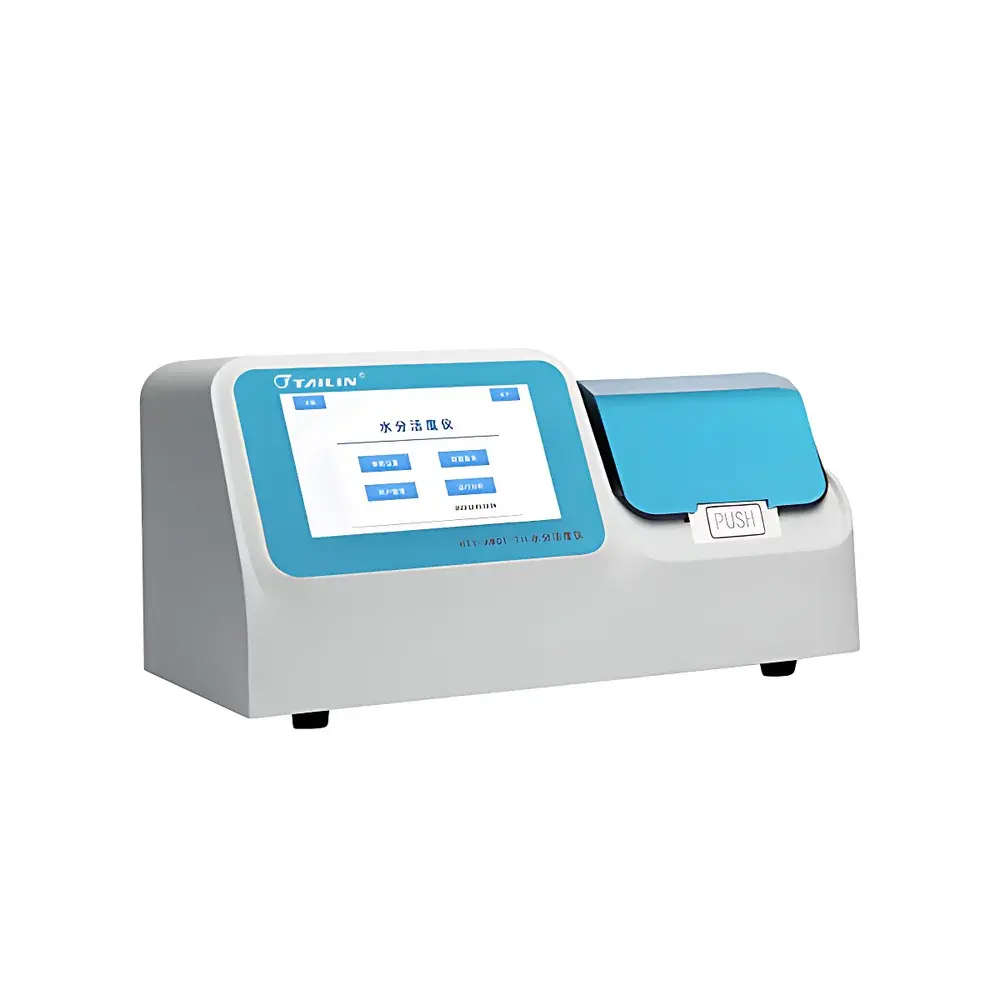
Tailin Biotech HTY-AW01-TH Temperature & Humidity-Based Water Activity Analyzer
| Brand | Tailin Biotech |
|---|---|
| Origin | Zhejiang, China |
| Manufacturer Type | Direct Manufacturer |
| Origin Category | Domestic (China) |
| Model | HTY-AW01-TH |
| Form Factor | Benchtop Laboratory Instrument |
| Measurement Principle | Dual-sensor Chilled Mirror + Capacitive Relative Humidity Detection with Active Temperature Control |
| Measurement Range | 0.000–1.000 a<sub>w</sub> |
| Accuracy | ±0.003 a<sub>w</sub> (typical), ±0.02 a<sub>w</sub> (per JJG(粤)52 metrological verification) |
| Resolution | 0.0001 a<sub>w</sub> |
| Repeatability | ≤5% RSD (per JJG(粤)52) |
| Equilibration Time | ≤30 min (dependent on sample matrix and temperature setpoint) |
| Temperature Control Range | 10–50 °C |
| Temperature Control Stability | ±0.2 °C |
| Sample Temperature Range | 10–50 °C (accuracy ±0.2 °C, resolution 0.01 °C) |
| Ambient Operating Conditions | 4–50 °C, 0–90% RH (non-condensing) |
| Power Supply | 100–240 VAC ±10%, 50/60 Hz |
| Power Consumption | ≤100 W |
| Sample Cup Capacity | 7 mL |
| Data Storage | ≥10 years (flash memory, timestamped entries including a<sub>w</sub>, sample temperature, equilibration time, date/time, operator ID, sensor status) |
Overview
The Tailin Biotech HTY-AW01-TH is a benchtop water activity (aw) analyzer engineered for precision, regulatory traceability, and operational efficiency in food safety, pharmaceutical stability, and quality control laboratories. It employs a dual-sensor measurement architecture combining a chilled-mirror dew point sensor and a high-stability capacitive relative humidity (RH) sensor, both housed within a thermally isolated sample chamber. Active Peltier-based temperature control ensures precise, uniform thermal conditioning of the sample headspace—critical for achieving rapid and thermodynamically valid equilibrium. Unlike passive or ambient-equilibration systems, this architecture eliminates drift from ambient fluctuations and enables controlled isothermal measurement across the full 0.000–1.000 aw range. The instrument complies with core principles outlined in ISO 21807:2022 (Food microbiology — Determination of water activity) and supports method validation per AOAC Official Method 978.18 and USP (Application of Water Activity Determination to Nonsterile Pharmaceutical Products). Its design prioritizes metrological integrity: each measurement includes synchronized recording of sample temperature, chamber RH, dew point, and thermal stabilization status.
Key Features
- High-fidelity dual-sensor detection: Chilled-mirror dew point sensor (primary traceable reference) paired with redundant capacitive RH sensor for cross-validated results and fault detection.
- Active temperature control module: Integrated Peltier elements maintain chamber temperature within ±0.2 °C across 10–50 °C, enabling standardized testing under defined isothermal conditions per ISO 21807 Annex B.
- Low-maintenance architecture: No routine sensor recalibration required; factory-traceable calibration certificates provided with instrument shipment. Sensor diagnostics run automatically at startup and during idle cycles.
- Benchtop footprint with ergonomic sample access: 7 mL sample cup accommodates representative portions of powders, pastes, gels, and semi-solids without pre-conditioning or grinding.
- Embedded real-time thermal profiling: Records sample temperature with ±0.2 °C accuracy and 0.01 °C resolution, ensuring compliance with temperature-sensitive aw protocols (e.g., chocolate, dried fruits, hygroscopic APIs).
- Energy-efficient operation: ≤100 W peak power draw; suitable for continuous use in shared lab environments without dedicated circuits.
Sample Compatibility & Compliance
The HTY-AW01-TH accommodates a broad spectrum of food-grade matrices—including dairy powders, cereal products, confectionery, fermented meats, dehydrated vegetables, and intermediate moisture foods—as well as non-sterile pharmaceutical excipients and botanical extracts. Its sealed chamber design prevents cross-contamination between runs and supports GLP-compliant workflows. Data output meets audit requirements for FDA 21 CFR Part 11 (when used with compliant LIMS integration), including electronic signatures, immutable timestamps, and operator-level access control. All measurements adhere to national metrological verification standard JJG(粤)52, with documented uncertainty budgets traceable to NIM (National Institute of Metrology, China). Optional IQ/OQ documentation packages are available for GMP-regulated facilities.
Software & Data Management
The embedded firmware stores all measurement records—including aw, sample temperature, equilibration curve metadata, date/time stamp, operator ID, and sensor health flags—for a minimum of ten years on industrial-grade flash memory. Export formats include CSV and PDF reports compliant with ISO/IEC 17025 documentation standards. USB interface enables direct data transfer to laboratory information management systems (LIMS) or statistical process control (SPC) platforms. Audit trail functionality logs all user actions (method changes, calibration events, data exports) with time-stamped, non-erasable entries. Firmware updates are delivered via signed binary files to preserve cryptographic integrity.
Applications
- Microbial risk assessment: Correlating aw thresholds with growth limits of Salmonella, Staphylococcus aureus, and Aspergillus flavus in low-moisture foods per FDA Food Code guidance.
- Shelf-life modeling: Inputting validated aw values into predictive microbiology tools (e.g., ComBase, Pathogen Modeling Program) to define safe storage conditions.
- Formulation optimization: Quantifying moisture migration in multi-phase products (e.g., filled chocolates, cereal bars) to prevent texture degradation or phase separation.
- Pharmaceutical stability: Monitoring aw-driven chemical degradation (e.g., hydrolysis of esters, Maillard reactions) in solid dosage forms under ICH Q1A(R3) accelerated conditions.
- Process validation: Verifying consistency of drying, roasting, or extrusion endpoints across production batches using statistically robust aw trending.
FAQ
What metrological standards does the HTY-AW01-TH comply with?
It conforms to JJG(粤)52 (Guangdong Provincial Verification Regulation), ISO 21807:2022, and supports alignment with AOAC 978.18 and USP . Calibration is traceable to NIM primary standards.
Is external calibration required after installation?
No routine recalibration is needed. The system performs automated self-diagnostics. A factory calibration certificate is supplied; optional annual verification services are available.
Can the instrument measure samples above 50 °C?
No—the maximum controlled sample temperature is 50 °C. For elevated-temperature studies, users must pre-equilibrate samples externally and load them within the 10–50 °C operating window.
How is data integrity ensured for regulatory submissions?
All records include digital signatures, tamper-evident timestamps, and full audit trails. When integrated with validated LIMS, the system satisfies 21 CFR Part 11 requirements for electronic records.
What sample preparation is required?
Minimal preparation: homogenize if heterogeneous, then fill the 7 mL cup to ~¾ capacity. No grinding, sieving, or desiccant conditioning is necessary for most food and pharma materials.