
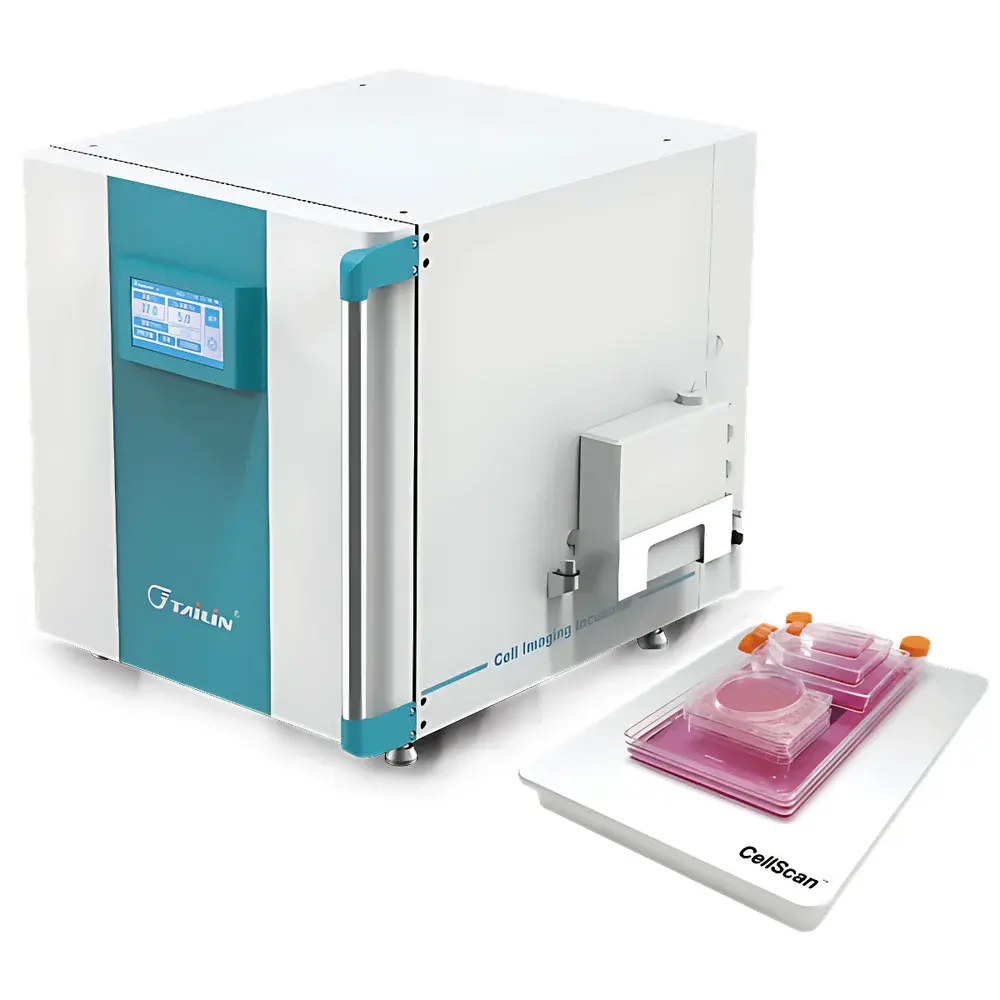
Tailin Bio Live-Cell Imaging System
| Brand | Tailin Bio |
|---|---|
| Origin | Zhejiang, China |
| Manufacturer Type | Original Equipment Manufacturer (OEM) |
| Country of Origin | China |
| Model | Live-Cell Imaging System |
| Pricing | Available upon Request |
Overview
The Tailin Bio Live-Cell Imaging System is a fully integrated, incubator-compatible platform engineered for non-invasive, label-free, real-time monitoring of adherent and suspension cell cultures under physiologically relevant conditions. Unlike conventional brightfield or phase-contrast microscopy that requires intermittent removal of samples from controlled environments, this system embeds a high-resolution optical imaging module directly within standard CO2 incubators. It operates on the principle of transmitted and reflected widefield illumination—enabling quantitative morphological assessment without exogenous dyes or fluorescent tags. The system captures time-lapse image sequences at user-defined intervals, supporting longitudinal studies of proliferation kinetics, confluence dynamics, cytotoxicity responses, and colony formation—all while maintaining strict thermal (37 °C), humidified (≥95% RH), and gaseous (5% CO2) stability. Its architecture complies with core requirements for Good Cell Culture Practice (GCCP) and supports GLP-aligned experimental workflows in bioproduction, regenerative medicine, and preclinical assay development.
Key Features
- In-situ, incubator-integrated imaging: Designed for permanent installation inside Class II biosafety cabinets or standard CO2 incubators—eliminating thermal shock, pH drift, and contamination risks associated with sample retrieval.
- Label-free, non-destructive imaging: Utilizes optimized contrast-enhancement algorithms applied to native cellular refractive index gradients—preserving viability and enabling repeated measurements over multi-day experiments.
- Multi-container compatibility: Supports standard T-flasks (25–175 cm²), Petri dishes (35–150 mm), multi-well plates (6–96-well), and stacked cell factories (up to 10 layers) via adjustable stage height and coaxial reflective illumination geometry.
- Automated confluence and cell counting: Implements deep learning-based segmentation models trained on diverse mammalian cell lines (HEK293, CHO-K1, A549, MCF-7) to deliver reproducible quantification of confluence (%) and absolute cell density (cells/cm²) with ≤5% inter-assay CV.
- Modular region-of-interest (ROI) scanning: Allows programmable grid-based or custom polygonal area acquisition across wells or flasks—facilitating spatial heterogeneity analysis and edge-effect correction.
- H2O2-compatible surface engineering: All exposed stainless-steel and polymer components undergo plasma-enhanced surface passivation to withstand vaporized hydrogen peroxide (VHP) sterilization cycles (≤1000 ppm, 60 min) without degradation or biofilm accumulation.
Sample Compatibility & Compliance
The system accommodates both adherent and low-attachment suspension cultures in commercially available tissue-culture-treated or ultra-low-attachment vessels. It meets ISO 13485:2016 design control requirements for in vitro diagnostic (IVD) ancillary equipment and aligns with ASTM E2877-21 guidelines for automated cell culture monitoring systems. Data integrity safeguards include audit-trail-enabled user authentication, timestamped metadata embedding (ISO/IEC 17025-compliant), and optional 21 CFR Part 11 compliance packages for regulated biomanufacturing environments.
Software & Data Management
Controlled via Tailin Bio’s proprietary CellVision Suite (v3.2+), the software provides intuitive scheduling of acquisition protocols, real-time preview streaming, batch image processing, and export of standardized TIFF/OME-TIFF stacks. All raw and processed data—including confluence curves, cell count heatmaps, and motion-corrected timelapses—are encrypted and synchronized to a secure, HIPAA- and GDPR-compliant cloud repository. On-premise deployment and air-gapped network configurations are supported for GMP-grade facilities requiring full data sovereignty.
Applications
- Bioreactor inoculum expansion monitoring and harvest timing optimization
- Stem cell differentiation trajectory mapping via morphology-driven clustering
- High-throughput cytotoxicity screening in 96-well format with kinetic IC50 derivation
- CRISPR-edited clone isolation validation using confluence stability metrics
- 3D spheroid growth kinetics in ultra-low-attachment plates
- QC release testing for master cell banks under ICH Q5D guidelines
FAQ
Can the system be installed in a hypoxia incubator (e.g., 1–5% O2)?
Yes—the optical module and electronics are rated for operation across 0.5–21% O2, 0–100% RH, and ambient pressure ranges typical of tri-gas incubators.
Does it support fluorescence imaging?
No—this is a dedicated label-free platform. Fluorescence capability is excluded by design to minimize phototoxicity and simplify regulatory validation pathways.
How is calibration verified across instruments?
Each unit ships with NIST-traceable resolution test targets and confluence reference standards; annual verification protocols are included in the service agreement.
Is offline operation possible without cloud connectivity?
Yes—local storage (RAID-1 SSD array, ≥8 TB) retains full image history and analytics; cloud sync occurs only upon user-initiated upload or scheduled backup.
What level of IT infrastructure is required for remote access?
A TLS 1.2+ secured corporate network with static IP assignment and port forwarding (TCP 443/8080) suffices; zero-trust architecture integration is supported via SAML 2.0 federation.



