
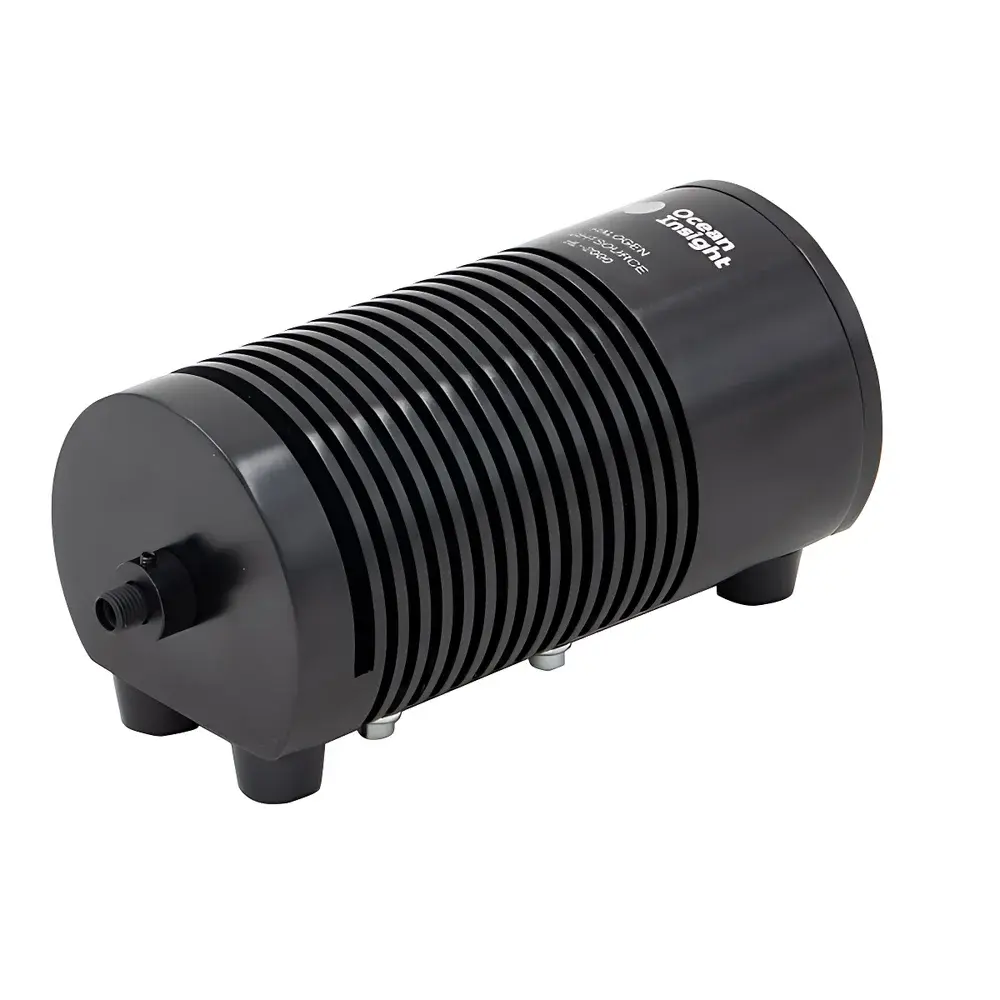
Ocean Optics HL-2000 Tungsten-Halogen Light Source
| Brand | Ocean Optics |
|---|---|
| Model | HL-2000 |
| Light Source Type | Tungsten-Halogen |
| Spectral Range | 360 nm – 2000 nm |
| Output Power | 7 W (standard), 20 W (HP variant) |
| Lamp Life | 1,500 h (standard), 10,000 h (LL variant), 2,000 h (HP) |
| Stability | ±0.5% |
| Drift | <0.3% per hour |
| Warm-up Time | ~5 min |
| Color Temperature | 2,960 K (standard), 2,800 K (LL), 3,000 K (HP) |
| Operating Temperature | 5–35 °C |
| Relative Humidity | 5–95% at 40 °C |
| Cooling | Integrated fan-cooled thermal management |
| Fiber Interface | SMA905-compatible adjustable coupling |
| Filter Holder | 25.4 mm × 25.4 mm or 50.8 mm × 50.8 mm square, 3 mm thick |
| Control Interface | RS-232 (optional on HP-RS-232), TTL shutter, manual attenuator |
| Shutter Options | Manual and TTL-controlled (HL-2000-FHSA) |
| Power Supply | Integrated stabilized DC supply |
Overview
The Ocean Optics HL-2000 is a precision-engineered tungsten-halogen light source designed for demanding optical laboratory applications requiring stable, broadband illumination across the visible to near-infrared (VIS-NIR) spectrum (360 nm – 2000 nm). Based on proven halogen lamp physics, the HL-2000 leverages high-temperature filament operation within a halogen regenerative cycle to deliver continuous spectral output with excellent temporal stability and low spatial non-uniformity. Its design prioritizes radiometric consistency over time—critical for quantitative spectroscopic measurements, spectrophotometer calibration, reflectance/transmittance studies, and fiber-optic sensor excitation. The unit integrates a thermally regulated architecture featuring an internal fan-driven cooling system that maintains lamp junction temperature within optimal operating bands, minimizing thermal drift and extending operational lifetime. All variants include a built-in, stabilized DC power supply to eliminate line-voltage fluctuations as a source of intensity noise—a key requirement in GLP-compliant optical validation protocols.
Key Features
- Adjustable SMA905 fiber coupling mechanism enabling precise alignment and maximum coupling efficiency with standard optical fibers and probe assemblies
- Dual-filter holder accommodating either 25.4 mm × 25.4 mm or 50.8 mm × 50.8 mm square optical filters (3 mm thickness), facilitating spectral shaping without external mounts
- Three configuration options: Standard (HL-2000), Long-Life (HL-2000-LL, 10,000 h rated), and High-Power (HL-2000-HP, 20 W output for large-core fibers or multi-fiber bundles)
- Integrated mechanical shutter (HL-2000-FHSA) with both manual actuation and TTL-triggered control (5 V logic compatible) for rapid light gating in time-resolved experiments
- Optional RS-232 interface (HL-2000-HP-RS-232) enabling remote digital control of shutter state and analog-intensity attenuation from 0–100%, synchronized via serial command protocol
- Thermally optimized housing with passive heatsinking and active forced-air cooling ensures <0.3% intensity drift per hour and full spectral stabilization within ~5 minutes of power-on
Sample Compatibility & Compliance
The HL-2000 is compatible with all standard silica-based optical fibers terminated with SMA905 connectors—including UV-VIS, VIS-NIR, and deep-NIR graded-index fibers. Its broad spectral output supports routine use in ASTM E308-compliant colorimetry, ISO 13406-2 display luminance testing, and USP photometric validation procedures. The device operates within environmental specifications aligned with IEC 61000-6-3 (EMC emissions) and IEC 61010-1 (safety for laboratory equipment). While not inherently FDA 21 CFR Part 11 compliant, its RS-232 control interface supports integration into validated systems where audit-trail-capable software enforces electronic signature, change tracking, and user authentication per GMP/GLP requirements.
Software & Data Management
No proprietary software is bundled with the HL-2000; instead, it adheres to open communication standards. The RS-232 interface uses ASCII-based command syntax (e.g., “SHUTTER ON”, “ATTEN 75”) with CR/LF termination, enabling seamless integration into LabVIEW, Python (PySerial), MATLAB, or custom C++ instrument control frameworks. All firmware-level settings—including shutter timeout, attenuation ramp rate, and auto-shutdown delay—are configurable via serial commands and persist across power cycles. Intensity logging requires external data acquisition; however, the source’s ±0.5% short-term stability and linear attenuation response make it suitable for reference-grade intensity monitoring when paired with NIST-traceable photodiodes and calibrated DAQ hardware.
Applications
- Calibration and verification of spectrometers (e.g., Ocean Insight QE Pro, Maya2000 Pro) across 360–2000 nm
- Excitation source for fluorescence lifetime imaging (FLIM) setups requiring stable broadband pump spectra
- Reference illuminant in reflectance spectroscopy of paints, coatings, and biological tissues under CIE Illuminant A conditions
- Stable broadband source for optical coherence tomography (OCT) system alignment and sensitivity testing
- Primary irradiance standard in UV-Vis-NIR radiometric intercomparisons per ISO/IEC 17025-accredited laboratories
- Time-gated illumination in pump-probe transient absorption experiments using external TTL synchronization
FAQ
What is the spectral irradiance uniformity across the 360–2000 nm range?
The HL-2000 exhibits typical spectral irradiance variation of ±8% (peak-to-peak) relative to 550 nm when measured through a 200 µm core fiber; absolute values are traceable to NIST SRM 2031 via calibrated spectroradiometry.
Can the HL-2000 be operated continuously for extended periods?
Yes—continuous operation is supported within ambient temperatures ≤35 °C and humidity ≤95% RH; thermal management sustains lamp stability for >8 hours without performance degradation.
Is the RS-232 interface optically isolated?
No—RS-232 signals are electrically referenced to the device ground; galvanic isolation requires external USB-to-RS-232 converters with isolation ratings ≥1 kVRMS.
How does the HL-2000-LL achieve 10,000-hour lamp life without sacrificing output?
Through reduced filament voltage bias and optimized halogen cycle kinetics, trading peak radiant flux for exponential lifetime extension while maintaining spectral shape integrity.
Are replacement lamps field-serviceable?
Yes—lamp modules (P/N HL-LAMP-2000) are user-replaceable using standard Torx T10 tools; alignment fixtures ensure repeatable positioning and coupling efficiency post-replacement.





