
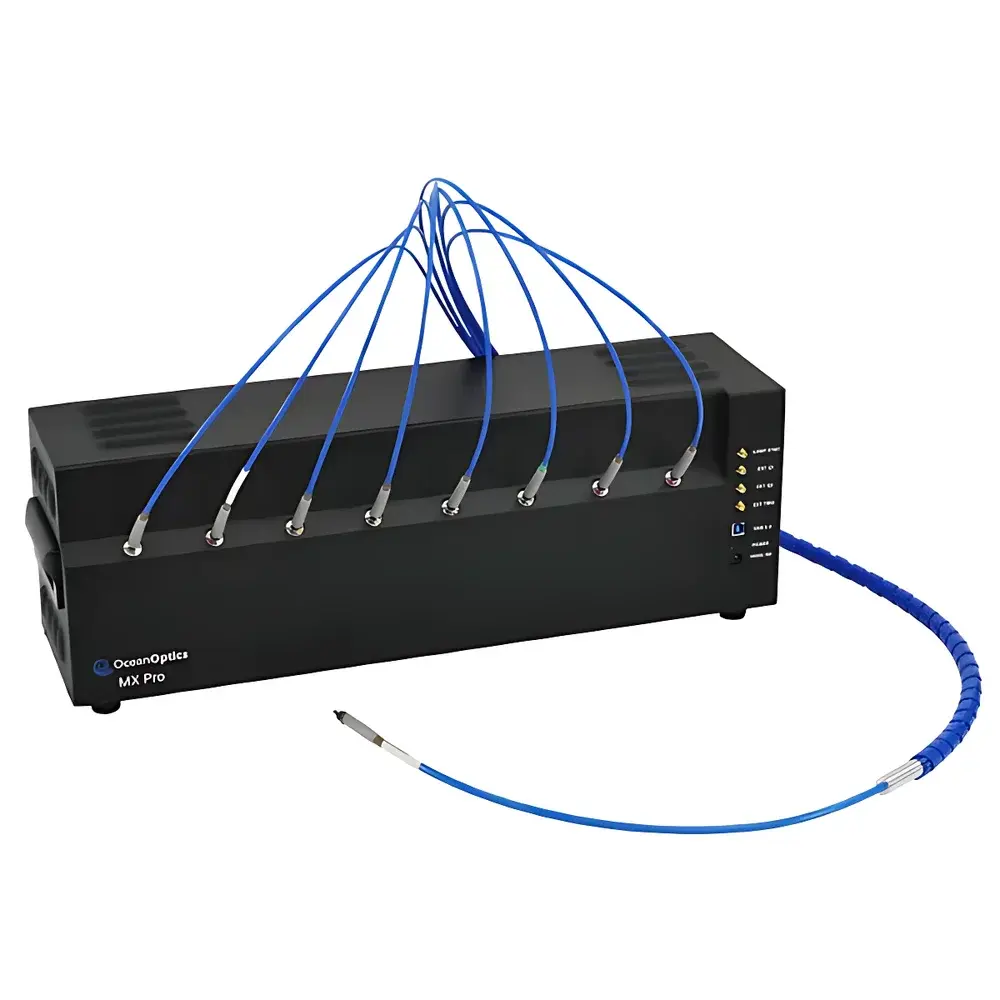
Ocean Optics MX Pro Laser-Induced Breakdown Spectroscopy (LIBS) System
| Brand | Ocean Optics |
|---|---|
| Model | MX Pro |
| Instrument Type | Benchtop |
| Integration | Fully Integrated Multi-Channel Spectrometer |
| Spectral Range | 180–1100 nm |
| Max Channels | 8 |
| Optical Resolution (FWHM) | 0.1 nm (configurable) |
| SNR (single-scan) | 380:1 |
| A/D Resolution | 16-bit |
| Detector Options | Linear CCD or Area CCD |
| Scan Rate | 500 Hz |
| Integration Time | 1 µs – 2 s |
| Trigger Delay Range | –450 ns to +450 ns |
| Trigger Jitter | 20–30 ns |
| Timing Step Resolution | 13.8 ns |
| Trigger Interface | TTL-compatible, <5.5 V |
| Data Interface | USB 3.0 |
| Power Supply | 5 V DC, 5 A |
| Operating Systems | Windows 7/8/10/11 (32-/64-bit) |
| Dimensions (8-ch) | 585 × 165 × 210 mm |
| Weight (8-ch) | 12 kg |
| Dimensions (4-ch) | 345 × 165 × 210 mm |
| Weight (4-ch) | 6.5 kg |
Overview
The Ocean Optics MX Pro Laser-Induced Breakdown Spectroscopy (LIBS) System is a benchtop, fully integrated multi-channel spectrometer engineered for high-fidelity atomic emission spectroscopy in demanding research and industrial environments. Based on the fundamental principle of laser-induced plasma generation—where a focused nanosecond-pulsed laser ablates a micro-volume of sample material to form a transient, high-temperature plasma—the MX Pro captures time-resolved elemental emission spectra across an extended spectral range (180–1100 nm). Unlike conventional elemental analysis techniques such as ICP-OES or XRF, LIBS requires no sample digestion, pelletization, or vacuum handling, enabling rapid, minimally invasive analysis of solids, liquids, and gases in situ or in ambient conditions. The MX Pro’s architecture is purpose-built for LIBS: its hardware-synchronized multi-channel acquisition ensures precise temporal alignment between laser pulse delivery and spectral capture, critical for resolving short-lived atomic line emissions during plasma decay (typically 0.1–10 µs post-ablation). This capability supports robust qualitative identification and semi-quantitative elemental mapping with high shot-to-shot reproducibility.
Key Features
- Multi-Channel Flexibility: Configurable up to eight independent optical channels, each supporting selectable Ocean HR2 or HR6 spectrometer modules—enabling simultaneous wide-range coverage or targeted high-resolution sub-bands.
- Precision Temporal Control: Onboard programmable timing engine with 13.8 ns resolution delay steps and ±450 ns adjustable trigger window; supports single-laser, dual-laser, laser-free manual, and external plasma-source triggering.
- Hardware-Level Synchronization: Dedicated low-jitter (<30 ns) clock distribution network ensures phase-coherent operation across all channels—eliminating inter-channel timing drift during high-speed burst acquisition.
- Digital I/O Architecture: Three high-precision digital outputs and one digital input enable deterministic control of auxiliary devices (e.g., laser Q-switches, shutter drivers, delay generators) via user-defined logic sequences.
- Robust Connectivity & Stability: USB 3.0 interface with optimized firmware stack minimizes packet loss during sustained high-throughput acquisition; independent channel power regulation prevents cross-talk under dynamic load conditions.
- Modular Detector Support: Compatibility with both linear CCD (for high-speed line-scan applications) and area CCD detectors (for spatially resolved plasma imaging or gated 2D spectral acquisition).
Sample Compatibility & Compliance
The MX Pro accommodates diverse sample matrices without preprocessing: conductive and non-conductive solids (metals, ceramics, polymers), aerosols, liquid jets, and low-pressure gas discharges. Its open optical interface allows integration with commercial Nd:YAG lasers (1064 nm, 532 nm, 266 nm), femtosecond systems, or custom plasma sources—including tokamak edge diagnostics, dielectric barrier discharge (DBD) reactors, and atmospheric-pressure plasma jets. The system adheres to core requirements for regulated analytical workflows: timing logs and acquisition metadata are timestamped with microsecond accuracy; raw spectral data files include full instrument configuration headers (wavelength calibration, integration time, trigger offset); and OceanLIBS software supports audit-trail-enabled session logging compliant with GLP documentation practices. While not pre-certified for FDA 21 CFR Part 11, the platform provides the foundational traceability infrastructure required for laboratory validation under ISO/IEC 17025 or ASTM E2926 (Standard Guide for LIBS Analysis).
Software & Data Management
OceanLIBS software serves as the unified control and analysis environment for the MX Pro. It provides real-time spectral preview, multi-channel overlay visualization, and synchronized parameter scripting for complex acquisition protocols (e.g., delay-scanned plasma evolution studies). All spectra are saved in vendor-neutral HDF5 format with embedded metadata per the Ocean Optics Spectral Data Interchange Standard (SDIS-1.0), ensuring long-term readability and interoperability with Python (NumPy/HDF5), MATLAB, or third-party chemometric tools. Batch processing pipelines support automated peak identification using NIST Atomic Spectra Database (ASD) reference lines, intensity normalization against internal standards (e.g., C I 247.86 nm), and multivariate regression models for concentration estimation. Export options include CSV, ASCII, and industry-standard JCAMP-DX for spectral library exchange.
Applications
- Laser-Induced Breakdown Spectroscopy (LIBS) for rapid elemental screening in geology, metallurgy, and recycling sorting.
- Plasma diagnostics in controlled fusion research—time-gated monitoring of impurity species (e.g., W, Mo, Be) at tokamak divertor regions.
- In-line monitoring of plasma-assisted thin-film deposition and etching processes via emission tracking of process gases (Ar, O₂, CF₄) and sputtered target atoms.
- Low-pressure and atmospheric-pressure plasma characterization, including DBD and corona discharge spectral fingerprinting for ozone generation efficiency assessment.
- Hybrid analytical configurations: coupling with ICP sources for simultaneous high- and low-concentration element detection across extended dynamic range.
- High-resolution transmission/reflection spectroscopy where precise laser synchronization enables pump-probe or stimulated Raman measurements.
FAQ
What spectrometer modules are compatible with the MX Pro?
The MX Pro supports Ocean Optics HR2 and HR6 spectrometer engines—both offering configurable slit widths, grating options, and detector variants to optimize resolution, throughput, or UV sensitivity.
Can the MX Pro operate in gated detection mode?
Yes—its programmable trigger delay and sub-nanosecond timing resolution enable precise electronic gating of plasma emission, allowing suppression of continuum background and enhancement of atomic line signal-to-noise ratio.
Is the system suitable for field-deployable LIBS applications?
While designed as a benchtop instrument, its compact footprint (585 mm × 165 mm × 210 mm for 8-channel configuration), low-power 5 V DC input, and shock-resistant aluminum chassis make it adaptable for mobile laboratories or integration into portable LIBS platforms with appropriate environmental enclosures.
How does the MX Pro handle spectral calibration across multiple channels?
Each channel performs independent wavelength calibration using onboard Hg/Ar or Ne lamp references; calibration coefficients are stored per-channel and applied in real time during acquisition and export.
Does Ocean Optics provide application-specific LIBS method development support?
Yes—application scientists offer protocol optimization services including plasma delay profiling, matrix-matched calibration standard selection, and partial least squares (PLS) model development for quantitative analysis in regulated industries.





