
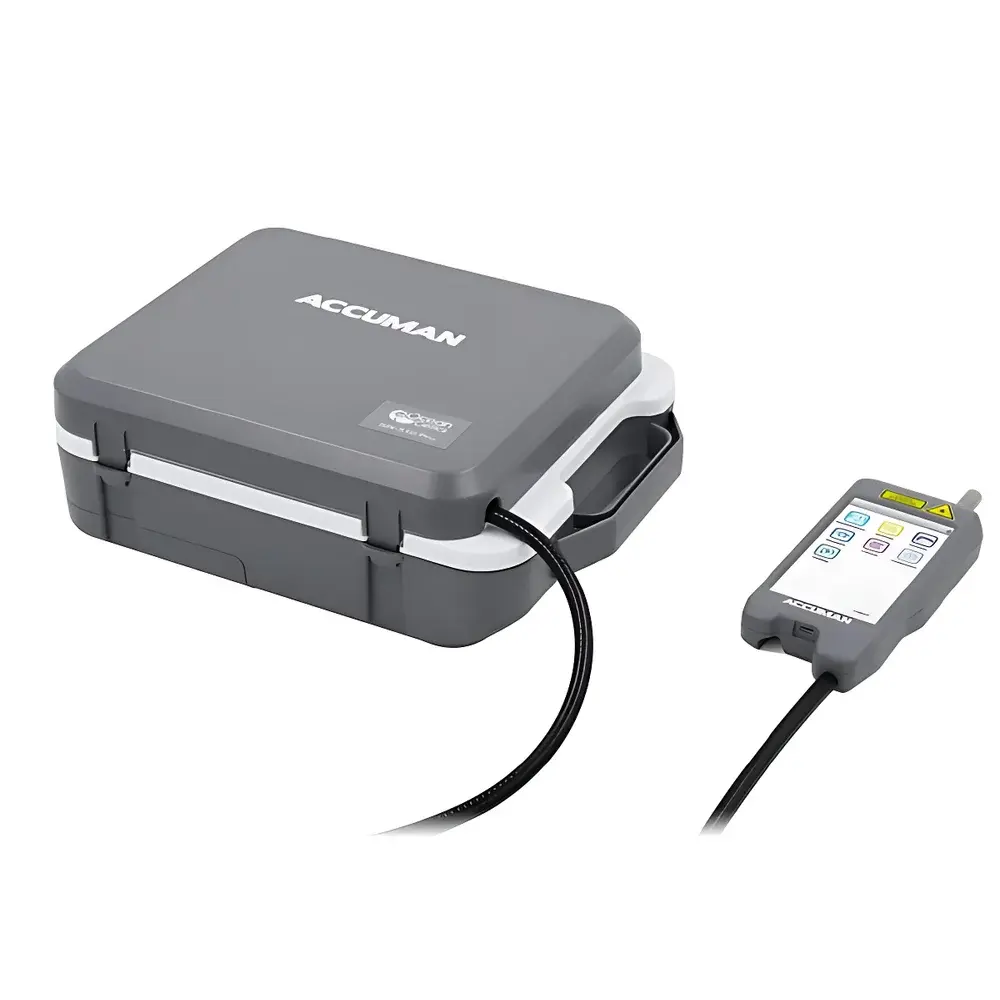
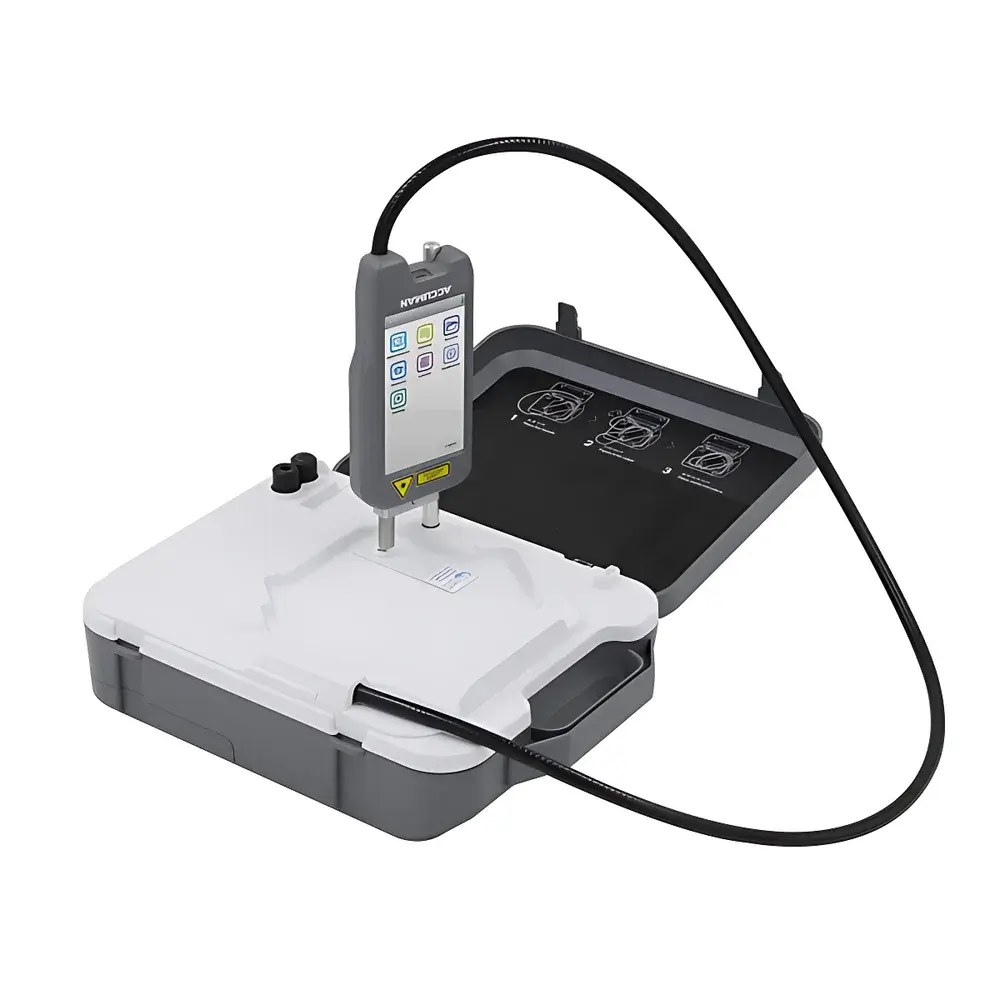
Ocean Optics ACCUMAN SR-510 Pro Portable Research-Grade Raman Spectrometer
| Brand | Ocean Optics |
|---|---|
| Origin | USA |
| Manufacturer Type | Original Equipment Manufacturer (OEM) |
| Product Category | Imported Instrument |
| Model | ACCUMAN SR-510 Pro |
| Instrument Type | Portable / Handheld Raman Spectrometer |
| Spectral Range | 200–3900 cm⁻¹ (configurable options) |
| Spectral Resolution | 4–12 cm⁻¹ (dependent on grating and spectral window selection) |
| Laser Wavelength | 785 nm ± 0.5 nm, linewidth < 2 cm⁻¹, frequency stability < 0.1 cm⁻¹ |
| Laser Power | Up to 350 mW, 10-step linear adjustment |
| Detector | TE-cooled back-illuminated thin CCD array |
| Signal-to-Noise Ratio | 1000:1 |
| Integration Time | 0.1–30 s |
| Optical NA | 0.22 |
| Working Distance | 7.5 mm |
| Display | 4.5″ capacitive multi-touch LCD (720p) |
| Data Interfaces | USB 2.0, Wi-Fi |
| Data Formats | .pdf, .csv, .txt, .jdx, .rdb |
| Battery Life | >5 hours (rechargeable Li-ion) |
| Weight | 330 g (handheld probe), 3.8 kg (main unit) |
| Dimensions | 15.5 × 7.4 × 2.5 cm (probe), 29 × 22 × 10 cm (main unit) |
| Operating Temperature | 0–45 °C |
Overview
The Ocean Optics ACCUMAN SR-510 Pro is a portable, research-grade Raman spectrometer engineered for high-fidelity molecular fingerprinting in both laboratory and field-deployed environments. Based on dispersive Raman spectroscopy using a stabilized 785 nm diode laser excitation source and a TE-cooled back-illuminated CCD detector, the system delivers laboratory-comparable spectral quality without requiring optical tables, alignment tools, or external cooling infrastructure. Its core optical architecture adheres to first-principles design for minimal stray light, high throughput, and reproducible wavenumber calibration—critical for quantitative comparison across instruments and time. Unlike consumer-grade handheld units, the SR-510 Pro integrates deep thermoelectric cooling (−15 °C detector stabilization), narrow-linewidth laser emission (<2 cm⁻¹), and precision grating-based dispersion to ensure spectral fidelity across its full configurable range (200–3900 cm⁻¹). This enables reliable detection of low-intensity Raman bands—including those from crystalline pharmaceuticals, carbon allotropes, and biological macromolecules—under ambient lighting conditions.
Key Features
- Research-grade optical path: Optimized Czerny–Turner spectrometer with holographic transmission gratings and fixed-focus optics for consistent resolution (4–12 cm⁻¹) across selected spectral windows.
- Stabilized 785 nm excitation: Laser wavelength accuracy ±0.5 nm, frequency drift <0.1 cm⁻¹ over 8 hours; power output continuously adjustable from 10–350 mW in 10 linear steps for optimal signal-to-background balance.
- High-sensitivity detection: Back-illuminated, thinned CCD with 1000:1 signal-to-noise ratio at 1 s integration; active TE cooling maintains dark current below 0.005 e⁻/pixel/s.
- Integrated human interface: 4.5″ capacitive multi-touch display (720p) enables standalone operation—real-time preview, baseline correction, peak identification, and report generation without external computing.
- Modular connectivity: Dual-mode control via USB 2.0 (for deterministic timing and firmware updates) or IEEE 802.11 b/g/n Wi-Fi (for remote monitoring and data streaming to LIMS or ELN systems).
- Ruggedized mechanical design: IP52-rated enclosure for dust resistance and incidental moisture protection; shock-absorbing elastomer housing tested to MIL-STD-810G for transport durability.
Sample Compatibility & Compliance
The ACCUMAN SR-510 Pro supports direct analysis of solids, powders, liquids, gels, and thin films without sample preparation in most cases. Its 7.5 mm working distance and 0.22 numerical aperture allow stable standoff measurements through transparent packaging (e.g., blister packs, glass vials, polymer bags), supporting non-invasive verification per USP and Ph. Eur. 2.2.48 guidelines. Optional accessories—including fiber-coupled immersion probes, XYZ translation stages, and confocal microscope adapters—extend compatibility to heterogeneous surfaces, micro-domains, and layered structures. The instrument complies with IEC 61000-6-3 (EMC emissions) and IEC 61000-6-2 (immunity), and its software architecture supports audit trails, electronic signatures, and data integrity controls aligned with FDA 21 CFR Part 11 requirements when deployed in regulated QC/QA workflows.
Software & Data Management
The bundled SpectraSuite™ software provides a validated platform for acquisition, processing, and reporting. Key modules include real-time fluorescence background subtraction using iterative polynomial fitting (5th–9th order), automated cosmic ray removal, Savitzky–Golay smoothing with adaptive window sizing, and peak deconvolution via constrained Gaussian–Lorentzian fitting. A built-in spectral library manager supports ISO/IEC 17025-compliant library curation, including metadata tagging (instrument ID, calibration date, operator, environmental conditions). Quantitative modeling leverages partial least squares (PLS) regression with cross-validation metrics (RMSEC, RMSEP, R²), while similarity matching employs cosine correlation and Euclidean distance scoring against user-defined reference sets. All reports export as PDF (with embedded spectra and metadata), CSV (tabular intensities), JDX (JCAMP-DX compliant), and RDB (Raman database format) for interoperability with third-party chemometric platforms.
Applications
- Pharmaceutical QA/QC: Raw material identification (RMI), counterfeit detection, polymorph screening, and blend uniformity assessment per ASTM E1840 and USP Raman validation protocols.
- Materials science: Characterization of graphene layer count, carbon nanotube chirality, stress/strain in semiconductors, and phase transitions in battery cathode materials.
- Cultural heritage: Non-contact pigment identification on manuscripts, paintings, and ceramics; degradation product mapping in conservation studies.
- Environmental forensics: In situ detection of microplastics (PET, PE, PP), hydrocarbon contaminants in soil/water, and explosive residues on surfaces.
- Academic teaching: Hands-on instruction in vibrational spectroscopy principles, spectral interpretation, and chemometrics—supported by pre-loaded pedagogical datasets and guided workflow templates.
FAQ
Is the ACCUMAN SR-510 Pro suitable for GLP/GMP-regulated environments?
Yes—when configured with SpectraSuite™ in audit-trail mode and paired with documented calibration procedures (NIST-traceable polystyrene and silicon standards), it meets core ALCOA+ data integrity criteria for routine identity testing.
Can the spectral resolution be adjusted in real time during acquisition?
No—resolution is determined by the installed grating and slit width; users select the optimal configuration (e.g., 4 cm⁻¹ @ 200–2000 cm⁻¹ or 12 cm⁻¹ @ 200–3900 cm⁻¹) prior to measurement based on application requirements.
Does the system support external triggering or synchronization with other instruments?
Yes—TTL-compatible trigger input/output ports enable hardware-synchronized acquisition with stage controllers, pump lasers, or thermal chambers.
What calibration standards are recommended for routine performance verification?
Polystyrene film (characteristic 1001 cm⁻¹ and 1601 cm⁻¹ peaks) and monocrystalline silicon (520.7 cm⁻¹ Raman shift) are traceable references for wavenumber accuracy and intensity linearity checks.
How is laser safety managed during handheld operation?
The system incorporates Class 3B laser safety interlocks, automatic beam shuttering upon probe detachment, and compliance with IEC 60825-1:2014; all operational modes require user acknowledgment of safety protocols prior to laser activation.




