
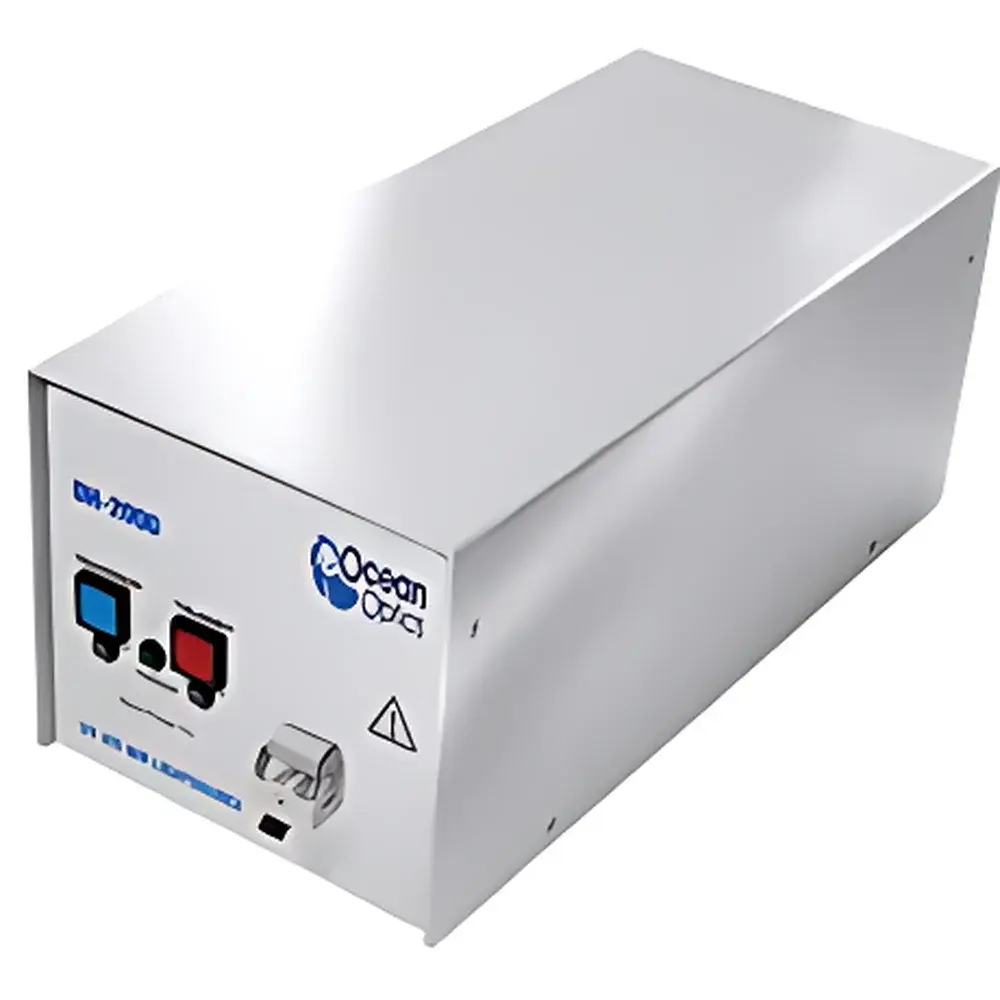
Ocean Optics DH-2000 Deuterium-Tungsten Halogen Combined Light Source
| Brand | Ocean Optics |
|---|---|
| Origin | USA |
| Manufacturer Type | Original Equipment Manufacturer (OEM) |
| Product Category | Imported Instrument |
| Model | DH-2000 |
| Light Source Type | Deuterium + Tungsten-Halogen Hybrid |
| Illumination Mode | External Illumination |
| Spectral Range | 190–1700 nm (UV-enhanced option), 215–2000 nm (standard) |
| Dimensions | 150 mm × 135 mm × 319 mm |
| Weight | 3.5 kg |
| Power Consumption | 25 W (deuterium lamp), 20 W (tungsten-halogen lamp), ~78 VA total |
| Warm-up Time | 40 min (D₂), 20 min (W-Hal) |
| Lamp Lifetime | 1,000 hours |
| Operating Temperature | 5–35 °C |
| Humidity | 5–95% RH at 40 °C (non-condensing) |
| Voltage Stability | <5 × 10⁻⁶ peak-to-peak (0.1–10.0 Hz) |
| Drift | <0.01% per hour |
| Safety Certifications | CE, VDI/VDE 0160, EN 61010 |
Overview
The Ocean Optics DH-2000 is a precision-engineered deuterium-tungsten halogen combined light source designed for broadband spectral applications requiring stable, continuous output across the deep ultraviolet (DUV) to near-infrared (NIR) regions. Its dual-lamp architecture integrates a deuterium arc lamp and a tungsten-halogen incandescent lamp within a single optical path—enabling seamless spectral coverage from 190 nm to 2000 nm without mechanical reconfiguration or source switching. The deuterium component delivers high-intensity, low-noise continuum emission in the 190–400 nm range, critical for UV-Vis absorbance, reflectance, and fluorescence excitation measurements. The tungsten-halogen lamp provides smooth, reproducible radiance from 350 nm through 2000 nm, supporting NIR spectroscopy, material characterization, and calibration traceability. Unlike discrete-source systems, the DH-2000 maintains consistent spatial and angular output profiles across its full bandwidth, minimizing alignment drift and photometric uncertainty during long-term experiments or multi-wavelength acquisitions.
Key Features
- Integrated dual-lamp design with collimated, co-aligned output—eliminates beam walk and spectral discontinuity at lamp crossover regions (typically ~350 nm)
- Manual or TTL-triggered integrated shutter (optional) for precise temporal control of illumination; supports synchronization with gated detectors or pulsed acquisition systems
- Dedicated filter holder accommodating square filters up to 25 mm × 25 mm or round filters up to Ø20 mm with thickness ≤4 mm—enabling spectral bandpass selection, ND attenuation, or order-sorting without external optics
- SMA 905 fiber-coupled output as standard; compatible with Ocean Insight’s full suite of spectrometers, integrating spheres, cuvette holders, and reflection probes
- Independent intensity adjustment via front-panel potentiometer: deuterium and tungsten-halogen lamp powers are balanced continuously from 10% to 100%, enabling optimization of signal-to-noise ratio across wavelength-dependent detector responsivity
- Internal safety shutter automatically engages when no fiber is connected—preventing unintended UV exposure and ensuring operator compliance with IEC 62471 photobiological safety guidelines
- Low thermal drift architecture: temperature-regulated lamp housing and current-stabilized power supplies ensure <0.01% intensity drift per hour under ambient lab conditions (23 ± 2 °C)
Sample Compatibility & Compliance
The DH-2000 is routinely deployed in ISO/IEC 17025-accredited laboratories for reference-standard calibration of spectroradiometers, UV-Vis-NIR photometers, and hyperspectral imaging systems. Its spectral stability and repeatability meet ASTM E275 and ISO 6780 requirements for reference light sources used in optical measurement validation. The unit complies with EN 61010-1 for electrical safety in laboratory equipment and carries CE marking under the EU Low Voltage Directive and Electromagnetic Compatibility (EMC) Directive. All lamps operate under controlled current regulation to minimize flicker-induced noise—critical for GLP-compliant QC workflows in pharmaceutical dissolution testing (USP ) and thin-film optical density verification. No hazardous substances are employed per RoHS 2011/65/EU Annex II restrictions.
Software & Data Management
While the DH-2000 operates as a standalone analog source, it integrates seamlessly into automated test benches via TTL triggering and analog intensity control signals. When paired with Ocean Insight’s OceanView or Ocean HDX software platforms, users can script synchronized acquisition sequences—including shutter gating, lamp intensity ramping, and spectral averaging—within validated method templates. Audit trails generated by these platforms support FDA 21 CFR Part 11 compliance when configured with electronic signatures and role-based access controls. Firmware updates (delivered via USB) maintain compatibility with evolving spectral analysis libraries, including NIST-traceable calibration databases and CIE illuminant reference spectra (e.g., D65, A, F2).
Applications
- Calibration and verification of UV-Vis-NIR spectrophotometers, especially for pharmacopeial methods (USP , EP 2.2.25)
- Reflectance and transmittance measurements of optical coatings, solar cell materials, and polymer films
- Baseline correction and stray-light assessment in high-resolution Raman and FTIR systems
- Excitation source for steady-state and time-resolved fluorescence spectroscopy across biological and chemical samples
- Reference irradiance source in environmental monitoring instruments measuring solar UV index or PAR (Photosynthetically Active Radiation)
- Validation of multispectral camera responses in agricultural remote sensing and food quality inspection systems
FAQ
What is the recommended fiber optic cable for UV applications with the DH-2000?
We recommend UV-grade fused silica fibers with solarization-resistant coatings (e.g., Ocean Insight’s QP400-2-SR or similar), rated for sustained transmission down to 190 nm. Standard silica fibers exhibit significant attenuation below 250 nm due to OH absorption and radiation damage.
Can the DH-2000 be operated continuously for extended periods?
Yes—the DH-2000 is rated for continuous operation up to its specified lamp lifetime (1,000 hours). However, optimal longevity is achieved when operated within the 5–35 °C ambient range with adequate ventilation; avoid enclosing the unit in unventilated enclosures.
Is the spectral output intensity uniform across the 190–2000 nm range?
No—intensity varies significantly by wavelength due to intrinsic lamp physics: deuterium output peaks near 220 nm and declines toward 400 nm, while tungsten-halogen output rises quadratically beyond 700 nm. Intensity balancing via the front-panel potentiometer compensates for this non-uniformity in downstream detection systems.
Does the DH-2000 require warm-up stabilization before data acquisition?
Yes—allow 40 minutes for deuterium lamp stabilization and 20 minutes for tungsten-halogen lamp thermal equilibrium. Intensity drift remains below specification only after full warm-up; we advise initiating acquisition only after the internal status LED indicates stable output.
How is lamp replacement performed, and are alignment tools included?
Lamp replacement requires factory service or trained personnel; both lamps are pre-aligned and sealed in thermally matched housings. User-replacement is not supported—Ocean Insight provides certified recalibration services post-lamp exchange to restore spectral fidelity and radiometric accuracy.





