
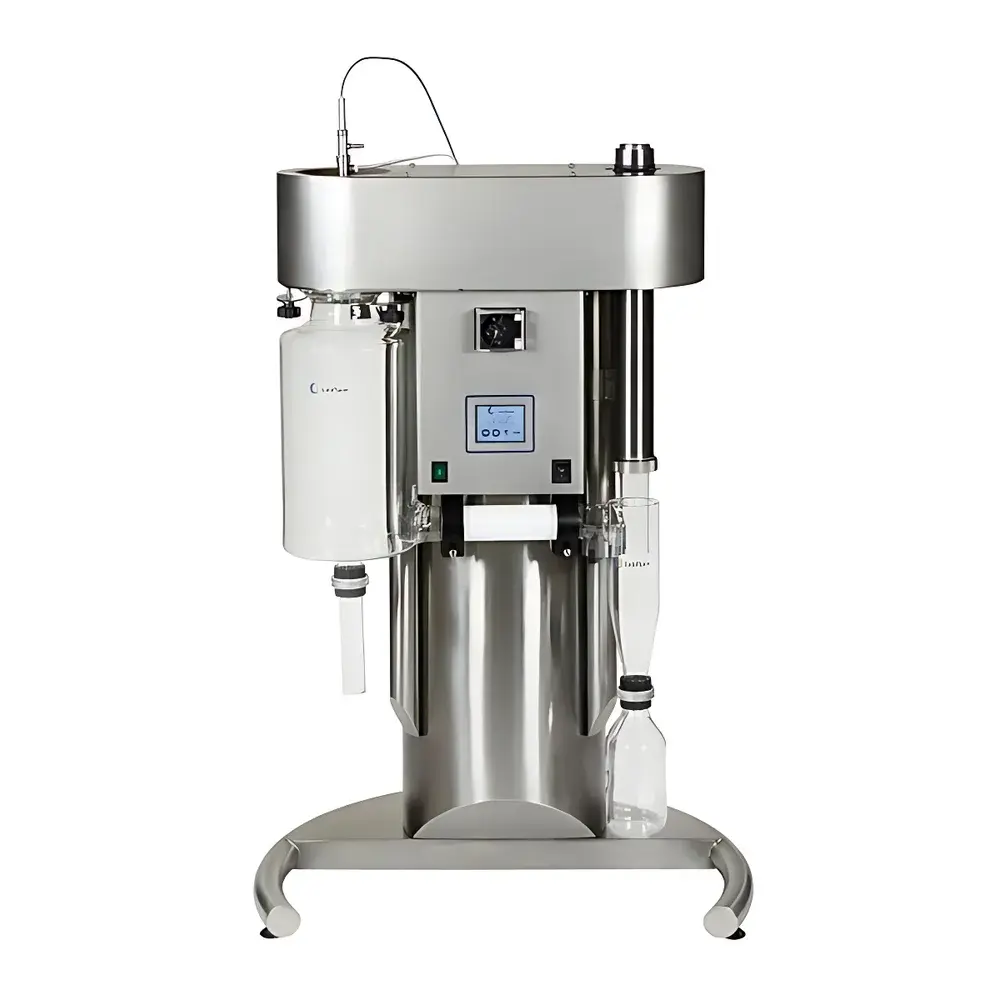
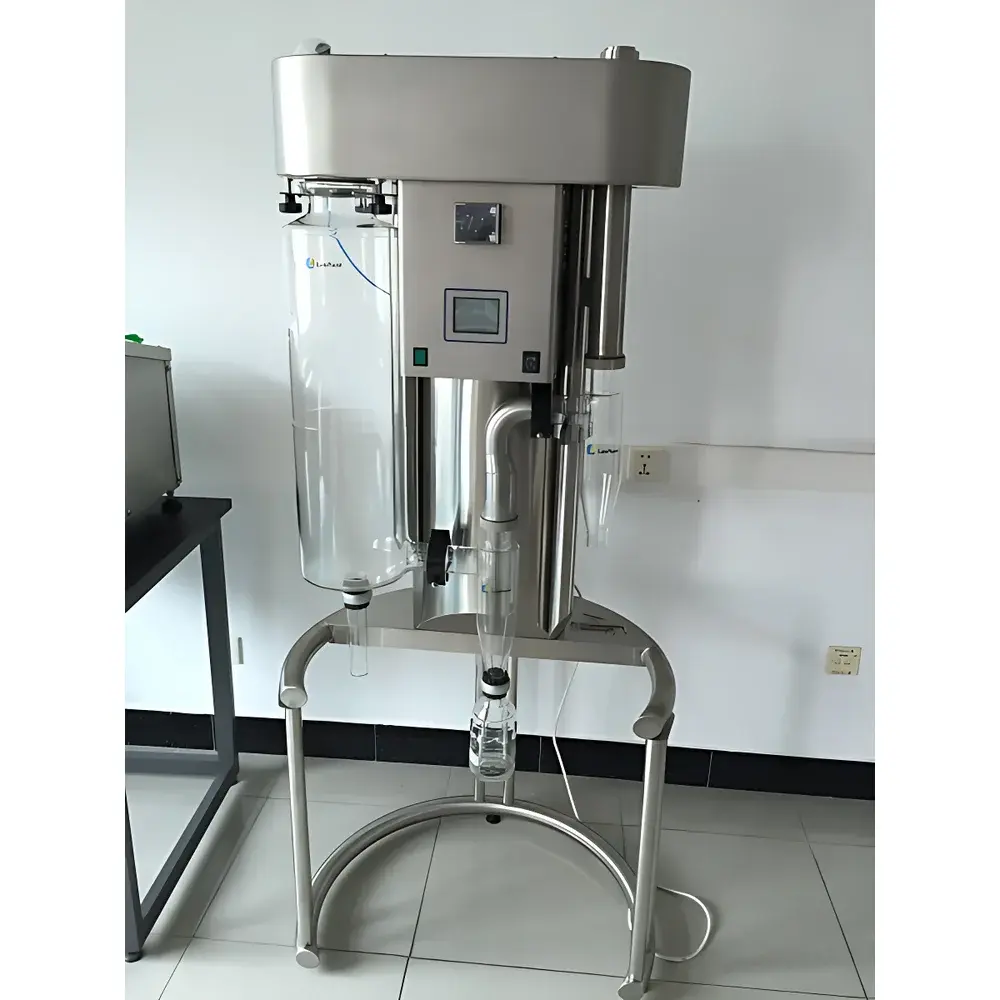
LabPlant SD-07AG Automated Spray Dryer
| Brand | LabPlant |
|---|---|
| Origin | United Kingdom |
| Model | SD-07AG |
| Maximum Feed Rate | 2000 mL/h (water equivalent) |
| Inlet Air Temperature Range | Ambient to 250 °C |
| Particle Size Output | 0.5 mm (typical median, adjustable via nozzle selection and process parameters) |
| Nozzle Orifice Options | 0.5 mm (standard), 0.7 mm, 1.0 mm, 2.0 mm |
| Air Flow Capacity | 500 m³/h |
| Heater Power | 4000 W |
| Pump Flow Range | 0–36 mL/min (peristaltic) |
| Chamber Diameter | ≥300 mm |
| Control Accuracy | ±1.0 °C |
| Integrated Oil-Free Compressor | Yes |
| Touchscreen Interface | Industrial IR Touch Panel with PLC-Based Control System |
| Compliance | Designed for GMP-aligned laboratory environments |
| materials of construction | 304 stainless steel enclosure, 316 stainless steel & PTFE wetted parts |
Overview
The LabPlant SD-07AG Automated Spray Dryer is a benchtop-to-pilot-scale continuous spray drying system engineered for precise, reproducible conversion of liquid feedstocks—including aqueous solutions, organic solvents, and mixed solvent systems—into free-flowing dry powders. Operating on the principle of rapid solvent evaporation via atomization into a controlled hot air stream, the SD-07AG employs coaxial two-fluid nozzle technology to generate fine, uniform droplets with high surface-area-to-volume ratios. Its design bridges the gap between laboratory-scale feasibility studies and early-stage process development, supporting formulation optimization, excipient screening, and stability testing under thermally sensitive conditions. The system integrates real-time thermal profiling, closed-loop parameter control, and intrinsic safety features—including upstream heater/fan interlocking and inertizable operation capability—making it suitable for handling flammable solvents in compliance with ATEX-informed lab safety practices.
Key Features
- Automated, PLC-driven process control with industrial-grade infrared touchscreen interface enabling intuitive setup and monitoring of inlet temperature, airflow, feed rate, and anti-clogging cycle frequency.
- Dual-mode atomization: Standard multi-fluid nozzle (0.5 mm orifice) with continuously adjustable atomizing gas pressure; optional nozzles (0.7 mm, 1.0 mm, 2.0 mm) support broad viscosity and solids-loading ranges (1–50% w/w).
- Integrated oil-free air compressor and HEPA-grade inlet filtration (99.99% particle removal at ≥0.3 µm) ensure contaminant-free drying air—critical for pharmaceutical, nutraceutical, and catalyst applications.
- GMP-compatible construction: 304 stainless steel chassis; all fluid-contact surfaces fabricated from electropolished 316 stainless steel or chemically inert PTFE; fully drainable, clean-in-place (CIP)-ready geometry.
- Thermal management architecture: Variable-frequency fan and 4 kW heating element positioned upstream of the spray chamber to prevent condensation and protect electronics; heater activation is interlocked with fan rotation.
- Self-cleaning nozzle function with programmable purge cycles minimizes downtime during extended runs with high-solids or viscous feeds.
Sample Compatibility & Compliance
The SD-07AG accommodates diverse feed chemistries without hardware modification: water-based colloids, ethanol/methanol/acetonitrile solutions, chlorinated solvents (e.g., dichloromethane), and binary or ternary solvent blends. Its robust thermal range (ambient to 250 °C inlet) supports both thermolabile biologics (via low-temperature, high-airflow mode) and refractory ceramic precursors (via high-temperature, low-moisture mode). Materials certification includes EN 10204 3.1 mill test reports for wetted components. While not certified as Class I Div 1 equipment, its design adheres to IEC 60079-0 general requirements for explosive atmospheres and aligns with ISO 22000 and USP guidance for spray-dried excipient manufacturing. Full audit trails, parameter locking, and electronic signature support are available via optional software modules compliant with FDA 21 CFR Part 11.
Software & Data Management
The embedded microprocessor logs all critical process variables—including inlet/outlet temperatures, air flow rate, pump speed, and nozzle pressure—at 1-second intervals. Real-time trend graphs are rendered directly on the touchscreen and exportable as CSV or PDF. Optional LabPlant DataLink software enables remote monitoring, historical batch comparison, SPC charting, and automated report generation. All data files include timestamped metadata, operator ID, and version-controlled method templates. Electronic records meet ALCOA+ principles (Attributable, Legible, Contemporaneous, Original, Accurate, Complete, Consistent, Enduring, Available) for GLP/GMP-regulated workflows.
Applications
- Pharmaceutical: Production of inhalable dry powder formulations (DPIs), amorphous solid dispersions (ASDs), and lyophilization-alternative microparticles.
- Food & Nutrition: Encapsulation of probiotics, omega-3 oils, and heat-sensitive vitamins; production of instant beverage powders and functional ingredient carriers.
- Materials Science: Synthesis of nanostructured metal oxides, battery cathode precursors (e.g., NMC, LFP), and porous silica microspheres.
- Academic Research: Kinetic studies of particle formation, solvent evaporation dynamics, and morphology–process parameter correlation modeling.
FAQ
Can the SD-07AG handle 100% organic solvent feeds safely?
Yes—its integrated oil-free compressor, upstream heater/fan interlock, and optional nitrogen purge kit enable safe operation with methanol, acetone, ethyl acetate, and other Class IB/IC solvents per NFPA 30 guidelines.
What is the typical particle size distribution (PSD) achievable?
Median particle diameter (D50) typically ranges from 5–50 µm depending on feed concentration, nozzle size, inlet temperature, and airflow; 0.5 mm nozzles favor finer particles, while 2.0 mm nozzles increase throughput at coarser distributions.
Is validation documentation (IQ/OQ/PQ) provided?
LabPlant supplies comprehensive factory-acceptance test (FAT) reports and user-executable OQ protocols; PQ support is available through authorized service partners with ISO/IEC 17025-accredited calibration labs.
How is cleaning validated between batches?
The system supports visual inspection, swab sampling (ISO 14644-1 Class 5 compatible), and residue analysis via TOC or HPLC; CIP procedures are documented in the operational manual with hold-time studies.
Does the SD-07AG comply with EU Machinery Directive 2006/42/EC?
Yes—CE marking is affixed; technical documentation includes risk assessment per EN ISO 12100 and conformity to EN 61000-6-2/6-4 for EMC.



