
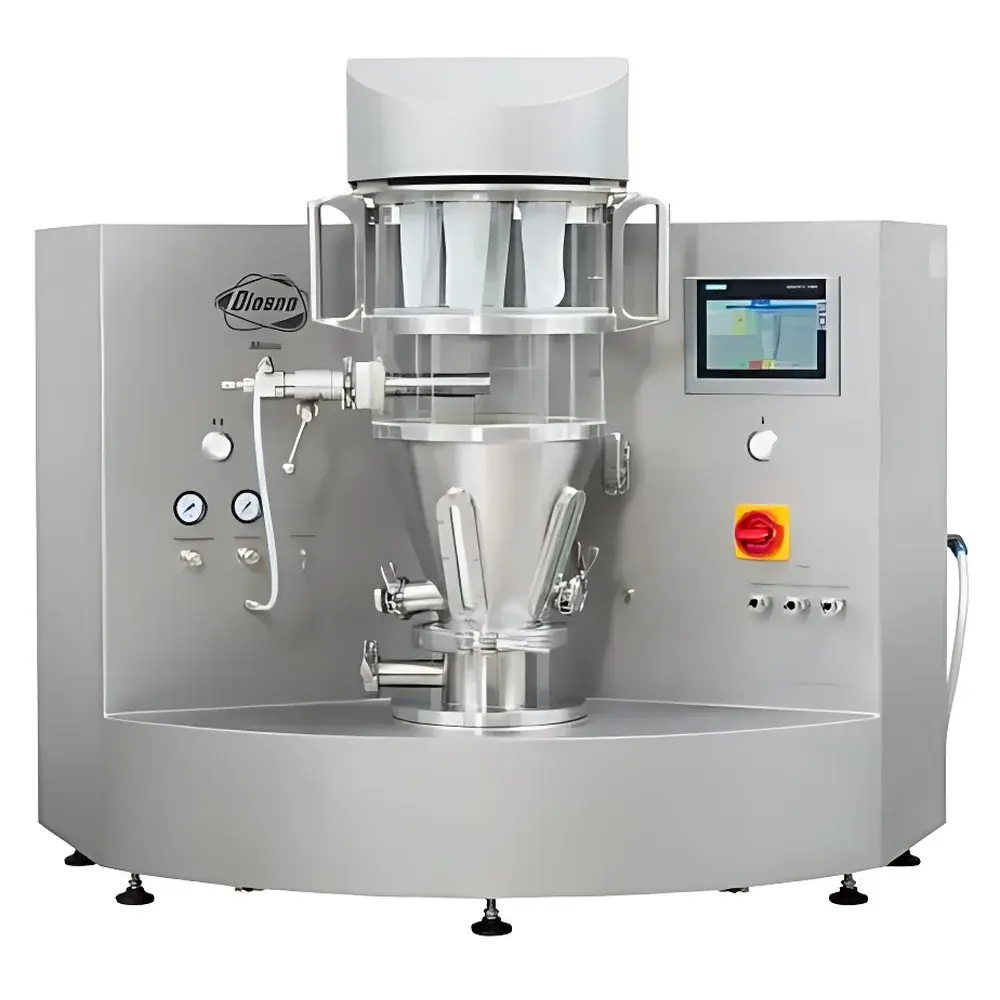
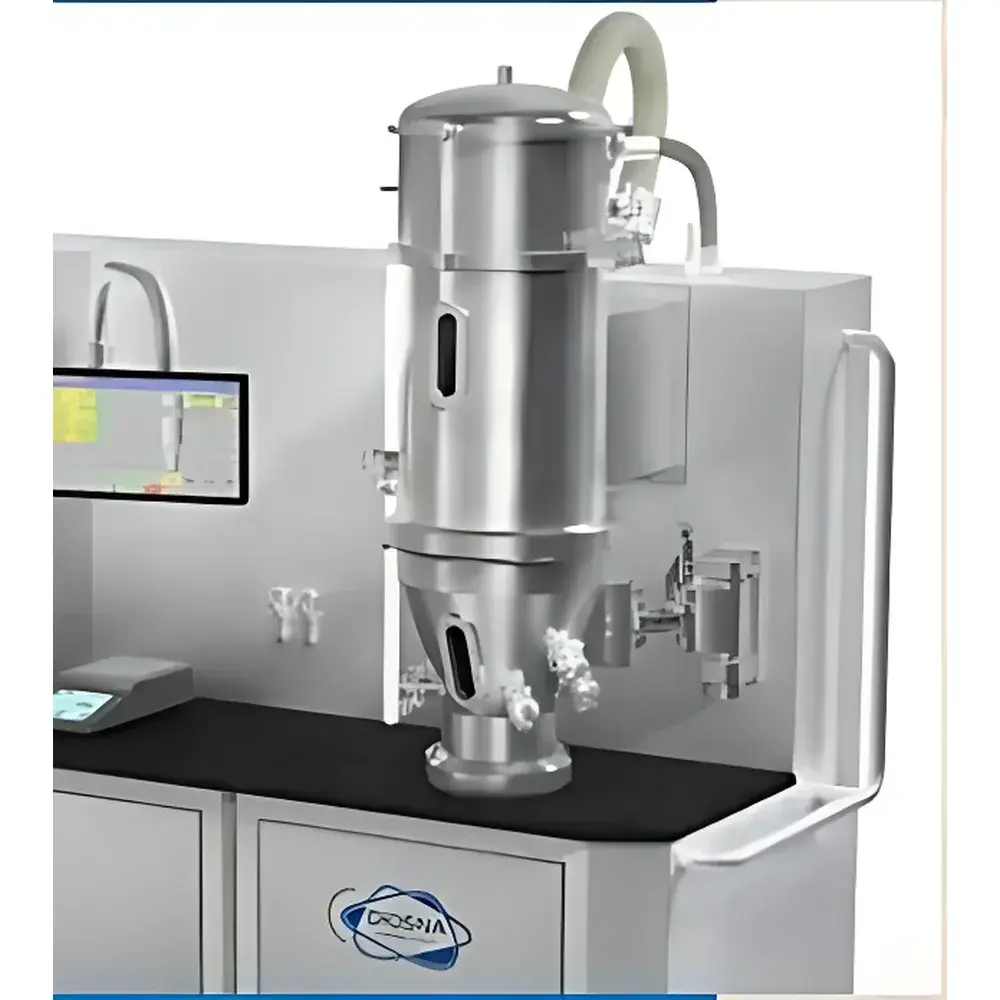
Diosna MiniLab Laboratory Fluidized Bed Granulator (Spray Granulation & Drying System)
| Brand | Diosna |
|---|---|
| Origin | Germany |
| Model | MiniLab |
| Sample Type | Organic |
| Max. Batch Capacity | 3 L |
| Temperature Range | <100 °C |
| Particle Size Range | 200 µm – 10 mm |
Overview
The Diosna MiniLab Laboratory Fluidized Bed Granulator is an integrated pilot-scale unit engineered for process development and formulation optimization in pharmaceutical, food, chemical, and materials science laboratories. It implements fluidization-based spray granulation — a continuous or batch-wise solid-liquid-suspension processing technique where heated air induces particle suspension (fluidization), while atomized binder or active solution is introduced to initiate nucleation, growth, and densification of granules. Simultaneously, moisture is removed via convective drying, enabling concurrent wet granulation and drying within a single vessel. This principle eliminates intermediate handling steps, reduces contamination risk, improves batch-to-batch reproducibility, and preserves thermolabile compounds due to precise control over inlet air temperature (<100 °C) and residence time.
Key Features
- Single-unit integration of powder mixing, liquid spraying, granule formation, and drying — eliminating transfer between separate equipment and minimizing operator intervention.
- Compact benchtop footprint (1200 × 550 × 950 mm; 80 kg) requiring only 0.5 m² floor space — suitable for ISO Class 5–7 cleanroom environments or standard R&D labs.
- Modular expansion chamber options (3 L / 5 L / 7 L) constructed from borosilicate glass or electropolished stainless steel (316L), compliant with ASME BPE and FDA-recommended surface finish standards.
- Digitally controlled inlet air temperature (up to 80 °C, ±0.5 °C accuracy) and volumetric airflow (0–120 m³/h, adjustable via frequency-controlled blower).
- Precision peristaltic pump delivery (0.1–50 mL/min, ±1% linearity) with interchangeable tubing for aqueous, organic, or viscous binders.
- Top- or bottom-mounted dual-fluid nozzle configuration supporting both downward spray (for uniform coating) and upward spray (for improved fluidization stability with fine powders).
- Integrated bag-type filter system with pulse-jet cleaning, achieving >99.9% particulate retention (down to 1 µm) and enabling safe handling of potent compounds.
Sample Compatibility & Compliance
The MiniLab accommodates organic powders including APIs, excipients, polymers, natural extracts, pigments, and ceramic precursors. Its low-thermal-stress operation supports heat-sensitive biologics, enzymes, probiotics, and volatile aroma compounds. The system meets core requirements for GLP-compliant process development: full parameter logging (temperature, airflow, pump rate, spray pressure), audit-trail-capable software (optional), and traceable calibration protocols aligned with ISO/IEC 17025. While not certified as GMP production equipment, its design reflects principles referenced in ICH Q5C, USP , and ASTM E2500-21 for laboratory-scale process simulation.
Software & Data Management
Standard operation uses a dedicated HMI with real-time graphical display of all critical process variables (inlet/outlet air temperature, differential pressure across filter, airflow rate, pump speed, and spray duration). Optional PC-based control software enables automated method execution, multi-step recipe programming, export of CSV-formatted time-series data, and compliance-ready electronic records. When configured with 21 CFR Part 11–compliant modules, the system supports user authentication, electronic signatures, and immutable audit trails — facilitating regulatory submissions for clinical trial material manufacturing processes.
Applications
- Pharmaceutical: Immediate- and sustained-release granule development; hot-melt extrusion feedstock conditioning; taste-masked multiparticulates; inhalable dry powder formulations.
- Food & Feed: Encapsulation of probiotics, vitamins, and flavors; agglomeration of instant beverages and dairy powders; functional ingredient stabilization.
- Chemicals & Materials: Catalyst support granulation; pigment dispersion and drying; polymer microsphere synthesis; ceramic green body formation.
- Biotechnology: Lyophilization pre-conditioning of cell lysates; recovery of fermentation broths; gentle drying of enzyme-loaded carriers.
- Academic Research: Fundamental studies on granule growth kinetics, moisture diffusion dynamics, and fluidization hydrodynamics under controlled shear and thermal conditions.
FAQ
Can the MiniLab be used for solvent-based granulation?
Yes — optional explosion-proof configurations (ATEX Zone 22) and inert gas purging capability support safe processing with ethanol, acetone, or isopropanol solutions.
What is the minimum sample requirement for method development?
Validated process data can be generated from batches as small as 50 g, enabling high-efficiency screening with limited API availability.
Is the system compatible with PAT tools such as NIR or Raman probes?
The expansion chamber includes standardized optical ports (Φ25 mm, quartz windows) for inline spectroscopic monitoring; third-party probe integration is supported via mechanical and electrical interface documentation.
How is cleaning validation addressed?
The fully drainable, CIP-compatible design (with no dead legs) and smooth internal surfaces allow detergent-based cleaning verification per PDA TR29 guidelines; residue limits are determined using swab testing and HPLC/UV quantification.
Does Diosna provide scale-up support from MiniLab to production systems?
Yes — Diosna’s engineering team offers dimensional, aerodynamic, and thermodynamic similarity analysis using the MiniLab dataset to inform specification of industrial-scale fluid bed processors (e.g., PMA series), ensuring consistent critical quality attributes (CQAs) across scales.



