
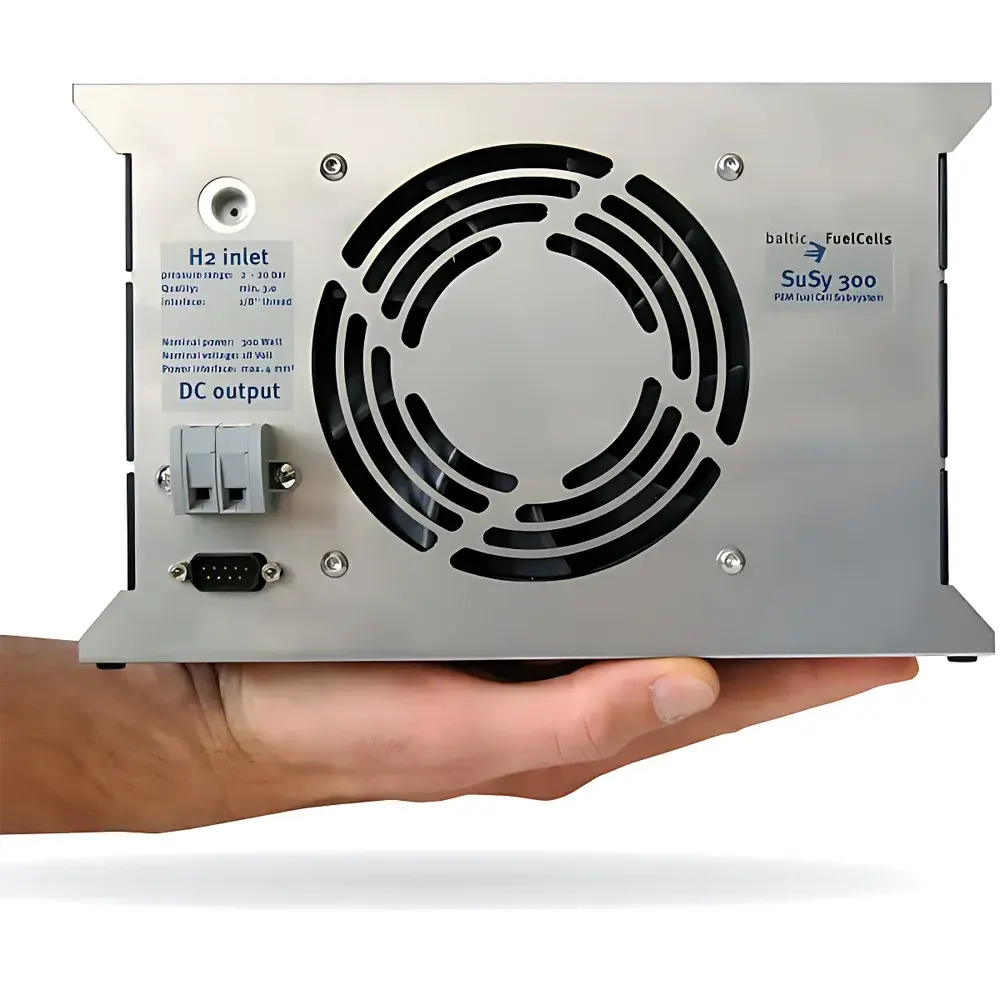
Baltic FuelCells SuSy500 500W Proton Exchange Membrane Fuel Cell Subsystem
| Brand | Baltic FuelCells |
|---|---|
| Origin | Germany |
| Model | SuSy500 |
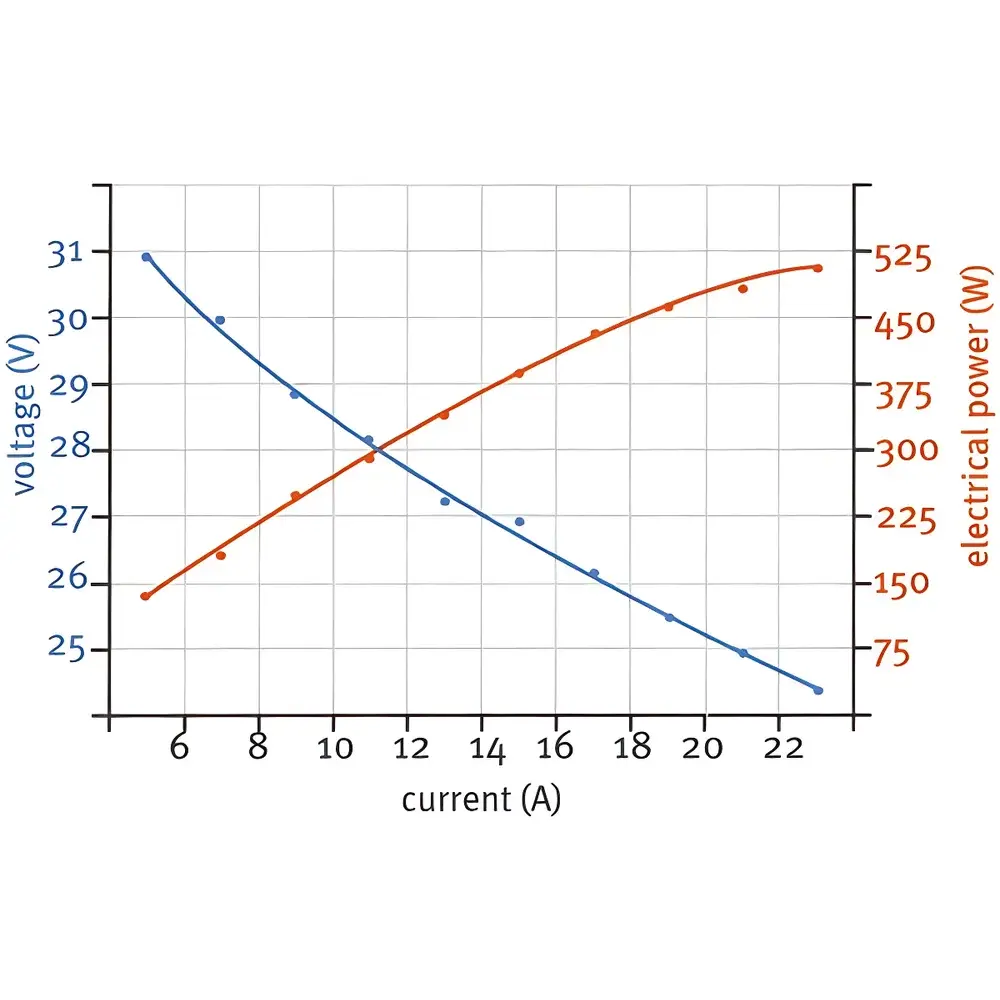
| Rated Power | 500 W (DC) |
| Output Voltage Range | 24–32 V DC |
| Nominal Current | 18 A |
| System Efficiency | 45% at 500 W |
| Fuel | 99.9% H₂ + Ambient Air |
| H₂ Inlet Pressure | 2–20 bar |
| Startup Time | <3 s |
| Safety Sensors | Integrated H₂ pressure & temperature monitoring |
| Gas Interface | 1/8″ NPT internal thread |
| Control Interface | SUB-D9 connector, RS-232 protocol |
| Dimensions | 244 × 155 × 180 mm |
| Weight | 3.9 kg |
Overview
The Baltic FuelCells SuSy500 is a compact, integrated proton exchange membrane (PEM) fuel cell subsystem engineered for laboratory-scale energy research, portable power validation, and electrochemical system integration. Unlike conventional benchtop power supplies or battery emulators, the SuSy500 delivers continuous, controllable DC power directly from hydrogen oxidation—enabling real-time investigation of fuel utilization dynamics, stack thermal behavior, and system-level efficiency under variable load conditions. Its design adheres to fundamental PEMFC operating principles: electrochemical conversion of high-purity hydrogen and atmospheric oxygen across a Nafion-based membrane, generating electricity, heat, and water as the sole byproducts. The subsystem operates without external humidification or complex balance-of-plant components, relying instead on passive air cathode ventilation and self-humidifying membrane technology—making it particularly suitable for controlled environment studies, teaching labs, and embedded prototyping where footprint, startup latency, and operational simplicity are critical.
Key Features
- Consistent mechanical form factor with SuSy300—enabling drop-in replacement in existing test benches and modular system architectures.
- High dynamic response: full-load power delivery achieved within <3 seconds from cold start, supporting transient load profiling and rapid duty-cycle testing.
- Dual-sensor safety architecture: redundant monitoring of inlet hydrogen pressure and stack temperature, with configurable shutdown thresholds compliant with IEC 62282-2 and ISO 17268 requirements for low-power PEM systems.
- Standardized industrial interfaces: RS-232 via SUB-D9 enables bidirectional communication for real-time telemetry (voltage, current, H₂ pressure, temperature) and remote control of operating state (start/stop, fault reset).
- Passive thermal management: convection-cooled design eliminates need for pumps or fans—reducing acoustic noise, EMI, and failure points during long-duration stability tests.
- Gas interface compatibility: 1/8″ NPT female port supports standardized hydrogen supply lines and leak-tested manifold integration per CGA G-4.1 guidelines.
Sample Compatibility & Compliance
The SuSy500 is designed for use with certified 99.9% purity hydrogen (Grade 4.0 per ISO 8573-1:2010 Class 2) and ambient air—no external humidification, CO scrubbing, or compressed air conditioning required. It complies with CE marking directives for electromagnetic compatibility (2014/30/EU) and low-voltage equipment (2014/35/EU). While not certified for human-occupied space deployment, its safety logic and pressure-rated enclosure meet functional safety targets aligned with SIL 2 per IEC 61508 for laboratory auxiliary power applications. Documentation includes Declaration of Conformity, technical file summary, and traceable calibration records for onboard sensors.
Software & Data Management
The subsystem communicates via ASCII-based RS-232 protocol with open command syntax (e.g., “GET:VOLT”, “SET:CURRENT=15.0”). Users may integrate telemetry into LabVIEW, Python (pySerial), MATLAB, or SCADA platforms using provided protocol documentation. All sensor readings—including time-stamped voltage, current, H₂ pressure, and stack temperature—are logged at user-defined intervals (100 ms–10 s resolution). Audit trails support GLP-aligned data integrity: timestamps are hardware-synced, and no data is overwritten without explicit command. Firmware updates are performed via serial bootloader; version history and checksums are retained in non-volatile memory for regulatory traceability.
Applications
- Academic PEMFC education: hands-on demonstration of polarization curves, efficiency mapping, and degradation analysis under constant-current and cyclic loading.
- Hydrogen infrastructure validation: performance benchmarking of electrolyzer-fuel cell coupling, H₂ storage interface testing, and refueling cycle simulation.
- Microgrid component development: integration with DC bus controllers, MPPT algorithms, and hybrid energy management systems (HEMS).
- Material science support: evaluation of novel catalyst layers, gas diffusion electrodes, and membrane durability under realistic current density profiles (0.2–1.2 A/cm²).
- Regulatory pre-compliance testing: generation of repeatable baseline datasets for ISO/IEC 17025-accredited laboratories conducting fuel cell characterization per ASTM D6335 and ISO 14687-2.
FAQ
Is the SuSy500 certified for continuous unattended operation?
Yes—when installed in a ventilated, non-confined laboratory environment with approved hydrogen monitoring and emergency shutoff, it supports 72-hour continuous operation per manufacturer’s maintenance schedule.
Can the output voltage be regulated externally?
No—the SuSy500 operates in constant-power mode with inherent droop regulation; precise voltage control requires an external DC-DC converter stage.
Does it support hydrogen recirculation or anode purge sequencing?
No—this is a dead-ended anode configuration optimized for simplicity and rapid startup; recirculation requires external balance-of-plant components.
What firmware version is shipped with new units?
All units ship with firmware v3.2.1, including enhanced thermal derating logic and extended RS-232 timeout handling.
Is calibration traceable to national standards?
Yes—pressure and temperature sensors are factory-calibrated against PTB-traceable references; calibration certificates are supplied with each unit.






