
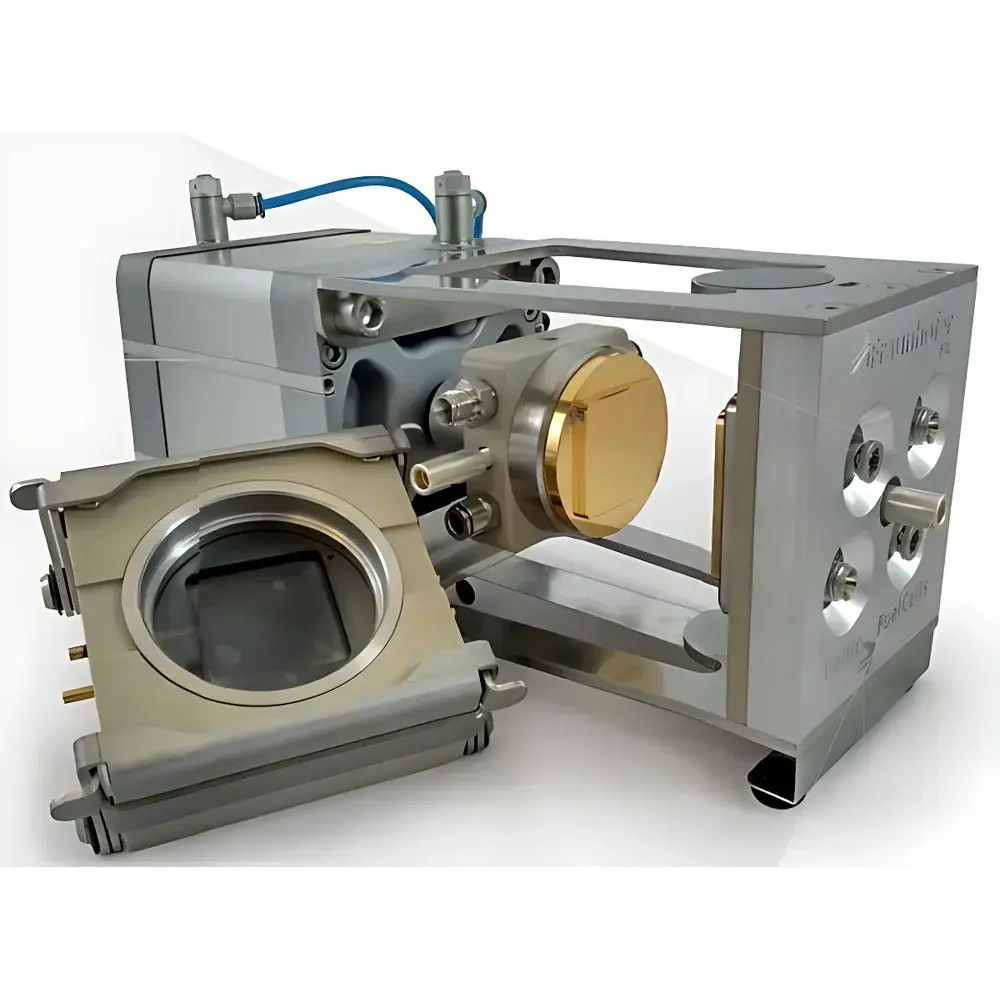
Baltic FuelCells QCF12 High-Current-Density Fuel Cell Test Fixture
| Brand | Baltic FuelCells |
|---|---|
| Origin | Germany |
| Model | QCF12 |
| Active Area | 12 cm² |
| Piston Diameter | Ø100 mm |
| Mass | 6 kg |
| Max Contact Pressure | 2.5 N/mm² |
| Operating Temperature Range | −20 to 150 °C |
| Coolant–Cathode Outlet ΔT | ≤1 K at 5 A/cm² |
| Cooling/Heating Medium | External Liquid Circulator (not included) |
| Gas Inlet Fittings | Ø4 mm (fuel/air supply via Ø6 mm ports) |
| Electrical & Thermal Interface | Stainless Steel with Gold-Plated Contacts and FKM Seals |
| Actuation | Motorized 5/2 Solenoid Valve |
Overview
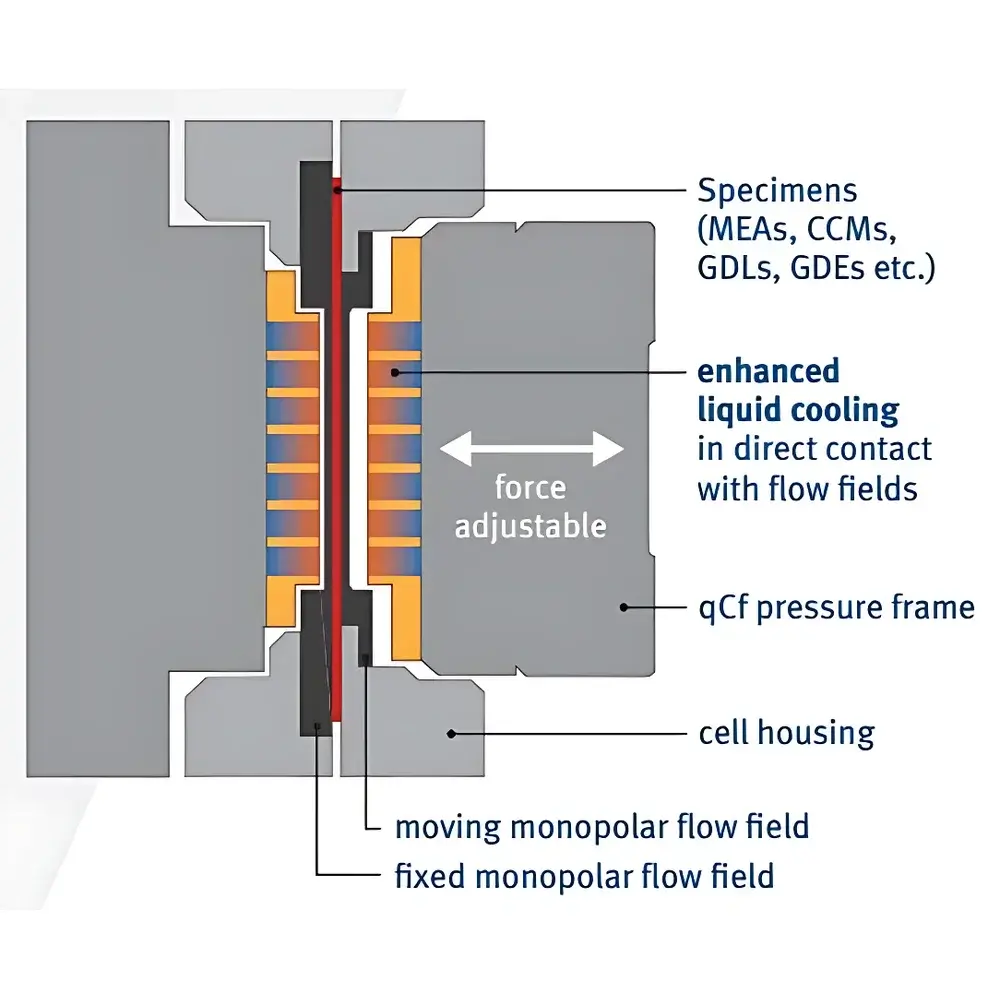
The Baltic FuelCells QCF12 High-Current-Density Fuel Cell Test Fixture is an engineered mechanical test platform designed for laboratory-scale evaluation of proton exchange membrane (PEM) fuel cell single cells and membrane electrode assemblies (MEAs) under industrially relevant high-current-density operating conditions—up to 5 A/cm². Unlike conventional test fixtures limited by thermal management constraints, the QCF12 integrates a co-located liquid cooling architecture developed in collaboration with Fraunhofer ISE, enabling direct thermal coupling between the coolant layer and graphite bipolar plates. This design minimizes thermal resistance across the cell stack interface, ensuring uniform temperature distribution and mitigating localized hot spots that compromise MEA durability and performance reproducibility. The fixture operates within a broad thermal envelope (−20 to 150 °C), supporting cold-start validation, freeze-thaw cycling, and accelerated stress testing per DOE and ISO 8528-12 protocols. Its rigid stainless-steel frame, gold-plated electrical contacts, and FKM elastomer sealing system ensure long-term dimensional stability and corrosion resistance in humid, acidic PEM environments.
Key Features
- Direct-contact liquid cooling system integrated into the flow-field plate interface, reducing cathode outlet–coolant temperature differential to ≤1 K at 5 A/cm² and 80 °C
- Continuously adjustable contact pressure (0–2.5 N/mm²) via precision-machined self-regulating single-stage piston, enabling optimization of interfacial contact resistance and maximum power density
- Tool-free assembly/disassembly: quick-connect clamping mechanism eliminates need for torque wrenches or alignment jigs; compatible with variable MEA and GDL thicknesses without recalibration
- Motorized 5/2 solenoid valve for automated gas switching (H₂/air/N₂), synchronized with thermal and electrical data acquisition
- Modular porting architecture: standardized Ø6 mm gas inlets, Ø4 mm pressure regulation ports, and thermally isolated stainless-steel heater/cooler connections with gold-plated current collectors
- Fully compliant with GLP-aligned test workflows: traceable pressure calibration, documented seal integrity verification, and mechanically stable contact force repeatability (<±0.5% over 500 cycles)
Sample Compatibility & Compliance
The QCF12 accommodates standard 12 cm² active-area MEAs with carbon paper or cloth gas diffusion layers (GDLs), including catalyst-coated membranes (CCMs) and full membrane-electrode-diffuser (MED) assemblies. Its piston-based compression system automatically compensates for dimensional variance across commercial and prototype MEAs (thickness range: 0.3–1.2 mm), eliminating manual shimming. All wetted surfaces are constructed from 316 stainless steel and sealed with fluorocarbon (FKM) gaskets rated for continuous exposure to humidified H₂, O₂, and CO₂ at temperatures up to 150 °C. The fixture meets mechanical safety requirements per EN 13445-3 and supports audit-ready documentation for ISO/IEC 17025-accredited laboratories. It is compatible with common PEM fuel cell test stations (e.g., Scribner Associates, Gaskatel, FuelCon) and enables compliance with ASTM D6356 (fuel cell performance testing) and US Department of Energy’s Fuel Cell Technical Targets for automotive applications.
Software & Data Management
While the QCF12 is a hardware-only platform, its mechanical and pneumatic interfaces are fully interoperable with industry-standard test station controllers and SCADA systems. Analog pressure, temperature, and voltage signals are routed through shielded connectors compatible with 0–10 V or 4–20 mA input modules. The motorized gas valve accepts TTL or Modbus RTU commands, allowing synchronization with electrochemical impedance spectroscopy (EIS) sweeps or cyclic voltammetry sequences. When deployed in regulated environments, the fixture supports 21 CFR Part 11-compliant electronic records when paired with validated data acquisition software (e.g., LabVIEW FPGA modules or MATLAB Data Acquisition Toolbox), including electronic signatures, audit trails, and user-access controls for pressure setpoints and thermal ramp profiles.
Applications
- High-fidelity polarization curve acquisition at >3 A/cm², including mass-transport-limited region analysis
- Cold-start behavior characterization under sub-zero ambient conditions (−20 to 0 °C)
- Thermal aging studies of catalyst layers and ionomer degradation under sustained high-current operation
- Validation of novel flow-field designs (e.g., serpentine, interdigitated, bio-inspired channels) via comparative thermal mapping
- Accelerated durability testing (ADT) per DOE protocol 1.2.2, including open-circuit voltage (OCV) hold and load-cycling sequences
- Quality assurance in MEA pilot-line production: batch-to-batch performance correlation using identical mechanical boundary conditions
FAQ
Is external cooling equipment required to operate the QCF12?
Yes—the fixture requires an external programmable liquid circulator capable of delivering coolant at −20 to 150 °C with flow rates ≥2 L/min and pressure stability ±0.02 bar.
Can the QCF12 be used for alkaline fuel cell (AFC) or solid oxide fuel cell (SOFC) testing?
No—it is specifically engineered for low-temperature PEM systems; material compatibility and thermal expansion coefficients are not validated for KOH electrolyte or ceramic electrolytes above 600 °C.
What is the recommended maintenance interval for the FKM seals?
Under continuous operation at ≤80 °C and 100% RH, FKM gaskets maintain integrity for ≥1,000 thermal cycles; replacement is advised after 12 months of intermittent use or following any exposure to hydrocarbon contaminants.
Does the fixture include pressure transducers or temperature sensors?
No—these must be integrated externally via the standardized ¼″ NPT and PT100-compatible ports provided on all fluid and gas manifolds.
How is contact pressure calibrated and verified?
Each unit ships with a NIST-traceable calibration certificate for the piston actuation system; users may verify force output using a calibrated load cell inserted between the piston head and endplate during commissioning.



