
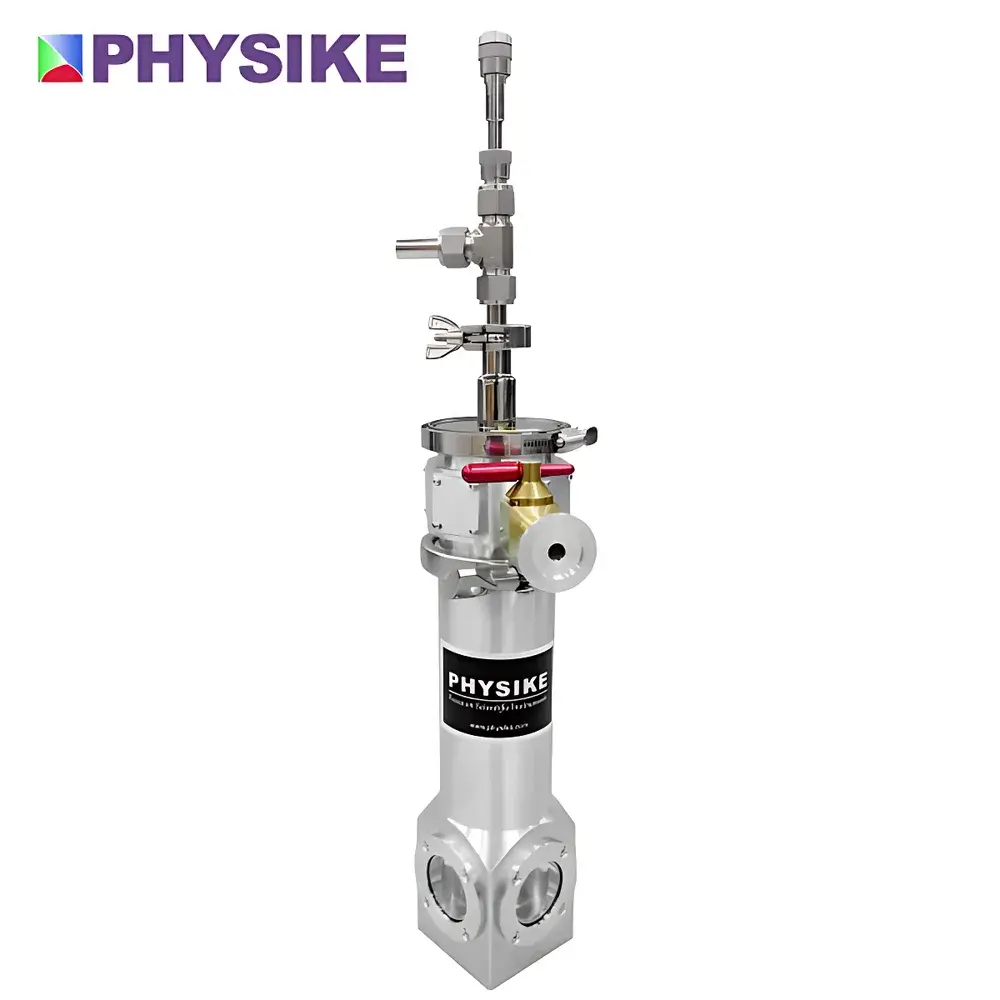
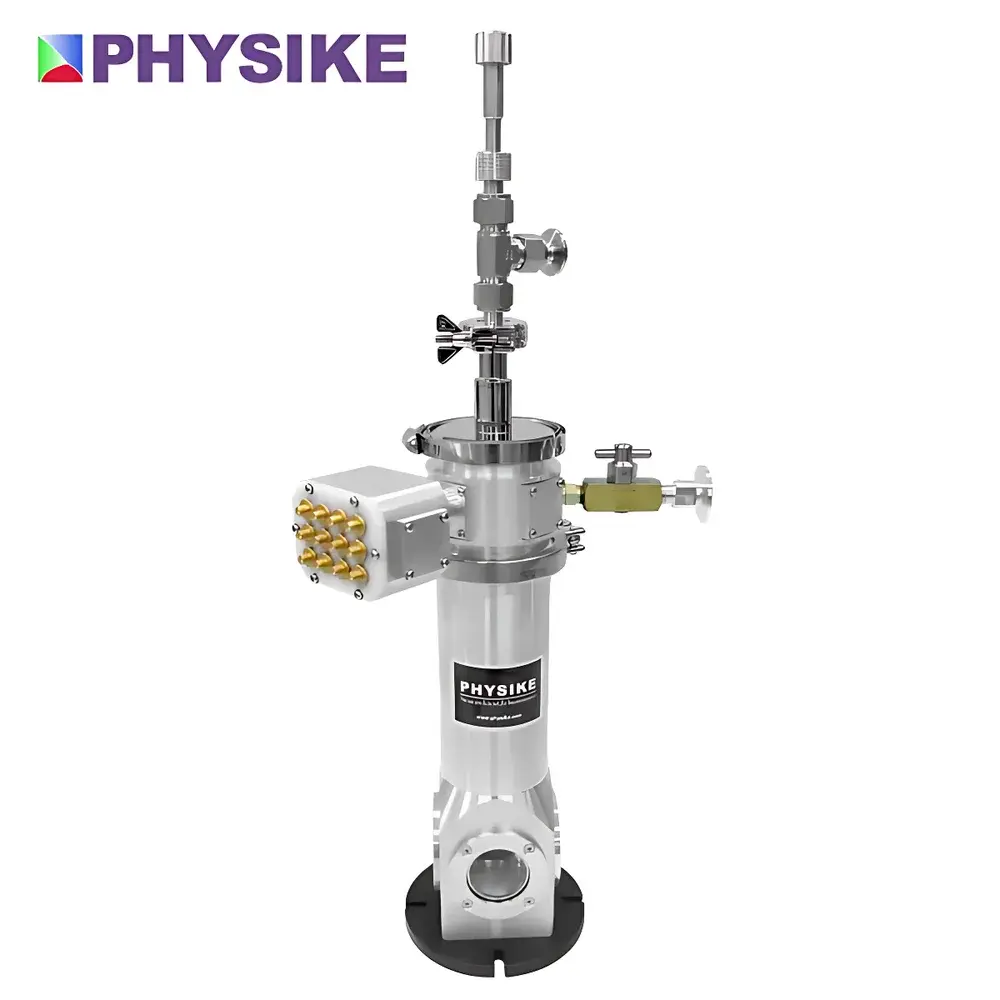
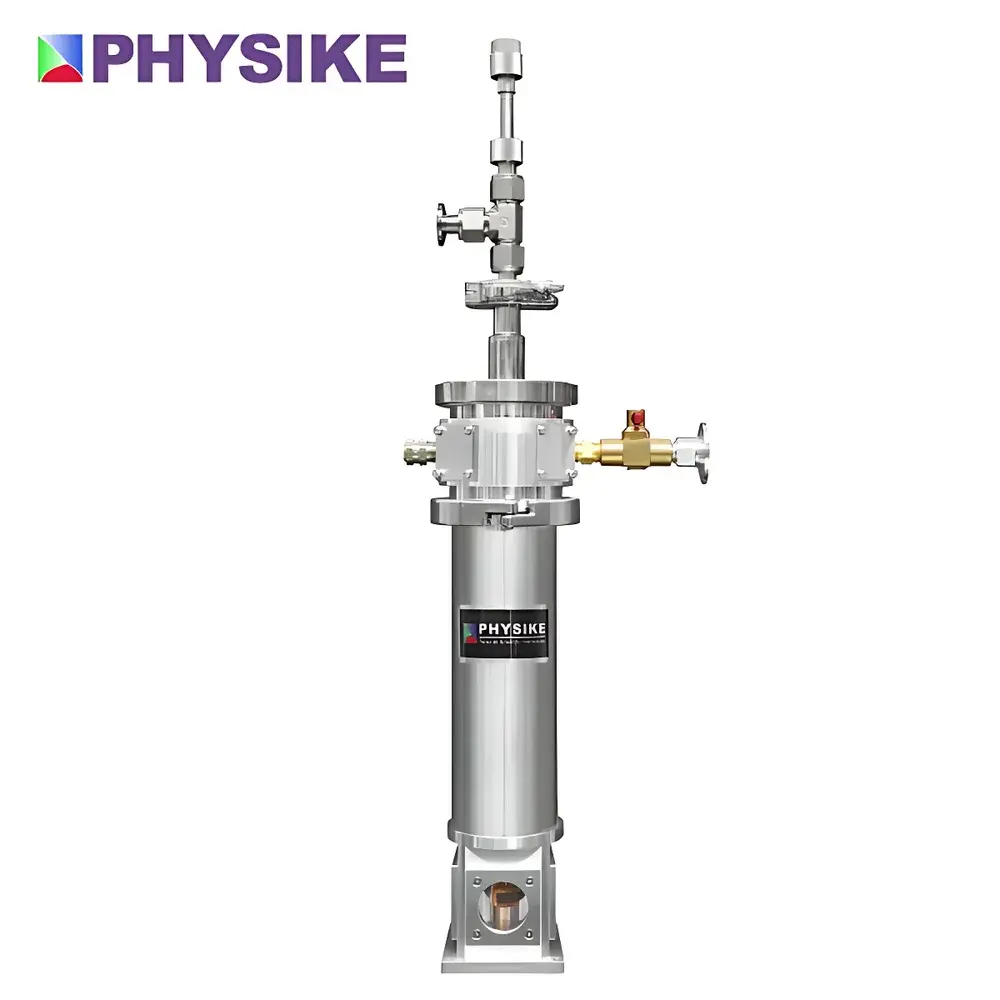
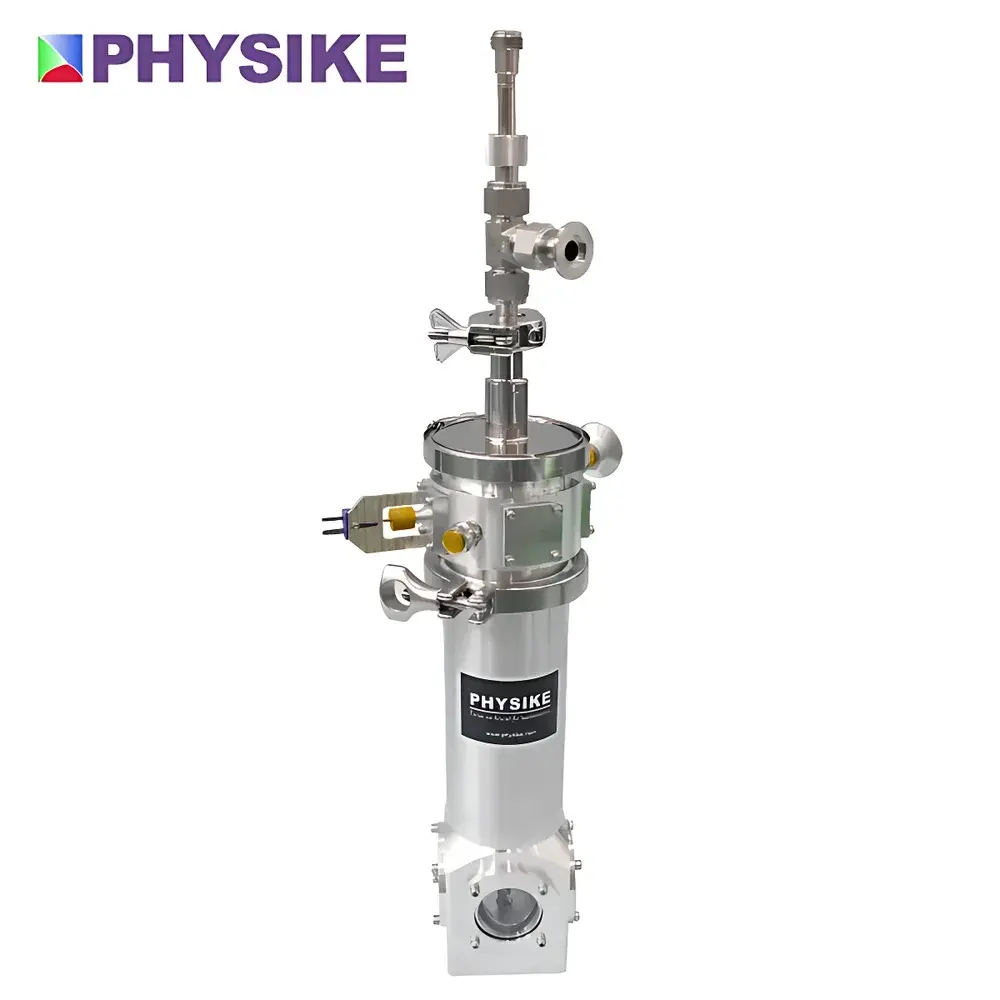
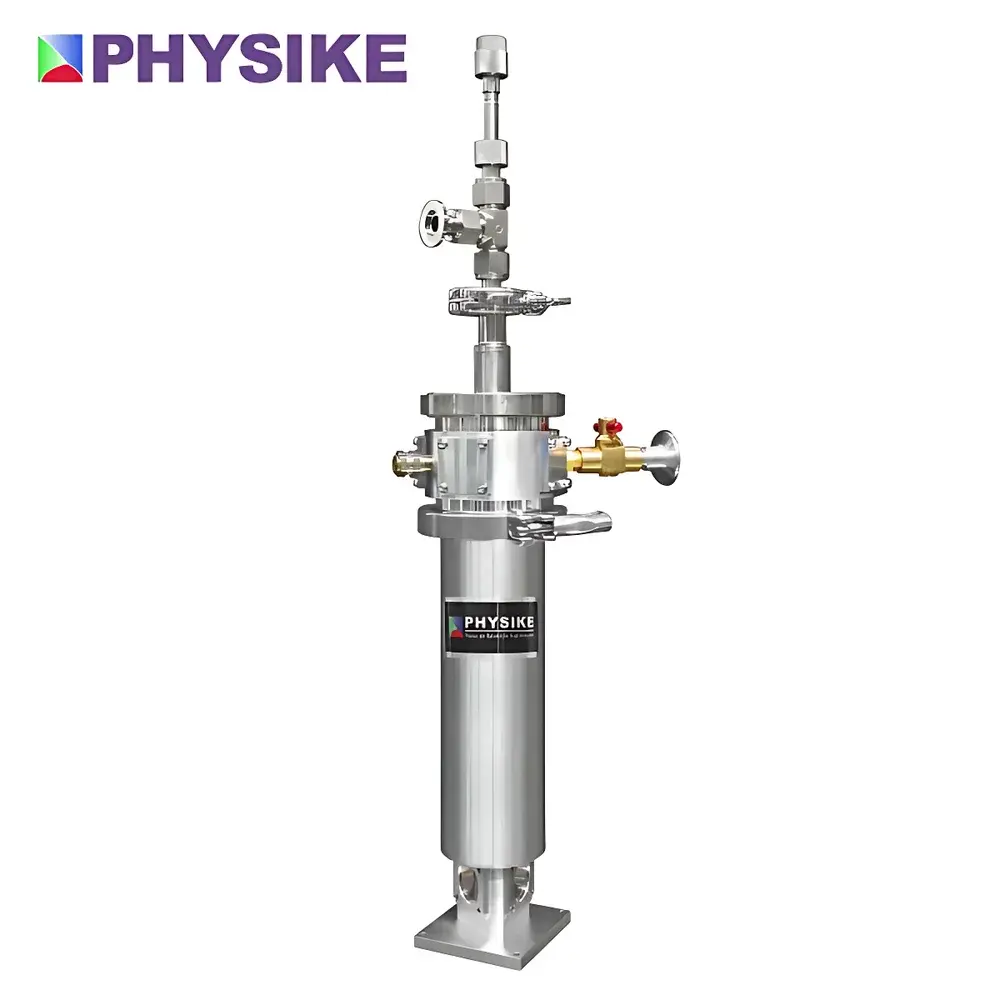
Physike Vcryo-V-100 Liquid Nitrogen Cryogenic Thermostat
| Brand | Physike |
|---|---|
| Origin | Beijing, China |
| Manufacturer Type | Direct Manufacturer |
| Product Category | Domestic |
| Model | Vcryo-V-100 |
| Price | Upon Request |
| Temperature Stability | ±25 mK |
| Operating Temperature Range | 65 K to 500 K (optional upgrade to 800 K) |
| Dewar Volume | 0.4 L |
| Cooling Medium | Liquid Nitrogen |
Overview
The Physike Vcryo-V-100 is a high-performance, liquid nitrogen–cooled cryogenic thermostat engineered for precision temperature control in optical, spectroscopic, and low-temperature electrical characterization experiments. Based on a closed-cycle, passive heat-sinking architecture with integrated thermal impedance modulation, the system achieves stable operation across a broad 65 K–500 K range—extendable to 800 K with optional high-temperature upgrade kits. Unlike conventional bath-style cryostats, the Vcryo-V-100 employs an internal 0.4 L liquid nitrogen reservoir combined with a built-in cryosorption pump, enabling continuous thermal regulation without interrupting experimental runs during LN₂ replenishment. Its thermally optimized copper cold stage delivers high thermal uniformity and low microphonic coupling, making it suitable for sensitive photoluminescence, electroluminescence, FTIR, UV-Vis-NIR spectroscopy, and time-resolved optical measurements where thermal drift and mechanical vibration must be minimized.
Key Features
- Integrated 0.4 L liquid nitrogen dewar with rapid-refill capability under active temperature control (no thermal interruption)
- Thermal stability of ±25 mK over extended dwell periods at any setpoint within 65–500 K
- Quick-release clamp mechanism for tool-free access to the sample chamber
- Standard configuration includes four fused silica optical windows, transmitting from deep UV (185 nm) through near-IR (2.5 µm)
- Modular vacuum feedthrough interface supporting up to 12 SMA (2.92 mm), BNC, triax, multi-pin, microwave (1.85 mm), and optical fiber penetrations
- Lightweight aluminum alloy main body with compact footprint (< 300 mm height), optimized for benchtop integration
- Compatibility with commercial spectrometers including Horiba FluoroMax-4, Edinburgh FLS1000/FS5, Shimadzu UV-3600 Plus, PerkinElmer FL6500, and PTI QM8000
Sample Compatibility & Compliance
The Vcryo-V-100 accommodates diverse sample geometries and measurement modalities via interchangeable sample mounts—including Puck-, DIP-, and LCC-style electrical carriers; transmission-capable holders for thin films or powders; and probe-based configurations for four-point probe or Hall effect studies. All standard window materials comply with ISO 10110–3 for surface quality and ASTM E430 for UV-transmitting fused silica. Optional window options include CaF₂ (UV–mid-IR), ZnSe (mid-IR), polyethylene (THz), and beryllium (X-ray). Vacuum integrity meets ISO 2861 standards for UHV-compatible systems (≤1×10⁻⁷ mbar base pressure with cryopump engaged). The platform supports GLP-compliant workflows when paired with external temperature controllers featuring audit-trail logging (e.g., Lake Shore 336 with 21 CFR Part 11 firmware).
Software & Data Management
While the Vcryo-V-100 operates as a hardware-integrated subsystem rather than a standalone instrument, it is fully interoperable with third-party temperature controllers and data acquisition platforms. When used with Lake Shore, Janis, or Oxford Instruments temperature controllers, full PID parameter logging, ramp profiling, and real-time thermal history export (CSV/TXT) are supported. Optional digital I/O modules enable TTL-triggered synchronization with pulsed lasers or gated detectors. All vacuum and temperature status signals can be routed into LabVIEW, Python (via PyVISA), or MATLAB environments using standard SCPI command sets. No proprietary software is required—configuration and monitoring rely entirely on industry-standard protocols.
Applications
- Temperature-dependent photoluminescence (PL) and electroluminescence (EL) mapping of quantum dots, perovskites, and 2D materials
- FTIR and Raman spectroscopy of phonon modes in superconductors and topological insulators
- Variable-temperature UV-Vis-NIR absorbance and transmittance of solar cell absorbers and OLED emissive layers
- Deep-level transient spectroscopy (DLTS) and Hall effect measurements on semiconductor heterostructures
- In situ high-pressure diamond anvil cell (DAC) studies coupled with synchrotron or laser excitation
- THz time-domain spectroscopy (THz-TDS) of carrier dynamics in ultrafast optoelectronic devices
- Calibration of infrared detectors and focal plane arrays across cryogenic operating ranges
FAQ
Can the Vcryo-V-100 operate continuously without manual refilling?
No—it requires periodic liquid nitrogen replenishment, but its design permits refilling while maintaining temperature stability within ±25 mK.
Is vacuum pumping integrated or external?
A built-in cryosorption pump is standard; for pressures below 1×10⁻⁷ mbar, an external turbomolecular pump may be added via CF-40 or KF-40 flange.
What is the maximum sample size compatible with the standard chamber?
The internal sample space accommodates samples up to Ø25 mm × 10 mm (diameter × height); larger volumes are available via the “Large Sample Space” option.
Does Physike provide calibration certificates traceable to NIST?
Yes—optional NIST-traceable temperature sensor calibration (Pt100 or Cernox™) is available upon request, with uncertainty ≤±50 mK over 65–300 K.
Can the Vcryo-V-100 be retrofitted for liquid helium operation?
Yes—the LH₂/LHe upgrade kit includes transfer line adapters, helium-compatible seals, and revised thermal anchoring paths for stable 4.2 K operation.



