
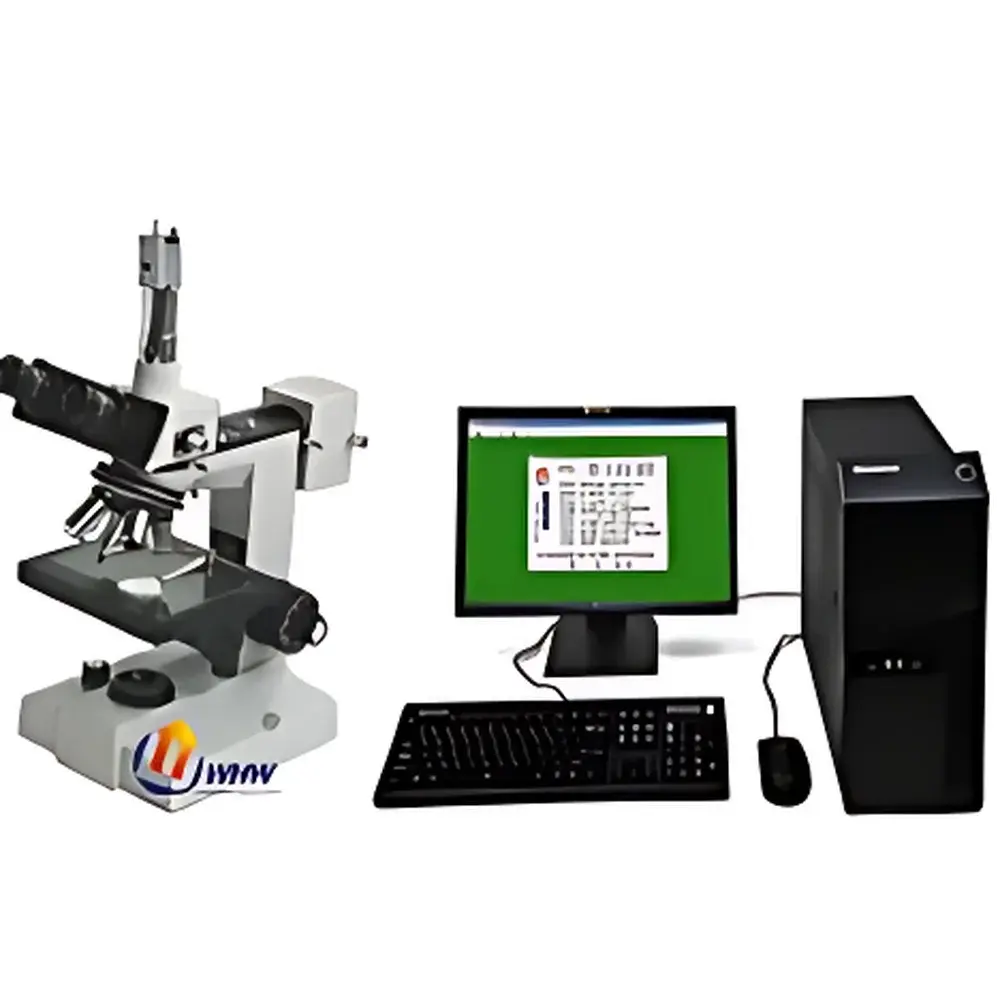
YANRUN AMM-200P Trinocular Upright Metallurgical Microscope with Video Imaging Capability
| Brand | YANRUN |
|---|---|
| Origin | Shanghai, China |
| Manufacturer Type | Direct Manufacturer |
| Region of Origin | Domestic (China) |
| Model | AMM-200P |
| Microscope Type | Upright (not inverted) |
| Image Analysis System Included | No |
| Eyepieces | Widefield 10× (18 mm field number), Widefield 16× (11 mm field number) |
| Objectives | Plan Achromatic, Cover-Slip-Free: 4×/NA 0.10, 10×/NA 0.25, 40×/NA 0.65 (Spring-Loaded), 63×/NA 0.85 (Spring-Loaded) |
| Mechanical Stage | 160 × 130 mm, X–Y Travel 76 × 50 mm, Vernier Scale Resolution: 0.1 mm |
| Nosepiece | Ball-Bearing Mounted Quadruple Revolving Nosepiece |
| Focus Mechanism | Coaxial Coarse/Fine Adjustment, Total Travel: 40 mm, Fine Focus Graduation: 0.002 mm |
| Illumination | Vertical Epifluorescence-Compatible Reflected-Light Illuminator, Dual-Voltage (110 V / 220 V AC), 6 V / 20 W Halogen Lamp with Adjustable Brightness and Interchangeable Color Filters (Light Blue, Light Green) |
Overview
The YANRUN AMM-200P is a precision-engineered trinocular upright metallurgical microscope designed for high-fidelity microstructural analysis of opaque, polished, and etched metallic and alloy specimens. Unlike inverted configurations optimized for bulk or large-section samples, the upright architecture of the AMM-200P provides optimal ergonomics for routine metallographic preparation workflows—especially during grinding, polishing, and final etching stages where direct top-down observation is essential. Its optical path employs Köhler illumination principles in reflected-light mode, ensuring uniform brightness, minimal glare, and high contrast across the entire field of view. The system supports both visual inspection via dual eyepieces and simultaneous real-time video capture through its dedicated trinocular port—enabling documentation, collaborative review, and integration into standardized quality control protocols.
Key Features
- Trinocular optical head with 30° inclined viewing angle and adjustable interpupillary distance (55–75 mm) for extended operator comfort during prolonged examination sessions.
- Plan achromatic objectives (4×, 10×, 40×, 63×) engineered for cover-slip-free operation—eliminating refractive distortion when imaging bare metal surfaces, as required by ASTM E3, ISO 643, and GB/T 13298 standards.
- Ball-bearing quadruple nosepiece ensures precise, repeatable objective alignment and long-term mechanical stability under laboratory use conditions.
- Coaxial coarse/fine focusing mechanism with 40 mm total travel and 0.002 mm fine-focus graduation enables sub-micron depth discrimination—critical for assessing grain boundary delineation, inclusion morphology, and phase distribution.
- Reflected-light illuminator with dual-voltage compatibility (110 V / 220 V), dimmable 6 V / 20 W halogen source, and selectable light-blue and light-green interference filters to enhance contrast for specific etchants (e.g., Nital, Kroll’s, or Beraha reagents).
- Large-format mechanical stage (160 × 130 mm) with 76 × 50 mm travel range and 0.1 mm vernier resolution facilitates systematic scanning of large-area cross-sections per ASTM E112 grain size evaluation procedures.
Sample Compatibility & Compliance
The AMM-200P accommodates standard metallographic specimens up to 30 mm in height and 50 mm in diameter, including mounted and unmounted sections, fracture surfaces, and clad or coated materials. Its rigid cast-aluminum frame and anti-vibration base minimize thermal drift and mechanical oscillation—key requirements for GLP-compliant laboratories conducting ASTM E3, E112, E407, and ISO 4967 evaluations. While the base configuration does not include image analysis software, the trinocular port conforms to C-mount (1″, 32 TPI) mechanical interface standards, permitting seamless coupling with third-party CCD/CMOS cameras compliant with USB3.0, GigE Vision, or Camera Link protocols—ensuring traceability-ready digital archiving under FDA 21 CFR Part 11–enabled systems when paired with validated acquisition software.
Software & Data Management
The AMM-200P operates as a hardware platform compatible with industry-standard image acquisition and measurement suites—including Olympus cellSens, Zeiss ZEN Core, and open-source alternatives such as FIJI/ImageJ (with appropriate calibration). When integrated with a C-mount camera and calibrated stage micrometer, users can perform quantitative metallography tasks: grain size classification (ASTM E112 intercept method), inclusion rating (ASTM E45), phase fraction analysis, and linear intercept measurements. Audit trails, user authentication, and electronic signatures may be implemented at the software layer to satisfy GMP documentation requirements; however, no proprietary analysis software is bundled with the instrument.
Applications
- Routine QC/QA of heat-treated steels, aluminum alloys, titanium grades, and sintered powder metallurgy components.
- Failure analysis investigations involving fatigue cracks, intergranular corrosion, weld zone heterogeneity, and coating delamination.
- Research-grade microstructure characterization in university metallurgy labs and national testing centers.
- Training platforms for ISO/IEC 17025-accredited personnel certification in metallographic specimen preparation and evaluation.
- Supporting cross-functional process validation in automotive, aerospace, and energy sectors where microstructural conformity directly impacts mechanical performance and service life.
FAQ
Is the AMM-200P suitable for fluorescence imaging?
No—the standard configuration lacks excitation filter cubes and mercury/xenon lamp sources required for epifluorescence. However, the optical pathway is compatible with aftermarket reflected-light fluorescence modules if upgraded.
Can oil immersion objectives be used with this microscope?
Yes—optional 100× oil-immersion plan achromat objectives (NA 1.25) are available and mechanically compatible with the quadruple nosepiece, provided appropriate immersion oil (n = 1.518) and cleaning protocols are followed.
Does the microscope meet CE or UL safety certification standards?
As a domestically manufactured instrument intended primarily for the Chinese market, formal CE or UL certification is not pre-installed; however, electrical components comply with IEC 61010-1 general safety requirements for laboratory equipment, and customization for international regulatory compliance is available upon request.
What is the maximum specimen weight supported on the mechanical stage?
The stage is rated for static loads up to 2 kg; heavier mounted specimens require auxiliary support fixtures to prevent tilt-induced focus drift.
Is parfocality maintained across all four objective positions?
Yes—all supplied plan achromats are factory-aligned to a common parfocal distance of 45 mm, minimizing refocusing time during magnification changes—a requirement specified in ISO 8578 for metallurgical microscope verification.



