
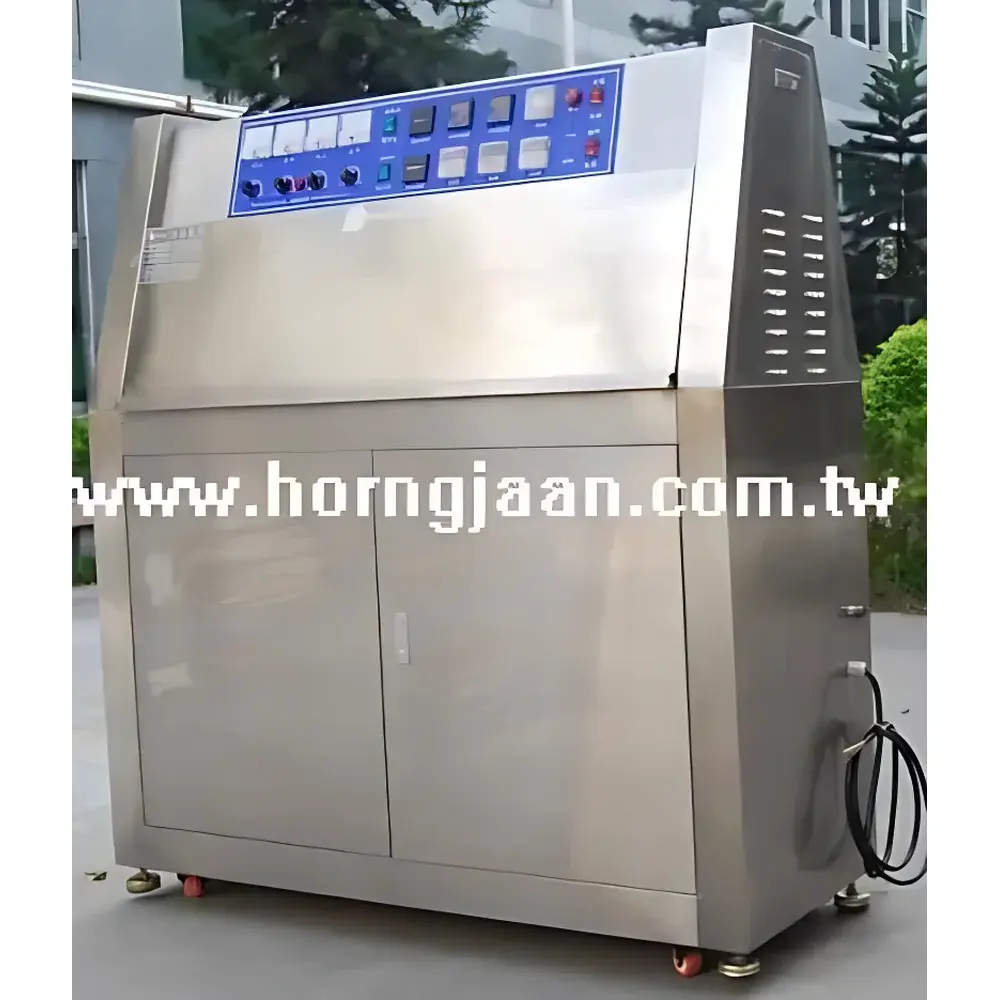
LabCompanion UV3 Advanced UV Aging Test Chamber
| Brand | LabCompanion |
|---|---|
| Origin | Guangdong, China |
| Manufacturer Type | OEM/ODM Producer |
| Country of Origin | China |
| Model | UV3 |
| Pricing | Available Upon Request |
| Temperature Range | RT+10°C to 70°C |
| Humidity Range | ≥90% RH |
| Sample-to-Lamp Distance | 50 ± 2 mm |
| Lamp Center-to-Center Spacing | 70 mm |
| Irradiance | UVA-340 @ 0.68 W/m² (295–360 nm), UVB-313 @ 0.60 W/m² (280–315 nm) |
| Interior Dimensions | 1170 × 450 × 500 mm (W×D×H) |
| Exterior Dimensions | 1300 × 550 × 1380 mm (W×D×H) |
| Construction | Stainless Steel Interior & Exterior |
| Control System | Intelligent Digital PID Controller with AI Algorithm |
| Condensation Mechanism | Steam-Based Cold-Condensation Cycle |
| Compliance Standards | GB/T 16422.3–1997, ASTM G53–88, GB/T 14522–93 |
| Optional | UV Irradiance Sensor with Real-Time Feedback and Automatic Lamp Power Compensation |
Overview
The LabCompanion UV3 Advanced UV Aging Test Chamber is an engineered environmental simulation system designed for accelerated photochemical degradation testing of polymeric and organic materials under controlled ultraviolet (UV) irradiation, thermal stress, and cyclic moisture exposure. It operates on the principle of fluorescent UV lamp-based photodegradation—leveraging the high quantum efficiency and spectral stability of low-pressure mercury-doped phosphor lamps to replicate the most damaging short-wavelength components of terrestrial solar radiation. Unlike full-spectrum xenon arc or carbon arc systems, the UV3 focuses exclusively on the UV-A (315–400 nm) and UV-B (280–315 nm) bands, which account for over 80% of the photochemical damage observed in outdoor weathering despite comprising only ~5% of total solar energy. Its condensation cycle mimics nocturnal dew formation via saturated steam exposure on the specimen surface while maintaining elevated chamber temperature—enabling realistic simulation of hydrolytic stress synergistic with UV exposure. This architecture supports quantitative evaluation of surface-level degradation phenomena including chalking, gloss loss, color shift (ΔE), microcracking, embrittlement, and polymer chain scission.
Key Features
- Dual-lamp configuration supporting interchangeable UVA-340 (295–360 nm) and UVB-313 (280–315 nm) fluorescent tubes—UVA-340 for realistic solar-spectrum correlation; UVB-313 for aggressive acceleration per ASTM G53 protocols
- Precision-engineered stainless steel chamber (interior and exterior) with electropolished finish for corrosion resistance and long-term UV reflectivity stability
- Intelligent digital PID controller with adaptive AI algorithm enabling simultaneous regulation of irradiance, black-panel temperature, and condensation humidity—no manual recalibration required
- Steam-driven condensation mechanism ensuring uniform dew formation across specimen surfaces without water spray or immersion, eliminating runoff artifacts and preserving coating integrity during wet/dry cycling
- Integrated UV irradiance sensor (optional) providing closed-loop feedback control: continuously monitors spectral irradiance at specimen plane and automatically adjusts lamp output to compensate for lamp aging, voltage drift, or quartz sleeve fouling
- Comprehensive safety architecture including overtemperature cutoff, phase-failure detection, ground fault interruption, low-water level lockout, and compressor overpressure protection—all triggering automatic power shutdown and audible alarm
Sample Compatibility & Compliance
The UV3 accommodates flat-panel specimens up to 110 mm × 200 mm (standard rack capacity: 48 samples per cycle), with adjustable aluminum sample holders compatible with ISO 4892-3, ASTM D4329, and JIS D0205 test geometries. Specimen mounting allows for both front-face and edge-exposed configurations to assess directional degradation effects. The chamber meets structural and operational requirements of multiple international standards: GB/T 16422.3–1997 (equivalent to ISO 4892-3), ASTM G53–88 (Standard Practice for Operating Fluorescent Ultraviolet (UV) and Condensation Exposure Apparatus for Polymer Testing), and GB/T 14522–93 (Mechanical Industry Standard for Artificial Climate Accelerated Testing of Plastics, Coatings, and Rubber). All control firmware and data logging modules comply with GLP documentation requirements—including time-stamped event logs, operator ID tagging, and non-erasable audit trails for regulatory submissions.
Software & Data Management
Equipped with LabCompanion’s proprietary UVControl Suite (v3.2), the UV3 supports real-time monitoring of irradiance (W/m²), black-standard temperature (°C), chamber humidity (%RH), and elapsed exposure time (hours). Data is logged at user-defined intervals (1 sec to 60 min) and exported in CSV or XML format compliant with LIMS integration. The software enforces 21 CFR Part 11–compatible electronic signatures for test method validation, parameter locking, and report generation. All calibration events—including UV sensor zeroing, thermocouple verification, and humidity probe adjustment—are recorded with traceable timestamps and operator credentials. Remote access via Ethernet enables centralized fleet management for multi-chamber laboratories operating under ISO/IEC 17025 quality systems.
Applications
- Formulation development and comparative ranking of automotive clearcoats, architectural sealants, and marine-grade polyurethanes
- Validation of UV stabilizer package efficacy in HDPE geomembranes and PVC roofing membranes per ASTM D4329
- Accelerated qualification of aerospace composite matrix resins (epoxy, BMI) exposed to tropical coastal environments
- Correlation studies between laboratory UV exposure and field service life using Arrhenius-based kinetic modeling
- Quality control screening of batch-to-batch consistency in pigment-dispersed coatings prior to outdoor exposure campaigns
- Supporting IEC 61215 certification testing for photovoltaic module backsheet materials (UV preconditioning step)
FAQ
What is the difference between UVA-340 and UVB-313 lamp spectra, and how do I select between them?
UVA-340 lamps emit a narrowband spectrum closely matching terrestrial sunlight between 295–360 nm—ideal for realistic weathering correlation. UVB-313 lamps extend output down to 280 nm, delivering higher photon energy and faster degradation kinetics—used when rapid screening or worst-case stress testing is required.
Does the UV3 support irradiance calibration traceable to NIST standards?
Yes—the optional UV irradiance sensor is factory-calibrated against NIST-traceable reference detectors (SRM 2032) and includes a certificate of calibration valid for 12 months.
Can the UV3 perform simultaneous UV + humidity + temperature profiling per ISO 4892-3 Cycle 1?
Yes—it executes all three ISO 4892-3 defined cycles (UV-only, UV/condensation, UV/light/dark) with programmable ramp rates, dwell times, and setpoint tolerances per clause 7.2.
Is remote diagnostic capability available for predictive maintenance?
The embedded Ethernet interface supports SNMP-based health monitoring, lamp hour tracking, and automated firmware update notifications through LabCompanion’s CloudLink platform.
How is condensation uniformity verified across the specimen plane?
A calibrated dew-point hygrometer and infrared thermal imager are included in the commissioning protocol to map surface temperature gradients and confirm ±0.5°C uniformity across the full test area.



