
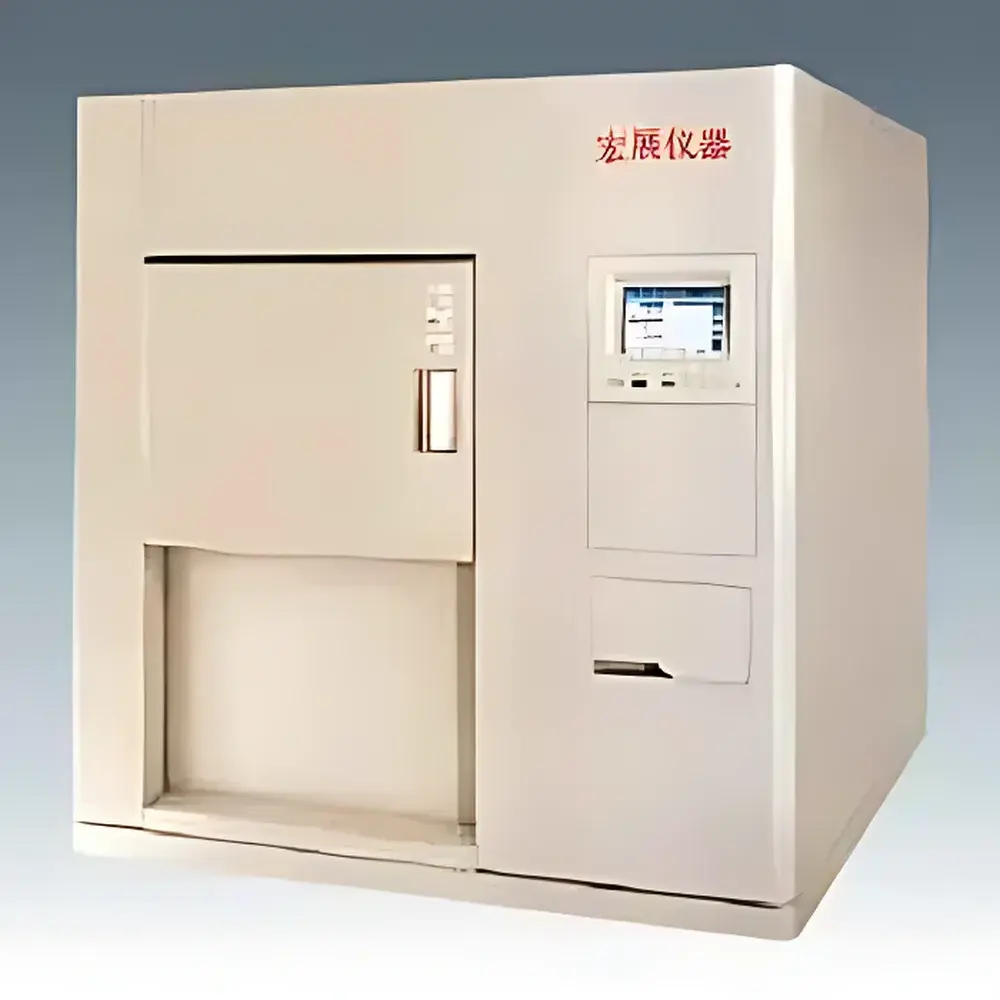
LabCompanion TS Series Thermal Shock Test Chamber
| Brand | LabCompanion |
|---|---|
| Model | TS Series |
| Temperature Range | −40 °C to +100 °C (optional +150 °C) |
| Low-Temp Chamber | −70 °C to −10 °C |
| High-Temp Chamber | +60 °C to +200 °C |
| Specimen Weight Capacity | 2.5 kg |
| Transfer Time | ≤10 s |
| Temp. Rise Time (−40 °C → +100 °C) | 40 min |
| Temp. Fall Time (+100 °C → −40 °C) | 70 min |
| Chamber Interior | SUS304 stainless steel |
| Exterior | Galvanized steel with epoxy-polyester powder coating |
| Control System | Microprocessor-based PID + SSR |
| Refrigerant | HFC-type eco-friendly refrigerant |
| Safety Protections | Overheat, compressor overload, high/low pressure, control system overload |
| Optional Interface | RS-232 serial communication |
Overview
The LabCompanion TS Series Thermal Shock Test Chamber is an engineered environmental test system designed for accelerated reliability assessment of electronic components, PCB assemblies, semiconductor packages, ceramic substrates, and polymeric materials under rapid, repetitive transitions between extreme temperature extremes. Operating on the two-chamber (hot/cold) air-to-air or liquid-to-liquid thermal shock principle—depending on configuration—the system subjects specimens to controlled, high-reproducibility thermal cycling without physical contact with heat transfer media during transfer. This architecture eliminates thermal lag associated with single-chamber ramping and ensures precise dwell time adherence per IEC 60068-2-14, MIL-STD-810H Method 503.5, and JESD22-A104D test protocols. The chamber’s dual-zone independent control enables simultaneous stabilization at user-defined hot and cold setpoints, with programmable dwell times, transition rates, and cycle counts—all critical for evaluating interfacial delamination, solder joint fatigue, coefficient-of-thermal-expansion (CTE) mismatch failure, and glass transition behavior.
Key Features
- Independent dual-zone temperature control with high-stability hot and cold chambers—capable of maintaining ±0.5 °C uniformity across each zone during dwell phases
- High-speed specimen transfer mechanism (<10 s) driven by pneumatic actuators, minimizing thermal soak delay and ensuring repeatable shock profiles
- Microprocessor-based controller with color LCD touchscreen (English/Chinese bilingual interface), intuitive navigation, and real-time graphical display of chamber temperatures and cycle progress
- Onboard 3.5-inch flash memory module storing up to 100 test programs and time-stamped temperature trajectory logs (CSV exportable via USB or RS-232)
- SUS304 stainless-steel interior chambers with seamless welding and electropolished finish for corrosion resistance and cleanroom-compatible operation
- Eco-friendly HFC refrigerant system compliant with EU F-Gas Regulation (EU) No 517/2014 and aligned with ISO 14001 environmental management requirements
- Integrated safety architecture including dual-stage overtemperature protection, compressor motor overload monitoring, refrigerant high/low pressure cutouts, and SSR failure detection
Sample Compatibility & Compliance
The TS Series accommodates specimens up to 200 mm (W) × 130 mm (H) × 200 mm (D) and 2.5 kg mass—suitable for populated PCBs, BGA packages, MEMS devices, encapsulated sensors, and molded plastic housings. Its mechanical design supports standardized mounting fixtures (e.g., DIN 41612 rails, custom jigs) and optional humidity-integrated variants for combined thermal-hygroshock testing (per IEC 60068-2-30). The system meets essential electromagnetic compatibility (EMC) per EN 61326-1 and safety standards per EN 61010-1. Documentation includes factory calibration certificates traceable to NIST-equivalent national metrology institutes and supports GLP/GMP audit readiness through secure user access levels, electronic signature capability (when paired with validated LabCompanion software), and full audit trail logging per FDA 21 CFR Part 11 requirements.
Software & Data Management
LabCompanion’s proprietary PC-based ThermalTest Suite enables remote configuration, real-time monitoring, and post-test analysis. Users can define multi-step shock profiles—including ramp rate limits, dwell durations, cycle repetition counts, and conditional branching logic—and synchronize data acquisition from external thermocouples or strain gauges via analog input modules. All logged temperature curves are timestamped with millisecond resolution, annotated with operator ID and test ID, and exported in CSV or XLSX format for statistical process control (SPC) integration. The software supports automated report generation compliant with ISO/IEC 17025 clause 7.8.2, including uncertainty budgeting for temperature measurement based on sensor class and calibration history.
Applications
- Qualification testing of automotive ECUs per AEC-Q200 Rev D thermal shock stress screening
- Reliability validation of aerospace avionics modules under MIL-STD-810H Condition I (air-to-air thermal shock)
- Failure mode analysis of chip-scale packages experiencing intermetallic growth or die attach cracking
- Process window qualification for reflow soldering and underfill curing cycles
- Material science studies on polymer matrix composites undergoing cyclic CTE-induced microcracking
- Accelerated life testing of OLED displays and flexible printed circuits exposed to ambient thermal transients
FAQ
What is the maximum allowable specimen weight and dimensional envelope for the TS-80-2P model?
The standard test basket accommodates specimens up to 2.5 kg and 200 × 130 × 200 mm (W × H × D). Custom baskets with reinforced support structures are available upon request.
Does the system support automated data export to LIMS or MES platforms?
Yes—via RS-232 or optional Ethernet interface, using ASCII-based SCPI command sets compatible with LabVIEW, Python (pySerial), and common industrial SCADA systems.
Is calibration verification performed before shipment?
Each unit undergoes full functional verification and temperature uniformity mapping at three load points (empty, 50% load, full load) across both chambers, with as-delivered calibration reports provided.
Can the chamber be integrated into a larger environmental test suite with vibration or HALT capability?
The TS Series features modular mounting interfaces and synchronized trigger I/O ports (TTL-level), enabling coordinated operation with electrodynamic shakers or HALT systems via external master controller.
What maintenance intervals are recommended for the refrigeration system?
Compressor oil and filter-drier replacement is advised every 24 months under continuous operation; annual inspection of refrigerant charge and pressure safety valves is required per ISO 5149-2.



