
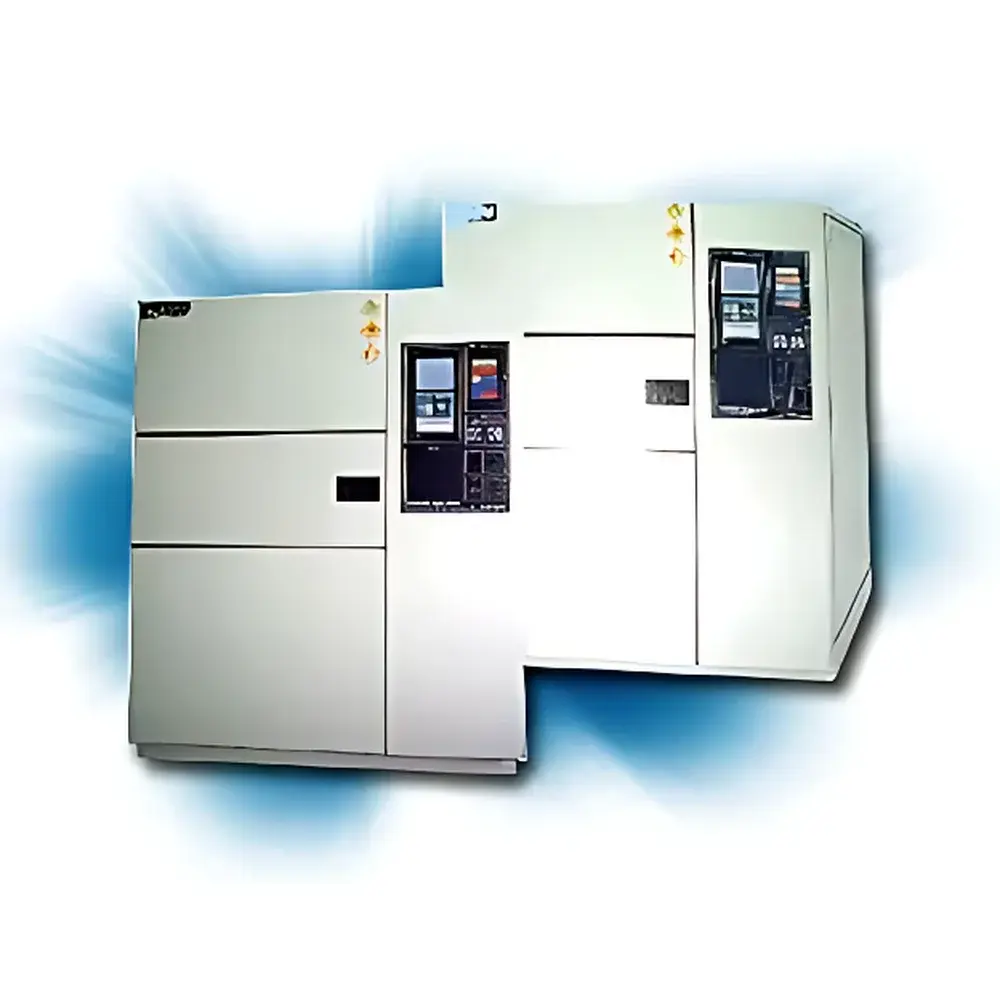
LabCompanion STS Series Thermal Shock Test Chamber
| Brand | LabCompanion |
|---|---|
| Model | STS-A / STS-B / STS-C / STS-D |
| Temperature Range Options | −60 °C to +150 °C |
| Shock Configuration | Dual-Zone (Low/High) or Triple-Zone (Low/Ambient/High) |
| Temperature Recovery Time | ≤ 5 min |
| Control System | Microprocessor-Based Programmable Controller with LCD Display |
| Internal Dimensions (W×D×H, cm) | STS-A: 40×35×30 |
| STS-B | 50×40×40 |
| STS-C | 60×50×50 |
| STS-D | 70×60×60 |
| External Dimensions (W×D×H, cm) | STS-A: 135×150×180 |
| STS-B | 155×152×190 |
| STS-C | 168×162×200 |
| STS-D | 178×172×210 |
Overview
The LabCompanion STS Series Thermal Shock Test Chamber is an engineered environmental stress screening (ESS) system designed for rapid, repeatable thermal cycling between extreme temperature extremes. It operates on the dual- or triple-chamber principle—physically isolating low-temperature and high-temperature zones with a transfer mechanism that moves test specimens between chambers in milliseconds. This architecture eliminates thermal lag inherent in single-chamber forced-air systems and enables true step-change thermal shock profiles per IEC 60068-2-14, MIL-STD-810H Method 503.5, and JESD22-A104. The chamber supports programmable dwell times, transition rates, and cycle counts, making it suitable for accelerated reliability testing of electronic assemblies, automotive ECUs, aerospace components, and hermetically sealed packages where interfacial delamination, solder joint fatigue, or CTE-induced cracking must be evaluated under controlled thermal transients.
Key Features
- Dual-zone or triple-zone configuration with independent refrigeration and heating circuits—ensuring stable, non-interfering temperature setpoints at −60 °C and +150 °C simultaneously
- High-speed specimen transfer mechanism with ≤ 5-second transfer time and verified temperature recovery to setpoint within ≤ 5 minutes (per IEC 60068-2-14 Annex A)
- Microprocessor-based programmable controller with intuitive LCD interface supporting up to 999 cycles, 99 segments per cycle, and user-defined ramp/dwell sequences
- Stainless steel interior chamber with seamless welding, anti-condensation heating on viewing window, and over-temperature/over-pressure safety interlocks
- Compressor-based refrigeration system with cascade design for sub-zero capability down to −60 °C; electric heating elements with PID control for precise high-temperature regulation
- Integrated data logging (optional RS-485/Ethernet) compliant with IEEE 1344 time-stamping standards for audit-ready test records
Sample Compatibility & Compliance
The STS series accommodates samples up to 70 cm wide × 60 cm deep × 60 cm tall (STS-D model), with configurable mounting trays, cable ports, and optional internal thermocouple feedthroughs. Chamber interiors are compatible with standard JEDEC trays, PCB carriers, and encapsulated semiconductor packages. All models meet structural and operational requirements of ISO 17025-accredited laboratories when used with validated procedures. The system supports traceable calibration per ISO/IEC 17025:2017 Annex A.3, with optional NIST-traceable temperature mapping reports available upon request. Safety compliance includes CE marking (2014/30/EU EMC Directive and 2014/35/EU LVD Directive), UL 61010-1 third-party certification, and adherence to EN 60068-3-5 for environmental test equipment construction.
Software & Data Management
LabCompanion’s optional TSC-Link software enables remote monitoring, real-time graphing of chamber zone temperatures and specimen surface thermocouple inputs, and automated report generation in PDF or CSV format. The software implements role-based user access control (administrator/operator/viewer), electronic signature support per FDA 21 CFR Part 11 (with audit trail enabled), and GLP/GMP-compliant data archiving. All test logs include timestamped metadata: operator ID, chamber serial number, calibration due date, and environmental ambient conditions recorded at test initiation. Data export conforms to ASTM E2918-20 for thermal shock test documentation integrity.
Applications
- Qualification testing of printed circuit board assemblies (PCBAs) per IPC-9701A for thermal cycling reliability
- Evaluation of die attach integrity and wire bond lift in power modules under repeated thermal transients
- Validation of conformal coating adhesion and microcrack propagation in automotive sensors exposed to desert-to-alpine thermal gradients
- Screening of MEMS packaging for hermeticity loss during rapid thermal excursions
- Accelerated life testing of lithium-ion battery cells and BMS modules under extreme thermal shock conditions
- Material compatibility assessment of optical adhesives and lens mounts in aerospace electro-optical systems
FAQ
What is the difference between dual-zone and triple-zone thermal shock configurations?
Dual-zone systems alternate specimens between low- and high-temperature chambers only. Triple-zone adds a dedicated ambient-temperature transfer chamber, reducing mechanical stress on specimens during intermediate holds and enabling more complex profiles such as “low → ambient → high → ambient” sequences.
Can the STS chamber be integrated into an automated test cell?
Yes—the system provides dry-contact relay outputs, analog 4–20 mA status signals, and Modbus TCP protocol support for seamless integration with MES or SCADA platforms.
Is temperature mapping validation included with purchase?
Temperature mapping is not included by default but can be performed pre-shipment or on-site by LabCompanion-certified field engineers using calibrated PT100 sensors per IEC 60068-3-5 requirements.
What maintenance intervals are recommended for long-term reliability?
Refrigerant oil analysis and filter dryer replacement every 24 months; door gasket inspection and cleaning quarterly; full system performance verification annually per ISO/IEC 17025 Clause 6.4.6.



