
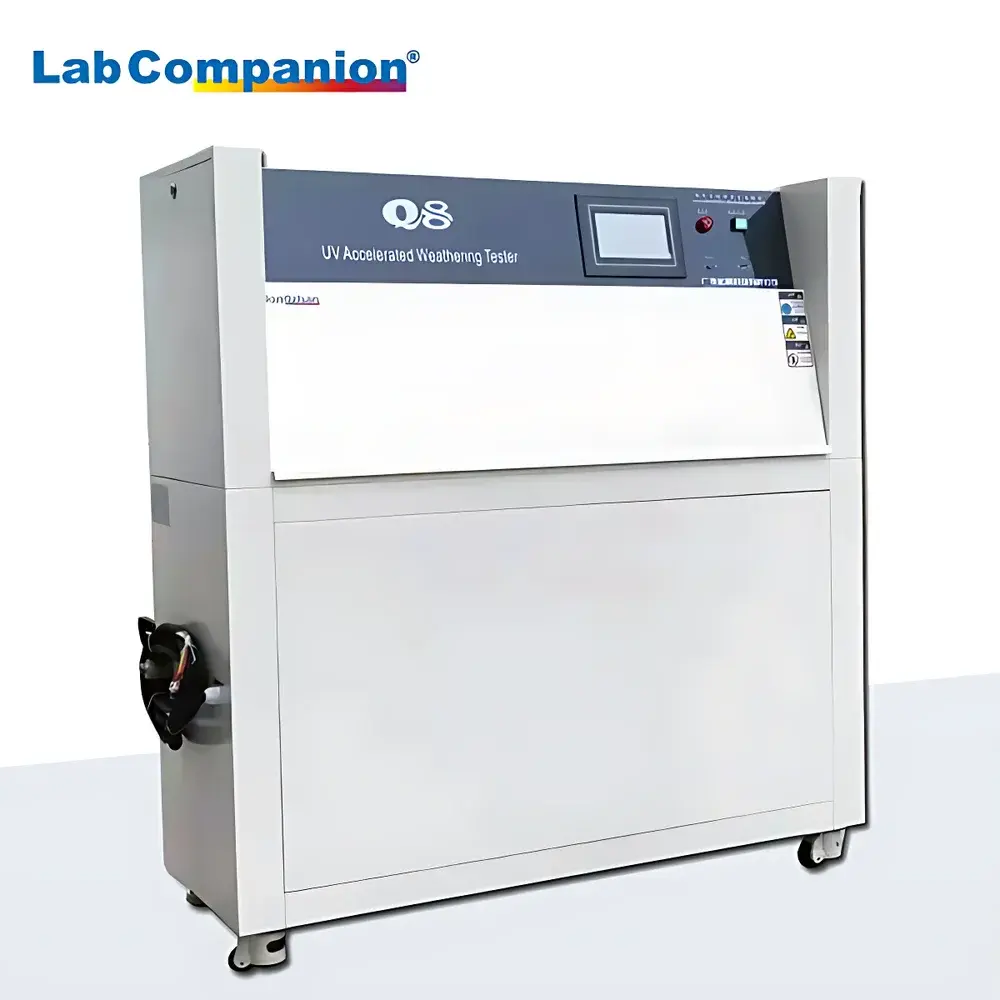
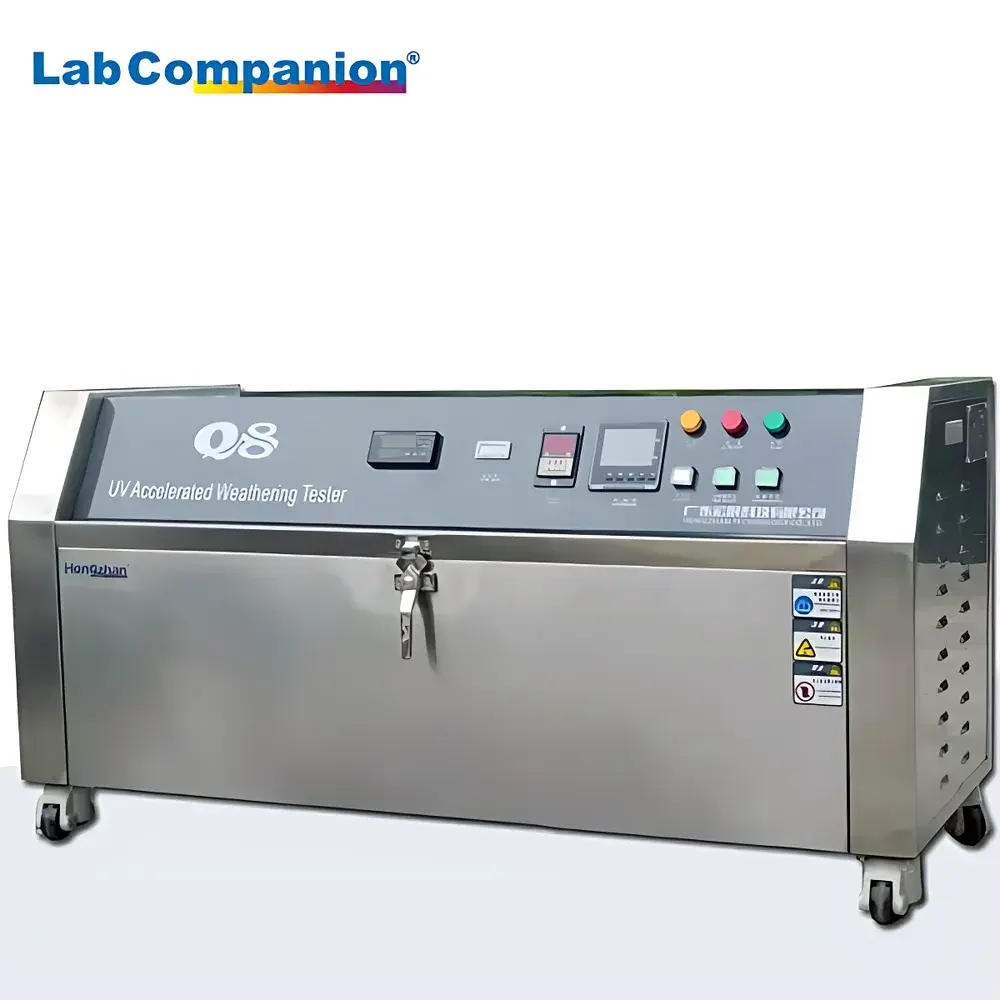
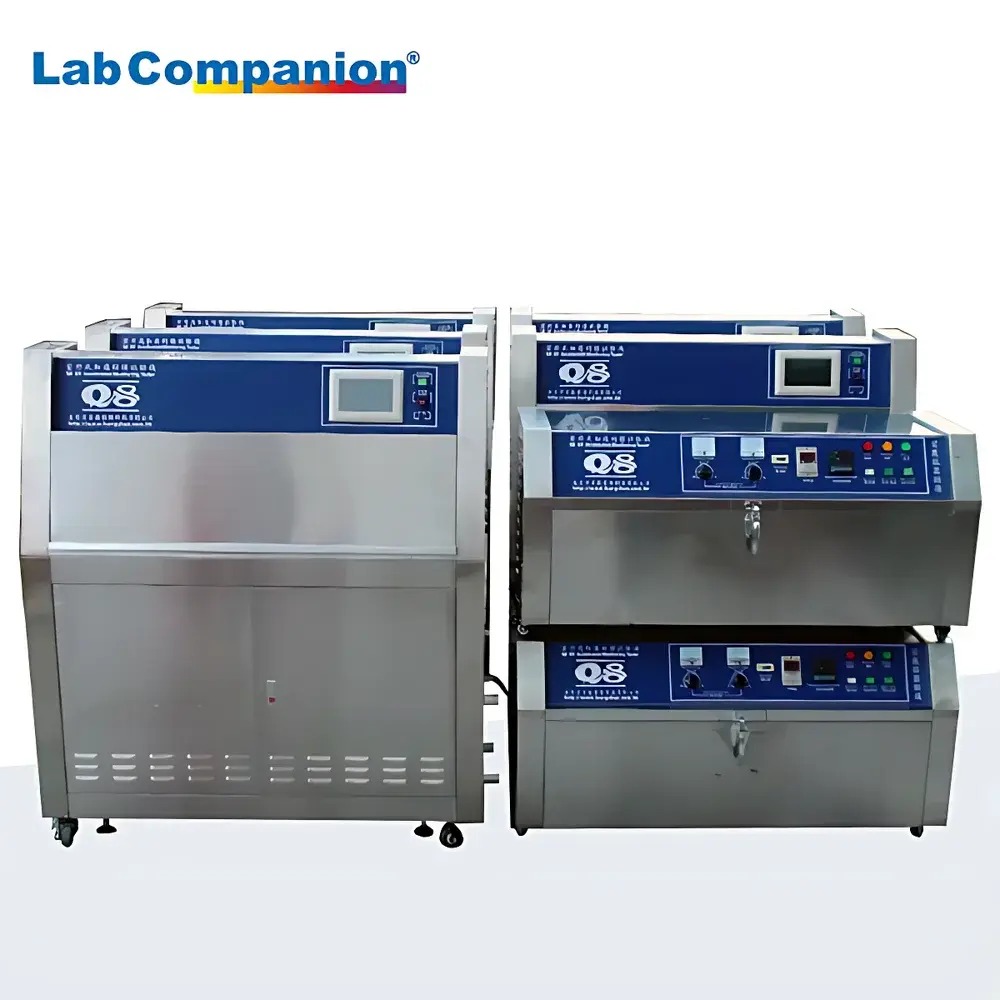
LabCompanion Q8-UV3 UV Weathering Test Chamber
| Brand | LabCompanion |
|---|---|
| Origin | Guangdong, China |
| Manufacturer Type | Direct Manufacturer |
| Model | Q8-UV3 |
| Test Duration | 1–9999 h (adjustable) |
| Irradiance Range | ≤1.0 W/m² @ 340 nm (adjustable) |
| Lamp Power | 40 W per lamp |
| Humidity Range | ≥95 %RH |
| Light Exposure Temperature Range | 40–60 °C |
| Black Panel Temperature Range | 50–70 °C |
| UV Wavelength Range | 290–400 nm |
| Chamber Internal Dimensions (L×W×H) | 48 specimen positions (75 mm × 150 mm each) |
Overview
The LabCompanion Q8-UV3 UV Weathering Test Chamber is an engineered solution for accelerated ultraviolet (UV) exposure testing of polymeric materials, coatings, inks, adhesives, and automotive interior/exterior components. It operates on the principle of controlled UV irradiation—primarily using fluorescent UV lamps emitting in the critical 290–400 nm spectral range—to simulate short-term solar radiation damage mechanisms such as photo-oxidation, chalking, gloss loss, color fading, and embrittlement. Unlike full-spectrum xenon arc systems, the Q8-UV3 focuses on the most damaging UV-B and UV-A bands, enabling high reproducibility in comparative aging studies under standardized conditions aligned with ASTM G154, ISO 4892-3, and SAE J2020 protocols. Its design emphasizes thermal stability, uniform irradiance distribution across the specimen plane, and precise black panel temperature control—critical parameters for correlating laboratory results with real-world outdoor performance.
Key Features
- Configurable UV lamp array supporting UVA-340 (simulating solar UV below 365 nm), UVB-313 (enhanced short-wave UV for aggressive testing), and optional UVC-351 lamps—compatible with certified replacements from Q-Lab and Atlas Materials.
- Independent control of black panel temperature (50–70 °C) and chamber air temperature (40–60 °C), enabling decoupled thermal and photolytic stress application per test method requirements.
- High-fidelity irradiance regulation via digital feedback loop, maintaining ±5 % stability at setpoints of 1.0 W/m² @ 340 nm or 1.1 W/m² @ 313 nm—traceable to NIST-traceable calibration standards.
- Condensation humidity system delivering ≥95 %RH via heated water reservoir; supports daily operation with ~8 L of distilled or deionized water.
- Integrated spray function (optional on Q8-UV3 configuration) providing cyclic water exposure at 7 L/min flow rate—enabling combined UV/water immersion cycles per ASTM D4329 or ISO 4892-3 Annex A.
- Rugged stainless-steel interior chamber with quartz-filtered UV-transparent viewing window and interlocked safety cutoff for lamp access.
Sample Compatibility & Compliance
The Q8-UV3 accommodates up to 48 flat specimens (75 mm × 150 mm each) mounted on standardized aluminum sample holders. Specimen geometry, thickness, and substrate compatibility are validated per ISO 11341 and ASTM D2565 guidelines. All operational parameters—including irradiance intensity, temperature ramp profiles, condensation duration, and spray timing—are programmable to meet GLP-compliant test execution. The system supports audit-ready documentation when paired with optional data logging accessories (e.g., irradiance meter, dual-channel temperature/humidity recorder). Regulatory alignment includes conformance with FDA 21 CFR Part 11 data integrity principles when used with compliant software extensions, and full traceability to ISO/IEC 17025-accredited calibration practices for irradiance sensors.
Software & Data Management
The Q8-UV3 operates via a front-panel touch interface with embedded microcontroller logic—no external PC required for basic operation. Optional Ethernet-enabled controller modules allow remote monitoring, real-time parameter logging, and export of CSV-formatted datasets timestamped to UTC. Firmware supports user-defined test sequences with up to 100 step segments, including conditional branching based on elapsed time or accumulated radiant exposure (kJ/m²). Audit trails record operator ID, parameter changes, alarm events, and lamp usage hours—meeting minimum requirements for GMP and ISO 9001 quality system documentation. Calibration certificates for irradiance sensors and temperature probes are supplied with initial commissioning and recommended annually.
Applications
- Automotive OEM validation of dashboard plastics, sealants, and exterior trim against ISO 11338 and GMW14124.
- Coatings industry qualification of architectural paints per ASTM D4587 and EN 927-6.
- Photovoltaic module backsheet durability assessment per IEC 61215-2 MQT10.
- Medical device packaging stability testing under ISO 11607-1 accelerated aging protocols.
- Academic research into polymer degradation kinetics, particularly for polyolefins, PVC, and fluoropolymers exposed to tropical or desert climatic simulations.
FAQ
What UV lamp types are supported, and how often do they require replacement?
The Q8-UV3 accepts UVA-340, UVB-313, and UVC-351 fluorescent lamps (40 W nominal). Typical service life is 1,600–2,000 hours at rated irradiance; automatic hour-meter tracking is built-in.
Is condensation cycle operation compatible with non-distilled water?
No. Only distilled or deionized water is permitted in the condensation reservoir to prevent mineral deposition on reflectors and sensor optics.
Can the Q8-UV3 be integrated into a centralized lab management system?
Yes—via Modbus TCP or optional RS-485 interface, enabling integration with LIMS or SCADA platforms for automated test initiation and status reporting.
Does the chamber meet IP rating or explosion-proof requirements?
The Q8-UV3 is rated for indoor laboratory use only (IP20). It is not designed for hazardous location deployment or Class I/II environments.
How is irradiance uniformity verified across the specimen plane?
Uniformity is validated during factory acceptance testing using a calibrated UV radiometer grid scan (per ASTM E2653), ensuring ±10 % deviation across all 48 specimen positions.



