
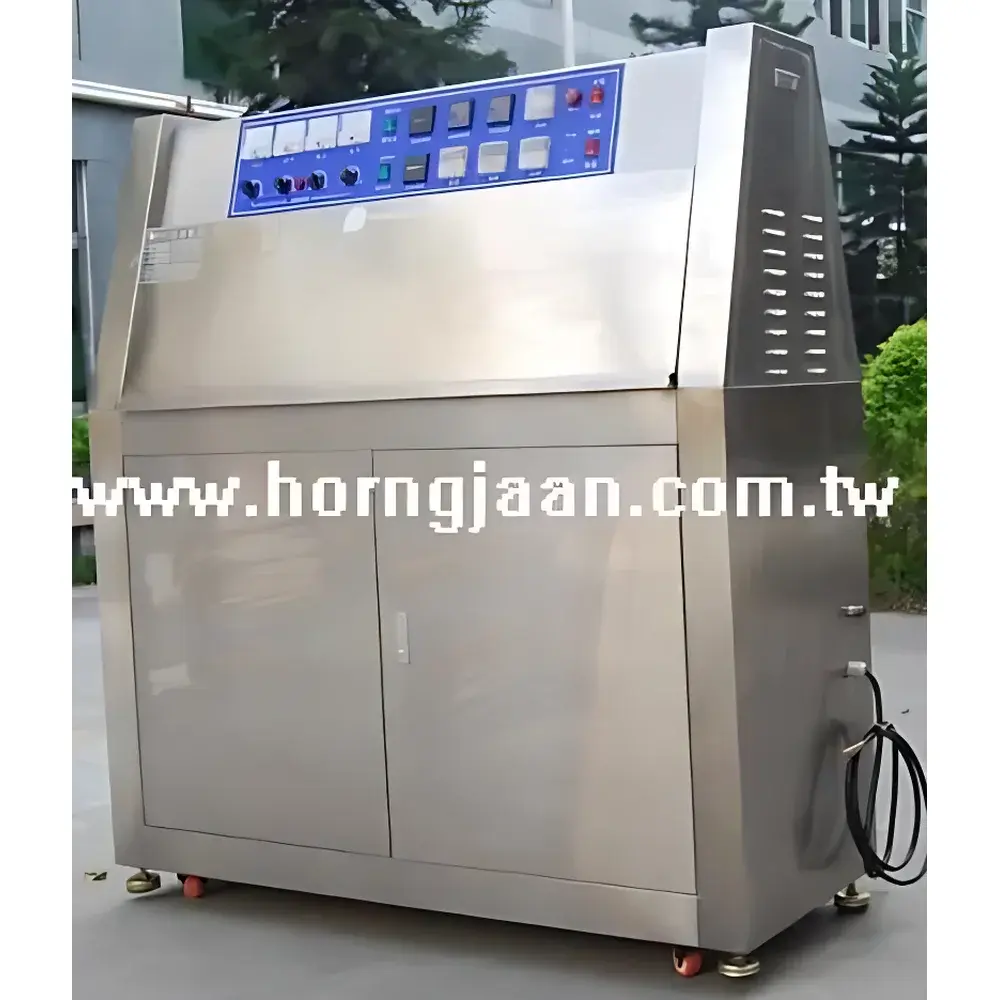
LabCompanion UV Series Accelerated Weathering Test Chamber
| Brand | LabCompanion |
|---|---|
| Origin | Guangdong, China |
| Manufacturer Type | OEM Manufacturer |
| Product Line | UV Series |
| Price | Upon Request |
| Temperature Range | RT+10 to 70 °C |
| Humidity Range | >90% RH |
| Sample-to-Lamp Distance | 50 ± 2 mm |
| Lamp Center-to-Center Spacing | 70 mm |
| Irradiance | UVA-340 @ 0.68 W/m² (295–360 nm), UVB-313 @ 0.60 W/m² (280–315 nm) |
| Interior Dimensions | 1170 × 450 × 500 mm (W×D×H) |
| Exterior Dimensions | 1300 × 550 × 1380 mm (W×D×H) |
| Construction | Stainless Steel Interior & Exterior |
| Control System | Intelligent Digital PID Controller with AI Algorithm |
| Condensation Mechanism | Steam-Based Cold-Condensation Cycle |
| Compliance Standards | GB/T 16422.3–1997, ASTM G53–88, GB/T 14522–93 |
Overview
The LabCompanion UV Series Accelerated Weathering Test Chamber is an engineered solution for simulating the photochemical degradation effects of solar ultraviolet (UV) radiation under controlled environmental conditions. Unlike full-spectrum xenon arc or carbon arc systems, this chamber employs fluorescent UV lamps—specifically UVA-340 and UVB-313—to replicate the most damaging short-wavelength portion of terrestrial sunlight (280–360 nm). UV radiation constitutes only ~5% of total solar energy but drives >80% of polymer photodegradation due to its high photon energy and strong correlation with bond dissociation thresholds in organic matrices. The chamber integrates cyclic UV irradiation with condensation humidity exposure to accelerate failure modes including chalking, gloss loss, cracking, embrittlement, yellowing, and surface oxidation—enabling predictive lifetime assessment of plastics, coatings, elastomers, adhesives, and composite laminates.
Key Features
- Stainless steel construction (interior and exterior) ensures long-term corrosion resistance and compliance with ISO 9001 cleanroom-grade fabrication standards.
- Dual-lamp configuration support: Interchangeable UVA-340 (peak at 340 nm; optimal for realistic outdoor simulation) and UVB-313 (peak at 313 nm; for aggressive accelerated testing per ASTM G154 Annex A3).
- Precision-controlled condensation cycle: Saturated steam environment maintains >90% RH during dark phases, inducing surface dew formation via thermal gradient between hot humid air (front) and ambient-cooled backside—mimicking nocturnal dew deposition per ASTM D4329.
- Intelligent digital controller with auto-tuning PID and AI-based adaptive regulation, supporting programmable irradiance setpoints, ramp/soak profiles, and real-time deviation compensation.
- Optional UV irradiance sensor (calibrated traceable to NIST standards) enables closed-loop feedback control, automatic lamp-output compensation for aging, and audit-ready irradiance logging.
- Comprehensive safety architecture: Overtemperature cutoff, dry-run protection, ground fault interruption, overcurrent tripping, and audible/visual alarm with automatic power isolation.
Sample Compatibility & Compliance
The chamber accommodates flat-panel specimens up to 110 mm × 200 mm (standard frame capacity: 48 samples per cycle), with adjustable aluminum sample racks ensuring uniform 50 ± 2 mm lamp-to-specimen spacing. It meets the geometric and spectral requirements of multiple international test standards, including ASTM G53–88 (fluorescent UV–condensation apparatus), ISO 4892–3 (plastics—methods of exposure to laboratory light sources—part 3: fluorescent UV lamps), and GB/T 16422.3–1997 (Chinese national standard for plastic UV exposure testing). All configurations are validated for GLP-compliant data integrity when paired with optional irradiance monitoring and timestamped event logging.
Software & Data Management
Equipped with RS485/Modbus RTU interface and optional Ethernet connectivity, the system supports integration into centralized LIMS or MES platforms. Data export formats include CSV and XML, with embedded metadata covering irradiance history, temperature/humidity profiles, alarm timestamps, and lamp operational hours. Audit trail functionality complies with FDA 21 CFR Part 11 requirements when used with user-access-controlled authentication and electronic signature modules (available as add-on firmware). Calibration certificates for irradiance sensors are issued with NIST-traceable uncertainty statements (< ±3% k=2).
Applications
- Formulation development and comparative ranking of UV stabilizers in polyolefins, PVC, and engineering thermoplastics.
- Qualification of automotive interior trim materials per SAE J2020 and OEM-specific UV exposure protocols.
- Validation of aerospace sealants and optical coatings under simulated high-altitude UV intensities.
- Accelerated aging of medical device polymer housings per ISO 10993–12 biocompatibility guidance.
- Quality control screening of architectural coatings and roofing membranes against ASTM D4587.
FAQ
What is the difference between UVA-340 and UVB-313 lamp spectra?
UVA-340 lamps emit primarily within 295–360 nm, closely matching the solar UV cutoff at Earth’s surface; they are recommended for realistic outdoor durability prediction. UVB-313 lamps emit down to 280 nm, producing higher-energy photons that induce faster degradation—used when rapid screening or worst-case stress testing is required.
Can the chamber operate without condensation cycles?
Yes—user-defined test programs may disable the condensation phase and run UV-only exposure, though this deviates from standard weathering protocols such as ASTM G154 Cycle 1 and ISO 4892–3 Method A.
Is third-party calibration support available?
LabCompanion provides factory calibration services with ISO/IEC 17025-accredited partners; on-site verification and recalibration are offered globally under service contract agreements.
How often must UV lamps be replaced?
Lamp replacement interval is typically 1600–2000 hours of operation; the integrated controller tracks cumulative lamp hours and triggers maintenance alerts. Actual lifespan depends on irradiance setpoint and cycling frequency.
Does the system comply with FDA 21 CFR Part 11 for regulated environments?
Yes—when configured with optional 21 CFR Part 11 firmware package (including role-based access control, electronic signatures, and immutable audit logs), the system meets electronic record and signature requirements for pharmaceutical and medical device applications.



