
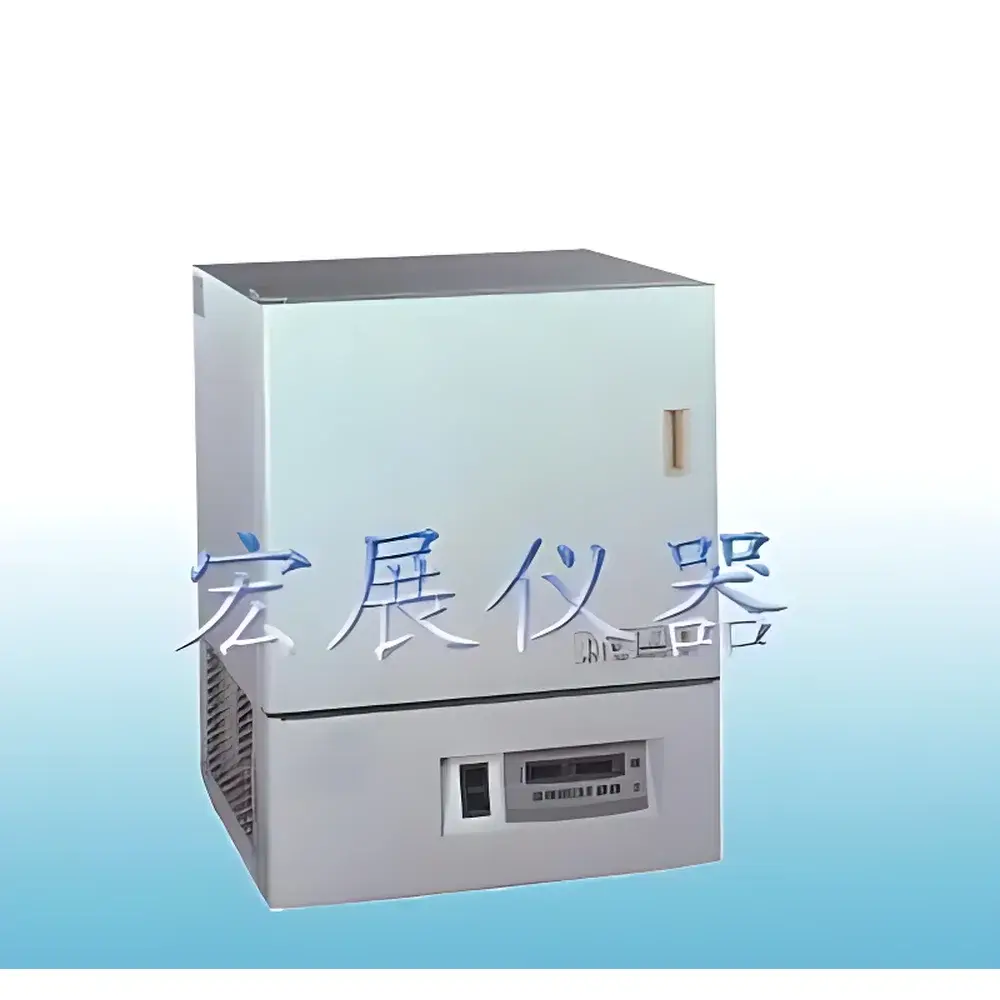
LabCompanion HH-72 Industrial Forced-Air Oven
| Brand | LabCompanion |
|---|---|
| Origin | Guangdong, China |
| Manufacturer Type | Direct Manufacturer |
| Country of Origin | China |
| Model | HH-72 |
| Voltage | 3-phase 380 VAC ±10% or 2-phase 220 VAC ±10% |
| Temperature Range | Ambient +5°C to 300°C (H-series) |
| Temperature Stability | ±1°C |
| Temperature Uniformity | ±1.5°C |
| Internal Chamber Dimensions (W×H×D) | 450×400×400 mm |
| External Dimensions | 610×905×575 mm |
| Insulation | High-efficiency compressed glass wool |
| Heating System | Finned tubular electric heaters |
| Air Circulation | Forced-air horizontal airflow with optimized outlet design |
| Safety Protection | Dual-stage overtemperature cutoff (alarm + power cutoff), MCCB overload protection, ceramic fuse, non-fuse circuit breaker, thermal self-tuning control |
| Control System | Microprocessor-based PID controller with setpoint/actual temperature dual display, auto-timer activation upon setpoint reach, audible alarm on timer completion |
| Accessories | 2–6 adjustable stainless steel shelves |
| Optional | Programmable controller (available as add-on) |
Overview
The LabCompanion HH-72 Industrial Forced-Air Oven is a precision-engineered thermal processing instrument designed for laboratory and pilot-scale applications requiring stable, uniform, and repeatable heating environments. Operating on the principle of forced convection, the oven utilizes a horizontally oriented, high-efficiency centrifugal blower system to circulate heated air across calibrated finned-tube heating elements and through a precisely engineered ducted outlet array. This architecture ensures minimal thermal stratification and achieves ±1.5°C temperature uniformity across the full working volume—critical for applications such as moisture loss determination (ASTM D229, ISO 758), polymer curing validation (ASTM D2570), residual solvent removal in pharmaceutical intermediates (ICH Q5C), and pre-conditioning of test specimens per ASTM D618. The unit complies with IEC 61010-1 safety standards for electrical equipment for measurement, control, and laboratory use, and its structural integrity supports GLP-compliant documentation workflows when integrated with external data loggers.
Key Features
- Microprocessor-based PID temperature controller with dual digital display (setpoint and real-time chamber temperature), intuitive up/down key parameter entry, and auto-tuning capability for optimal thermal response.
- Dual-stage overtemperature protection: Stage one triggers visual/audible alarm at user-defined threshold; stage two initiates immediate power cutoff via dedicated thermal cutout relay—fully independent of main control circuitry.
- High-density compressed glass wool insulation (≥80 mm thickness in side/wall panels) minimizes heat loss and enables rapid thermal recovery after door opening, verified per ISO 8503-2 thermal inertia testing protocols.
- Horizontally directed forced-air circulation system with asymmetric outlet geometry ensures laminar flow distribution and eliminates cold spots—validated by 9-point thermocouple mapping per ASTM E2207.
- Modular upright assembly with reinforced cold-rolled steel outer casing (powder-coated finish) and electropolished 304 stainless steel interior chamber (mirror-finish) for corrosion resistance and ease of decontamination.
- Integrated delayed fan shutdown function: blower continues operation for preset duration (0–30 min) after heating termination to dissipate residual chamber heat and prevent thermal shock to sensitive samples.
Sample Compatibility & Compliance
The HH-72 accommodates standard laboratory ware including porcelain crucibles, borosilicate glass Petri dishes, aluminum weighing pans, and polymer sample trays up to 450 mm width. Its chamber geometry permits simultaneous processing of multiple ASTM E145-compliant test specimens without inter-sample interference. All electrical components meet RoHS Directive 2011/65/EU requirements. The oven’s mechanical and thermal design aligns with EN 60529 (IP20 enclosure rating) and UL 61010-1 third-party certification prerequisites. While not inherently 21 CFR Part 11 compliant, audit-ready operation is achievable when paired with validated external electronic logging systems supporting ALCOA+ data integrity principles.
Software & Data Management
The base model operates via embedded firmware without proprietary software dependency. For traceable operation, optional programmable controller modules support RS-485 Modbus RTU communication, enabling integration into SCADA or LIMS platforms. Time-stamped event logs—including setpoint changes, overtemperature events, door-open intervals, and timer completions—can be exported via USB interface (optional module). Firmware supports configurable password-protected parameter locking to satisfy internal SOP requirements for operator-level access control.
Applications
- Moisture content analysis per AOAC 950.46 and USP <731> Loss on Drying procedures.
- Curing and post-cure thermal treatment of epoxy composites and adhesive bonds per MIL-STD-883 Method 2015.
- Pre-drying of filter media prior to gravimetric particulate matter collection (EPA Method 201A).
- Accelerated aging studies of packaging materials under controlled thermal stress (ASTM F1980).
- Conditioning of reference standards and calibration artifacts in metrology labs per ISO/IEC 17025 Clause 7.2.2.
- Stabilization of hygroscopic reagents and desiccant regeneration in analytical chemistry workflows.
FAQ
What is the maximum operating temperature of the HH-72 model?
The HH-72 is rated for continuous operation up to 300°C, consistent with H-series configuration per manufacturer specification.
Does the oven support validation protocols such as IQ/OQ?
Yes—the mechanical design, sensor layout, and control architecture are compatible with standard qualification protocols; users must perform site-specific protocol development and execution per Annex 15 of EU GMP Guidelines.
Can the internal chamber be customized for non-standard dimensions?
LabCompanion offers OEM engineering services for modified chamber volumes and mounting configurations, subject to structural feasibility review and extended lead time.
Is the temperature sensor calibrated to NIST-traceable standards?
The unit ships with factory-calibrated PT100 sensor; end-user calibration against NIST-traceable reference thermometers is required for regulated environments.
What maintenance intervals are recommended for optimal performance?
Blower motor lubrication every 12 months, glass wool integrity inspection every 24 months, and verification of overtemperature cutoff functionality prior to each new validation cycle.



