
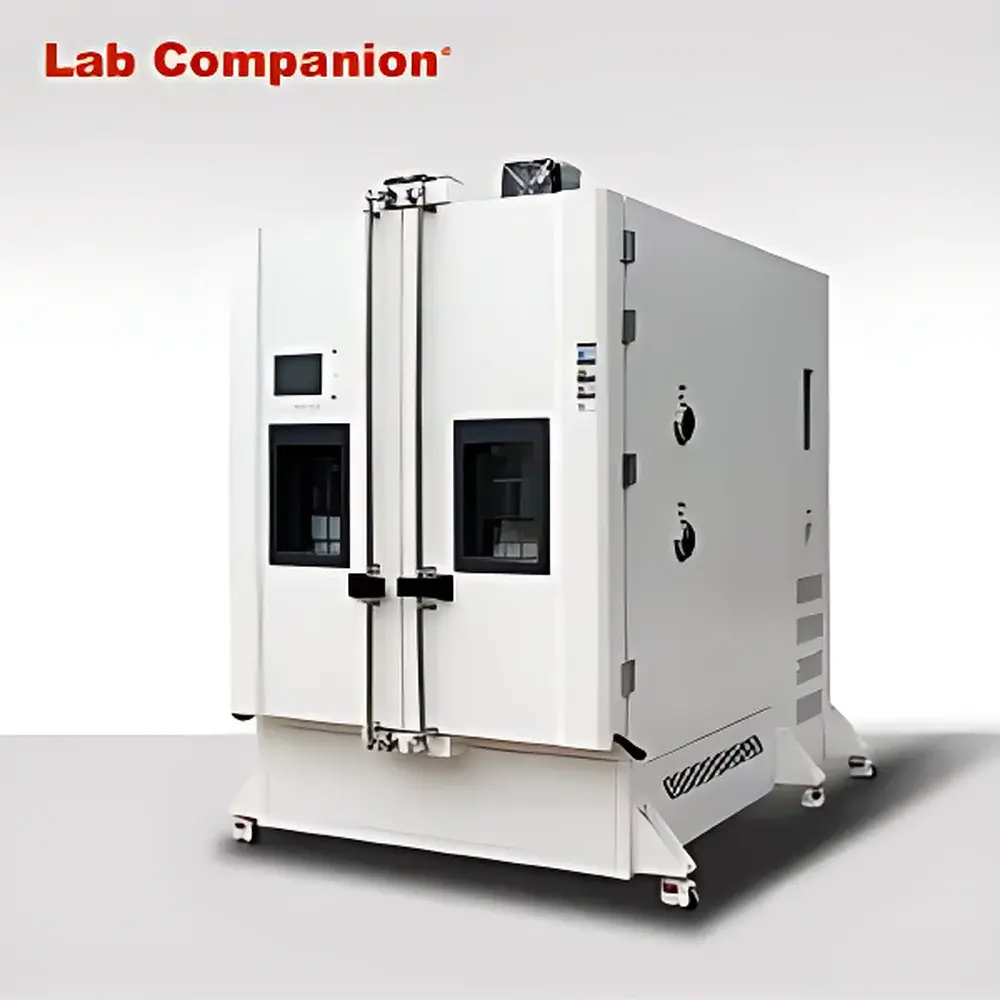
LabCompanion NC-OVEN Series Natural Convection Thermal Test Chamber
| Brand | LabCompanion |
|---|---|
| Origin | Guangdong, China |
| Manufacturer Type | Direct Manufacturer |
| Model | NC-OVEN Series |
| Temperature Uniformity (Natural Convection) | ≤ ±1.5°C (at steady state, per IEC 60068-2-2 / GB/T 2423.2) |
| Max Operating Temperature | 150°C |
| Temperature Resolution | 0.1°C |
| Data Logging Channels | ≥ 20 simultaneous thermocouple inputs |
| Supported Thermocouple Types | B, E, J, K, N, R, S, T |
| Control Interface | Touchscreen HMI with USB export |
| Software | LabCompanion TempTrack™ (multilingual: EN/zh-CN/zh-TW), Excel report generation, curve overlay & delta-T analysis |
| Compliance | IEC 60068-2-2, GB/T 2423.2-2008 (Clause 3.3.1), GB/T 2423.2-89 (3.1.1 & 3.3.1), ISO/IEC 17025-aligned validation support |
Overview
The LabCompanion NC-OVEN Series Natural Convection Thermal Test Chamber is an engineered environmental test system designed specifically to replicate *free-air thermal conditions*—without forced air circulation—for accurate thermal characterization of powered electronic devices. Unlike conventional forced-convection chambers or industrial ovens, the NC-OVEN eliminates internal fans, blowers, or airflow mechanisms, thereby eliminating convective heat transfer interference during operational testing. This architecture adheres strictly to the physical boundary conditions defined in IEC 60068-2-2 and GB/T 2423.2-2008 Clause 3.3.1 for “tests without forced air circulation.” It enables true thermal equilibrium assessment under natural convection, where heat dissipation occurs solely via conduction and radiation—mirroring real-world indoor usage environments such as living rooms, office spaces, or vehicle cabins. The chamber’s thermal mass, insulated cavity geometry, and precision PID-controlled heating elements are optimized to achieve ≤ ±1.5°C temperature uniformity across the working volume at steady state—verified per standardized sensor grid mapping protocols.
Key Features
- Zero-forced-air thermal environment: No internal fans, no airflow-induced cooling artifacts—ensuring measurement fidelity for powered DUTs (Devices Under Test).
- Integrated 20+ channel digital data logger with real-time synchronization: Simultaneously records chamber ambient gradients, surface temperatures at multiple DUT locations, and spatial average profiles.
- Multi-sensor thermocouple compatibility: Supports industry-standard types B, E, J, K, N, R, S, and T—enabling traceable calibration per ASTM E230 or IEC 60584.
- Embedded touchscreen HMI controller with on-screen multi-curve visualization: Displays up to 20 concurrent temperature traces with configurable time scales, alarms, and pass/fail thresholds.
- USB-based data export: All logged thermal profiles—including raw timestamped values and interpolated curves—can be saved directly to removable USB storage in CSV-compatible format.
- LabCompanion TempTrack™ software suite: Provides intuitive overlay analysis, ΔT (delta-temperature) calculation between reference and DUT points, thermal stabilization detection algorithms, and automated Excel report generation compliant with internal QA documentation requirements.
- Tri-lingual interface support: English, Simplified Chinese, and Traditional Chinese—facilitating global lab deployment and cross-regional technical collaboration.
- Scalable thermal ramping architecture: Optional high-power heater modules and adaptive control tuning allow acceleration of heating rates while maintaining stability margins within ±0.5°C/min per GB/T 2423.2-89 Section 3.3.1(d).
Sample Compatibility & Compliance
The NC-OVEN Series accommodates a wide range of powered electronic assemblies—from large-format consumer displays (e.g., 85″ LCD/LED TVs) and desktop computing systems to automotive infotainment units and embedded audio/video receivers. Its open-chamber layout and modular mounting rails permit flexible DUT positioning without obstructing natural buoyancy-driven airflow. All thermal test procedures align with internationally recognized standards governing non-forced-air thermal testing: IEC 60068-2-2 (Test B: Dry Heat), GB/T 2423.2-2008 (High Temperature Test, Clause 3.3.1), and legacy GB/T 2423.2-89 definitions for “heat-dissipating” vs. “non-heat-dissipating” specimens. For regulatory submissions, the system supports IQ/OQ documentation packages and provides audit-ready data logs with embedded timestamps, operator ID fields, and version-controlled firmware metadata—compatible with GLP and GMP-aligned quality management systems requiring 21 CFR Part 11–compliant electronic records.
Software & Data Management
LabCompanion TempTrack™ is a Windows-based analysis platform built for engineering-grade thermal validation workflows. It ingests native .csv exports from the chamber controller and reconstructs synchronized multi-channel timelines with sub-second interpolation. Users can define custom thermal metrics—including time-to-stabilization, peak ΔT between hot-spot and ambient, and rate-of-change thresholds—and generate annotated comparative reports across test runs. The software enforces data integrity through SHA-256 hash verification of imported files and maintains immutable audit trails for all user-initiated actions (e.g., curve annotation, report export, parameter modification). Export formats include Excel (.xlsx) with formula-locked summary tabs, PDF with embedded metadata, and XML for integration into LIMS or PLM platforms. Firmware updates are digitally signed and delivered via secure HTTPS channels—ensuring chain-of-custody continuity throughout the instrument lifecycle.
Applications
- Thermal validation of heat-dissipating consumer electronics under realistic static-air conditions (e.g., thermal derating analysis for gaming consoles, AV receivers, and smart home hubs).
- Verification of thermal management design in automotive ECUs and display modules prior to climatic chamber integration.
- Stability testing of optical components (e.g., laser diodes, camera sensors) sensitive to forced-air-induced micro-vibrations or localized cooling.
- Material aging studies where convective drying or oxidation must be excluded—such as polymer encapsulant reliability or conformal coating performance evaluation.
- Calibration reference environments for contact thermometry labs requiring low-turbulence, high-uniformity thermal sinks.
- Academic research in natural convection heat transfer modeling—providing empirical boundary condition datasets for CFD validation.
FAQ
What distinguishes natural convection testing from forced-air thermal testing?
Natural convection relies exclusively on buoyancy-driven air movement, eliminating fan-induced cooling artifacts that distort surface temperature measurements on powered devices. This reflects actual end-use conditions where airflow is absent.
How is temperature uniformity verified in the NC-OVEN chamber?
Uniformity is validated using a 9-point thermocouple grid per IEC 60068-2-2 Annex B, with measurements taken at steady state after 30 minutes of thermal soak. Deviation is reported as maximum deviation from chamber setpoint.
Can the system support thermocouples with cold-junction compensation?
Yes—the integrated data logger includes hardware-level CJC referenced to a calibrated internal sensor, ensuring accuracy per ASTM E220 for Type K and other supported thermocouple families.
Is the TempTrack™ software qualified for regulated environments?
While not pre-certified, the software architecture supports 21 CFR Part 11 compliance when deployed with organizational controls (e.g., role-based access, electronic signatures, and audit log retention policies). Validation protocols are provided upon request.
What is the maximum recommended DUT power load inside the chamber?
For optimal thermal stability, total continuous DUT power dissipation should remain below 300 W. Higher loads require optional thermal mass augmentation and extended stabilization periods—details available in Application Note AN-NC-004.



