
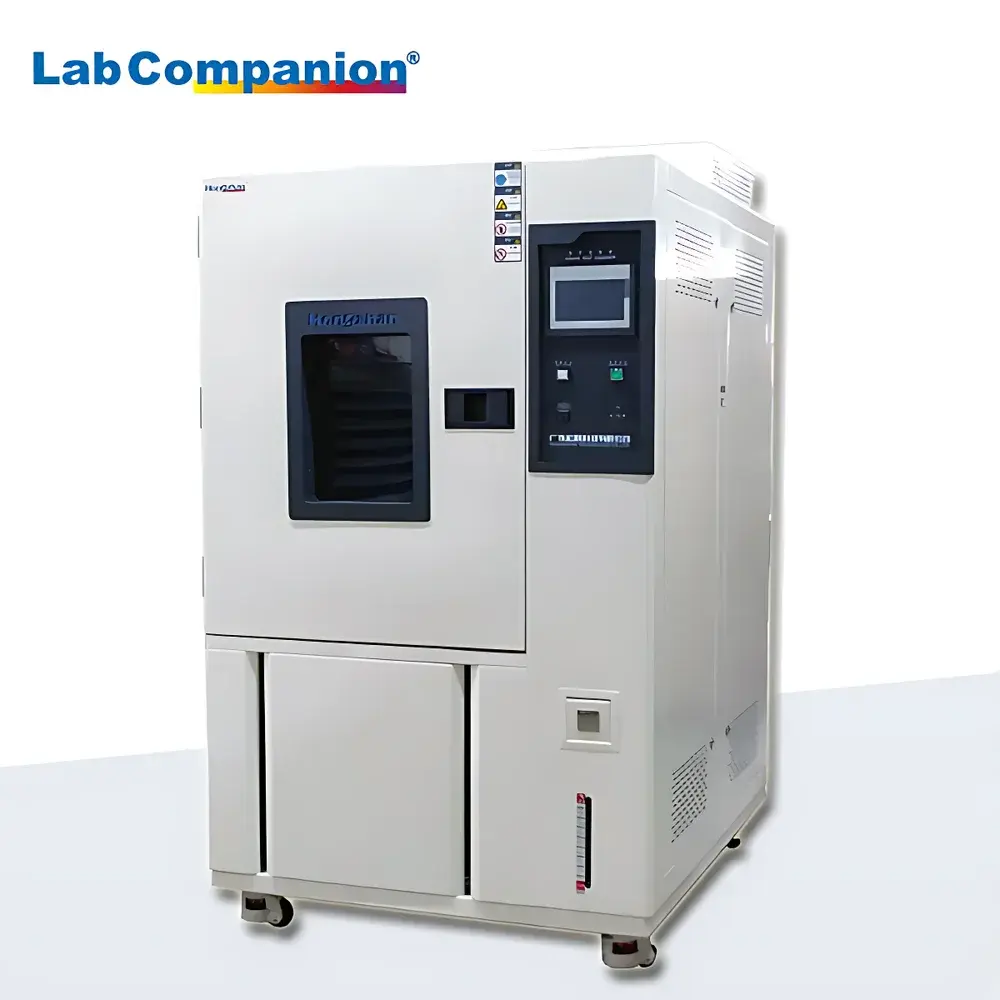
LabCompanion Q8-SUN-225 Xenon Arc Weathering Test Chamber
| Brand | LabCompanion |
|---|---|
| Origin | Guangdong, China |
| Manufacturer Type | OEM Manufacturer |
| Country of Origin | China |
| Model | Q8-SUN-225 |
| Xenon Lamp Power | 1.8 kW × 3 = 5.4 kW |
| Irradiance | 60 W/m² (290–800 nm) |
| Light Exposure Cycle | 1–999 h/min/sec |
| Humidity Range | 20–90% RH |
| Temperature Range | RT+10°C to 80°C |
| Black Panel Temperature | 63–100°C ±3°C |
| Temperature Uniformity | ≤ ±2.0°C |
| Temperature Stability | ≤ ±0.5°C |
| Xenon Lamps | 3 × imported air-cooled lamps (Q-Lab, USA) |
| Filter System | Triple-layer borosilicate glass filters |
| Rain Simulation | continuous/intermittent |
| Spray Pressure | 0.12–0.15 MPa |
| Nozzle Orifice | Ø0.8 mm |
| Sample Tray Dimensions | 450 × 720 mm |
| Lamp-to-Specimen Distance | 230–280 mm |
| UV Irradiance (290–400 nm) | ≤130 W/m² (average) |
Overview
The LabCompanion Q8-SUN-225 Xenon Arc Weathering Test Chamber is an engineered environmental simulation system designed to replicate the full-spectrum solar irradiation, thermal cycling, and moisture exposure conditions encountered in real-world outdoor service environments. It employs three high-intensity, air-cooled xenon arc lamps—sourced from Q-Lab (USA)—to deliver spectrally stabilized light output across 290–800 nm, closely matching terrestrial sunlight when filtered through standard borosilicate glass optics. This spectral fidelity enables accurate acceleration of photodegradation, color fading, chalking, cracking, and polymer embrittlement mechanisms per ASTM G155, ISO 4892-2, and SAE J2527 protocols. The chamber integrates precise black panel temperature control (63–100°C ±3°C), programmable humidity regulation (20–90% RH), and calibrated irradiance monitoring (60 W/m² nominal, adjustable up to 130 W/m² in UV band), ensuring reproducible test conditions essential for comparative material qualification and regulatory compliance.
Key Features
- Triple-lamp xenon arc source with Q-Lab-certified air-cooled lamps, delivering high radiometric stability and extended operational lifetime
- Triple-stage borosilicate glass filter system to simulate daylight through window glass (Daylight-Q/B) or direct outdoor exposure (Direct Sun-Q/B)
- Black panel temperature sensor with PID-controlled heating and active cooling, maintaining ±3°C accuracy across 63–100°C range
- Integrated rain simulation subsystem with independently programmable continuous or cyclic spray modes (0–9999 min duration; 0–240 min cycle; 18/102 min ON/OFF default)
- Precision humidity control via steam-based humidification (0.75 kW) and refrigerated dehumidification, achieving stable 20–90% RH at operating temperatures
- Robust stainless-steel interior chamber with insulated double-wall construction, minimizing thermal leakage and improving energy efficiency
- Intuitive 7-inch TFT touchscreen controller supporting multi-step profile programming, real-time parameter logging, and USB data export
Sample Compatibility & Compliance
The Q8-SUN-225 accommodates flat-panel specimens up to 450 × 720 mm on a motorized, height-adjustable sample tray (lamp-to-specimen distance: 230–280 mm). Its modular sample holder design supports standardized specimen racks per ASTM D7869 and ISO 11341. All critical performance parameters—including irradiance uniformity (±10% over test area), temperature uniformity (≤ ±2.0°C), and humidity stability (±3% RH)—are verified against traceable NIST-traceable calibration standards. The system meets functional requirements for GLP-compliant laboratories and supports audit-ready documentation including electronic log files, calibration certificates, and deviation reports. It is compatible with FDA 21 CFR Part 11-compliant software extensions for electronic signatures and audit trails when integrated with LabCompanion’s optional LMS-Cloud platform.
Software & Data Management
The embedded controller firmware supports ISO/IEC 17025-aligned data integrity practices, including time-stamped event logging, password-protected parameter modification, and automatic backup of test profiles and runtime data to internal flash memory and external USB drives. Optional Ethernet connectivity enables remote monitoring via Modbus TCP or HTTP API, allowing integration into centralized laboratory information management systems (LIMS). Exported CSV logs include timestamped irradiance (W/m²), black panel temperature (°C), chamber humidity (% RH), spray status, and lamp operating hours—structured for statistical process control (SPC) analysis and accelerated life modeling per IEC 60068-2-5 and MIL-STD-810H Annex G.
Applications
- Automotive exterior materials: paint systems, plastic trim, headlamp lenses, sealants, and adhesives per SAE J2412 and GMW14124
- Architectural coatings and roofing membranes tested under ASTM D4798 and EN 13523-19
- Textile and synthetic fiber degradation studies per AATCC TM16 and ISO 105-B02
- Photovoltaic encapsulant and backsheet durability assessment per IEC 61215-2 MQT10
- Medical device packaging validation per ISO 11607-1 accelerated aging protocols
- Quality assurance of consumer electronics housings, signage, and outdoor furniture components
FAQ
What spectral range does the Q8-SUN-225 replicate, and how is it filtered?
The system emits broadband radiation from 290 to 800 nm. Standard triple-layer borosilicate glass filters attenuate short-wave UV (800 nm), yielding a spectrum aligned with CIE No. 85 and ISO 4892-2 Daylight-Q/B reference.
Can irradiance be adjusted during a test cycle?
Yes—the controller supports dynamic irradiance ramping and stepwise setpoint changes within the 60–130 W/m² (290–400 nm) range, enabling multi-phase exposure profiles such as low-dose preconditioning followed by high-intensity stress.
Is rain simulation synchronized with light/dark cycles?
Absolutely. Spray timing is fully decoupled from illumination control, permitting independent scheduling of wet/dry phases relative to UV exposure, thermal soak, and dark recovery periods.
How is lamp aging compensated for during long-term tests?
The system includes closed-loop irradiance feedback using a calibrated silicon photodiode sensor. Automatic power modulation maintains target irradiance throughout lamp life, eliminating manual recalibration between test runs.
Does the chamber support third-party calibration services?
Yes—LabCompanion provides factory calibration certificates (traceable to NIST) and partners with ISO/IEC 17025-accredited calibration labs for on-site verification of irradiance, temperature, and humidity sensors.



