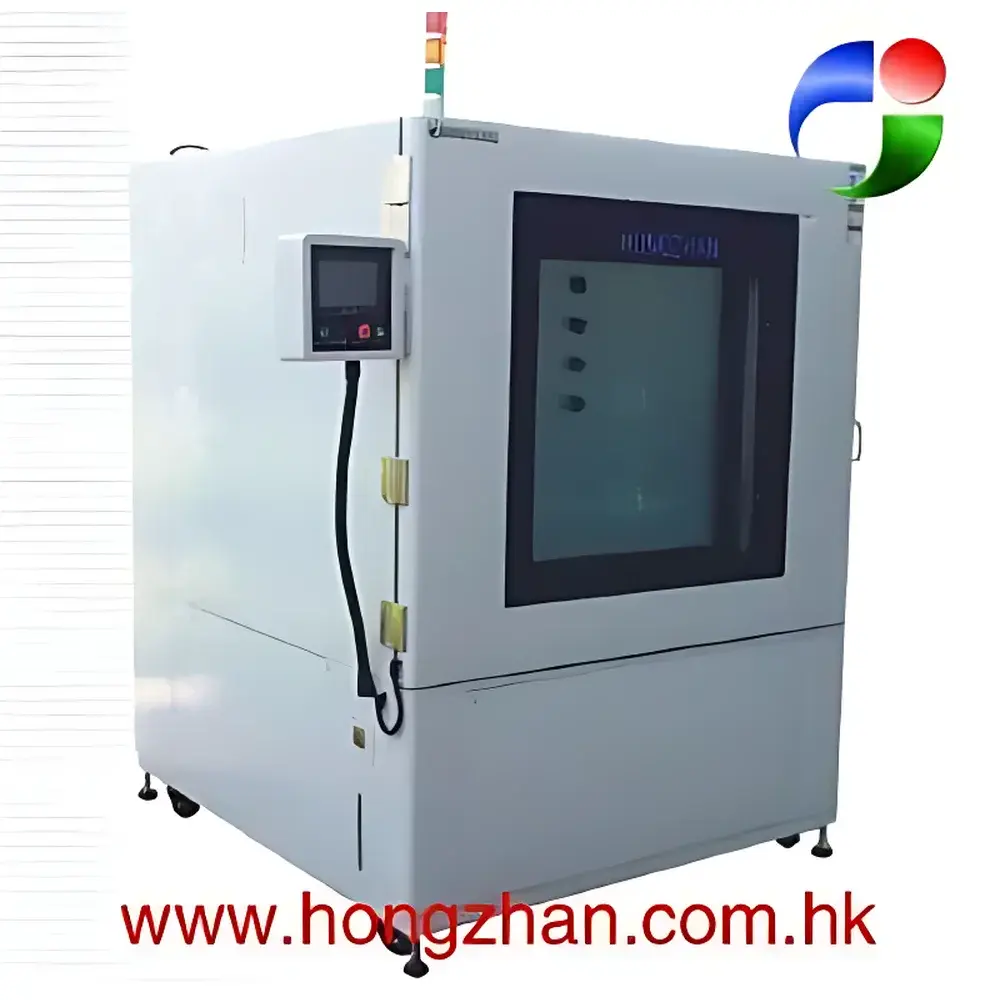
LabCompanion LCD Series Environmental Test Chamber for Temperature and Humidity Cycling (Patented Design)
| Brand | LabCompanion (Hongzhan) |
|---|---|
| Origin | Guangdong, China |
| Manufacturer Type | OEM/ODM Manufacturer |
| Country of Origin | China |
| Model | LCD Series |
| Price | Upon Request |
| Temperature Range | −40 °C to +100 °C |
| Humidity Range | 20–98 %RH |
| Temperature Uniformity | ±1 °C |
| Humidity Uniformity | ±5 %RH |
| Door Configuration | Dual-front & dual-rear access doors |
| Viewing Window | 72 cm (W) × 152 cm (H), double-sided, anti-fog coated |
| Sample Mounting | Adjustable-angle LCD fixture (10″, 18″, 20″, 30″ |
| tilt angles | 0°, 30°, 45°, 60°) |
| Controller | Q8-901 Korean-imported color touchscreen PID controller with English/Chinese/Korean UI |
| Communication Interfaces | RS-232 & RS-485 (multi-unit daisy-chain capable) |
| Optional Data Logger | 256 MB CF card module with user-defined logging interval |
| Power & Safety Interlock | Integrated power supply interface with interlocked safety cutoff for DUT |
Overview
The LabCompanion LCD Series Environmental Test Chamber is a patented, purpose-engineered climatic chamber designed specifically for reliability validation and qualification testing of flat-panel display (FPD) modules under controlled temperature and humidity cycling conditions. It operates on the principle of forced-air convection combined with precision steam-based humidification and refrigerant-driven cooling, enabling stable and repeatable simulation of real-world environmental stress profiles across wide operational ranges. This system meets the stringent thermal and hygroscopic test requirements defined in industry standards including IEC 60068-2-1 (cold), IEC 60068-2-2 (dry heat), IEC 60068-2-30 (damp heat, cyclic), and JEDEC JESD22-A104 for display subassemblies. Its architecture supports both development-stage parametric evaluation and production-line quality assurance workflows for TFT-LCD panels, LCM modules, OLED emitters, LTPS backplanes, and PDP components.
Key Features
- Patented dual-access chamber design with front-and-rear hinged doors for seamless integration into inline FPD handling systems and ergonomic operator access.
- Large-format, double-sided observation windows (72 cm × 152 cm) featuring anti-fog optical coating—eliminating mechanical wipers and ensuring uninterrupted visual monitoring during extended test cycles.
- Modular, angle-adjustable LCD mounting fixtures accommodating standard panel sizes (10″–30″ diagonal) and configurable tilt angles (0°, 30°, 45°, 60°) to replicate installation-specific thermal gradients and condensation pathways.
- Q8-901 microprocessor-based controller with 7-inch full-color touchscreen, supporting multilingual UI (English, Chinese, Korean), built-in PID auto-tuning, fuzzy logic compensation, and ARW (anti-reset-windup) functionality for minimized overshoot during setpoint transitions.
- Dual-standard serial interfaces (RS-232 and RS-485) enabling simultaneous local operation and centralized PC-based supervision across up to 99 interconnected units—ideal for lab-scale multi-chamber validation or factory-floor fleet management.
- Integrated DUT power interlock circuitry that synchronizes chamber safety shutdown with external power supply status, preventing uncontrolled thermal exposure during unexpected power loss or device failure.
- Automated water replenishment system with level-sensing reservoir and low-maintenance steam generator—ensuring consistent RH delivery without manual intervention over multi-day tests.
Sample Compatibility & Compliance
The LCD Series chamber accommodates rigid and semi-flexible flat-panel substrates up to 30 inches diagonally, including glass-based TFT arrays, polymer-encapsulated OLEDs, and metal-backed LCM assemblies. Fixture adaptability allows vertical, horizontal, and angled orientation to simulate end-use mounting configurations. All internal surfaces are constructed from electropolished stainless steel (SUS304) with non-outgassing silicone gaskets, satisfying cleanroom-compatible material requirements per ISO 14644-1 Class 8. The system supports traceable calibration per ISO/IEC 17025-accredited protocols and provides audit-ready event logs compliant with GLP and GMP documentation practices. Optional CF-card data logging enables long-term trend analysis aligned with FDA 21 CFR Part 11 electronic record integrity guidelines when paired with validated software.
Software & Data Management
While the Q8-901 controller delivers standalone operation, its embedded communication stack supports bidirectional data exchange via Modbus RTU over RS-485. Third-party SCADA platforms or custom Python/Node-RED applications can poll real-time PV/SV values, alarm states, and cycle progress. The optional 256 MB CF module records timestamped temperature/humidity profiles at user-defined intervals (1 s to 24 h), storing up to 30 days of continuous data. Logged files export in CSV format for post-processing in MATLAB, JMP, or Minitab. Built-in curve visualization displays up to 8 days of historical PV trends directly on the controller screen—facilitating rapid diagnosis of thermal lag or humidity recovery anomalies without external tools.
Applications
- Qualification testing of TFT-LCD and LCM modules per AEC-Q200 stress categories for automotive infotainment systems.
- Humidity-induced defect screening in OLED encapsulation layers under 85 °C / 85 %RH accelerated aging protocols.
- Thermal shock evaluation of LTPS driver IC solder joints using −40 °C ↔ +100 °C ramp rates of 5 K/min.
- Condensation resistance validation of touch-integrated display stacks during rapid cooldown from high-RH ambient conditions.
- Process window definition for moisture-sensitive adhesive curing steps in display module assembly lines.
- Pre-compliance verification prior to formal submission to UL, TÜV Rheinland, or SGS for IEC 60950-1 or IEC 62368-1 certification.
FAQ
What display panel sizes and orientations does the LCD Series support?
Standard fixtures accommodate 10″, 18″, 20″, and 30″ diagonal panels with adjustable tilt angles of 0°, 30°, 45°, and 60°—configurable to match vehicle dashboards, medical monitors, or industrial HMI layouts.
Is the chamber compatible with automated test systems?
Yes—the RS-485 interface supports Modbus RTU protocol and daisy-chain topology for integration into PLC-controlled test cells or MES-managed validation workflows.
How is humidity controlled and maintained at low temperatures?
A dedicated steam-humidification system with PID-regulated boiler output ensures stable RH generation down to −20 °C; below this, dehumidification is achieved via cold-wall condensation with reheating compensation to maintain target setpoints.
Can test profiles be exported and reloaded?
Yes—cycle programs (including ramp/soak sequences, dwell times, and RH transitions) are saved as .PRG files on USB or CF card and can be duplicated across multiple units for cross-lab reproducibility.
Does the system include calibration documentation?
Each unit ships with a factory-as-found calibration report referencing NIST-traceable standards; optional annual recalibration services are available with ISO/IEC 17025-certified certificates.