
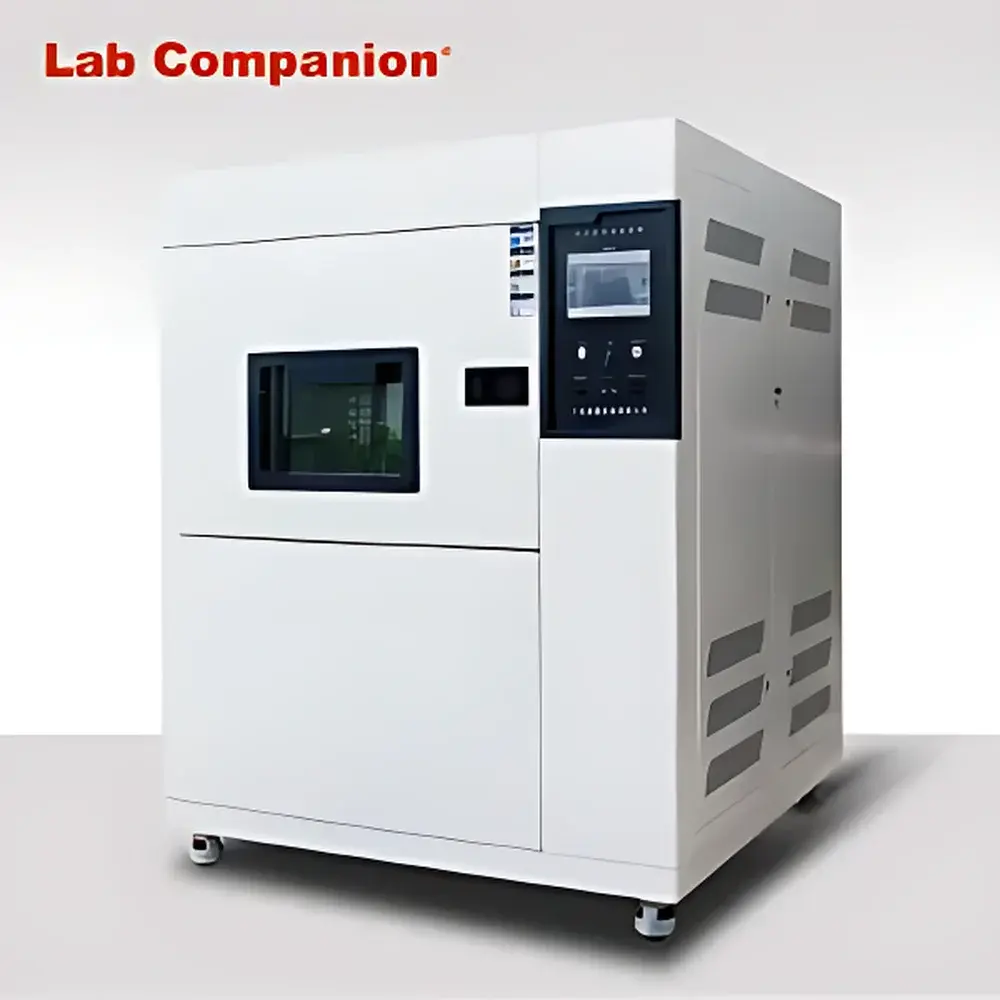
LabCompanion TSC-3 Triple-Chamber Thermal Shock Test Chamber
| Brand | LabCompanion |
|---|---|
| Origin | Guangdong, China |
| Manufacturer Type | Direct Manufacturer |
| Product Category | Domestic |
| Model | TSC-3 Triple-Chamber Thermal Shock Test Chamber |
| High-Temperature Range | +150 °C |
| Low-Temperature Range | −65 °C |
| Thermal Shock Range | −65 °C to +150 °C |
| Heating Rate | +60 °C to +200 °C ≤ 20 min |
| Cooling Rate | +20 °C to −75 °C ≤ 60 min |
Overview
The LabCompanion TSC-3 Triple-Chamber Thermal Shock Test Chamber is an engineered solution for accelerated reliability assessment of electronic components, aerospace materials, automotive assemblies, and polymer-based products subjected to rapid and extreme temperature transitions. Unlike single- or dual-chamber thermal shock systems, the TSC-3 employs a true triple-zone architecture—comprising independent high-temperature, low-temperature, and test chambers—enabling precise, repeatable, and contamination-free thermal cycling without mechanical movement of the test specimen. This design eliminates thermal lag associated with basket-transfer mechanisms and ensures consistent exposure profiles per IEC 60068-2-14, MIL-STD-810H Method 503.7, and JESD22-A104E. The chamber’s core function is to quantify material integrity, solder joint fatigue, delamination resistance, and seal performance under abrupt thermal stress, supporting qualification testing in R&D labs, quality assurance departments, and third-party certification facilities.
Key Features
- Triple-chamber configuration with physically isolated hot, cold, and ambient test zones—no specimen transfer required during cycling
- Independent PID-controlled temperature regulation in each chamber, ensuring stability within ±0.5 °C at setpoint under load
- High-efficiency cascade refrigeration system with environmentally compliant R404A/R23 mixed-refrigerant circuit for sustained −65 °C operation
- Electric heating elements with over-temperature cut-off and redundant safety interlocks compliant with IEC 61000-6-2/6-4 EMC requirements
- Stainless steel 304 interior construction with welded seams and non-outgassing insulation to prevent condensation-induced corrosion
- Integrated real-time monitoring of chamber pressure differentials and dew point to minimize moisture ingress during ultra-low temperature phases
Sample Compatibility & Compliance
The TSC-3 accommodates standard test specimens up to 500 mm × 500 mm × 500 mm (W×D×H) with optional custom chamber liners for non-standard geometries. It supports both powered and unpowered device-under-test (DUT) configurations, including PCBs with active thermal management, encapsulated sensors, and hermetically sealed modules. All operational modes—including step-stress, ramp-and-soak, and programmable dwell sequences—are traceable to NIST-traceable reference thermocouples installed per ASTM E220 and calibrated annually. The system meets ISO/IEC 17025 requirements for test equipment validation and includes documentation packages aligned with GLP and GMP audit trails. Full compliance with RoHS 2011/65/EU and REACH Annex XVII is verified through material declarations from component suppliers.
Software & Data Management
Equipped with LabCompanion’s TC-Manager v4.2 control software, the TSC-3 delivers deterministic test sequencing, multi-channel data logging at 1 Hz resolution, and automated report generation in PDF/CSV formats. The interface supports user-defined alarm thresholds, event-triggered data capture (e.g., door open, compressor fault), and password-protected access levels conforming to FDA 21 CFR Part 11 requirements—including electronic signatures, audit trail retention (>18 months), and immutable record archiving. Remote monitoring via Ethernet/IP or optional LTE module enables real-time status viewing and emergency intervention without local presence. Data export protocols include OPC UA and Modbus TCP for integration into enterprise MES/QMS platforms such as Siemens Opcenter, ETQ Reliance, or Qualio.
Applications
- Qualification testing of semiconductor packaging (e.g., QFN, BGA, SiP) per JEDEC JESD22-A104E and A106B
- Evaluation of thermal expansion mismatch in multilayer ceramic capacitors (MLCCs) and flex-rigid PCBs
- Validation of adhesive bond strength in EV battery module housings exposed to −40 °C to +85 °C field cycles
- Accelerated aging of optical coatings and IR lens assemblies subject to diurnal thermal gradients
- Reliability screening of medical device enclosures (ISO 14971 risk analysis input)
- Pre-compliance verification for automotive electronics per AEC-Q200 and LV-124 specifications
FAQ
What distinguishes the triple-chamber design from conventional two-chamber thermal shock systems?
The TSC-3 eliminates mechanical specimen transfer, removing positioning error, vibration artifacts, and thermal overshoot common in basket-type systems—resulting in higher measurement reproducibility and reduced test cycle uncertainty.
Can the chamber operate continuously at −65 °C while maintaining ±0.5 °C stability?
Yes—the cascade refrigeration system is rated for continuous operation at −65 °C with full-load thermal mass, validated per IEC 60068-3-3 Annex A.
Is calibration documentation included with shipment?
Each unit ships with a factory calibration certificate referencing NIST-traceable standards, covering all internal thermocouples, pressure transducers, and timebase accuracy.
Does the system support custom test profiles beyond standard MIL-STD or JEDEC templates?
Yes—TC-Manager allows creation of multi-segment profiles with variable ramp rates, dwell times, and conditional branching logic for failure-mode-specific stress sequencing.
What maintenance intervals are recommended for long-term reliability?
Refrigerant oil analysis every 2,000 operating hours; filter dryer replacement every 12 months; full system performance verification annually per ISO/IEC 17025 Clause 6.4.6.



