
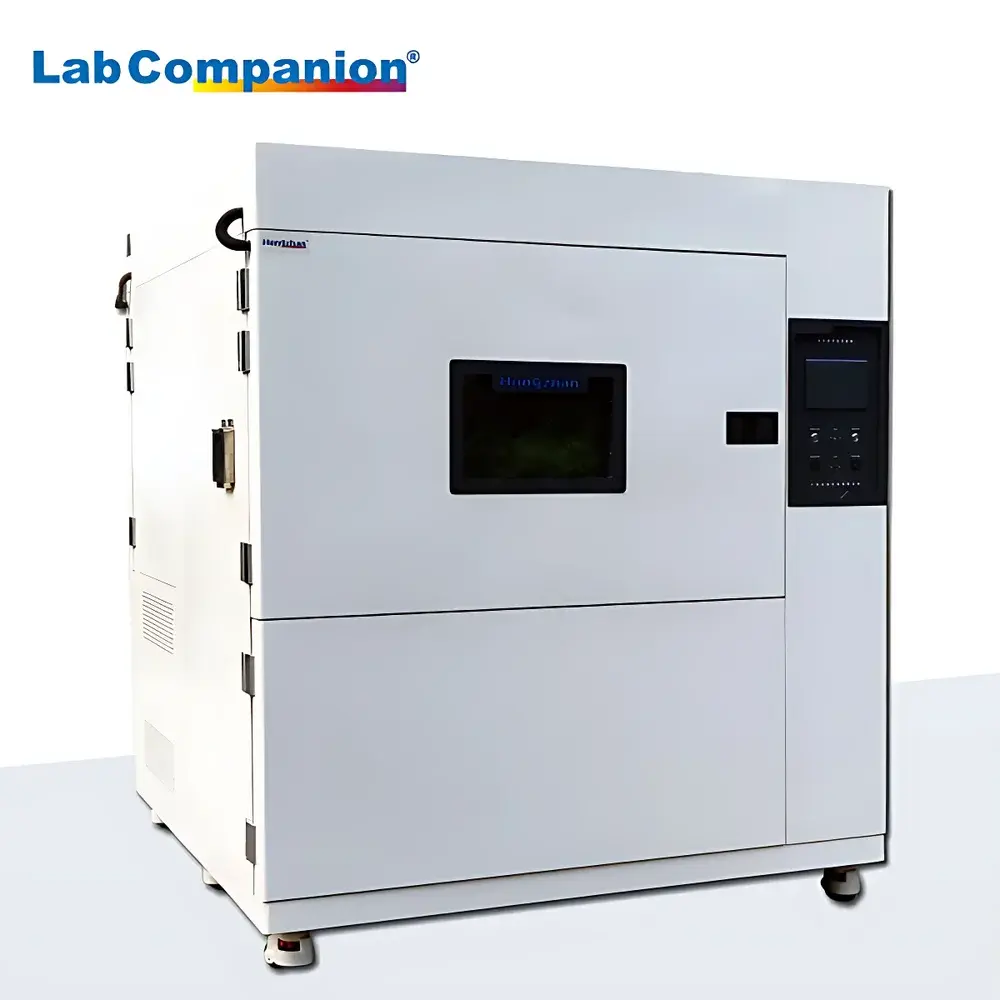
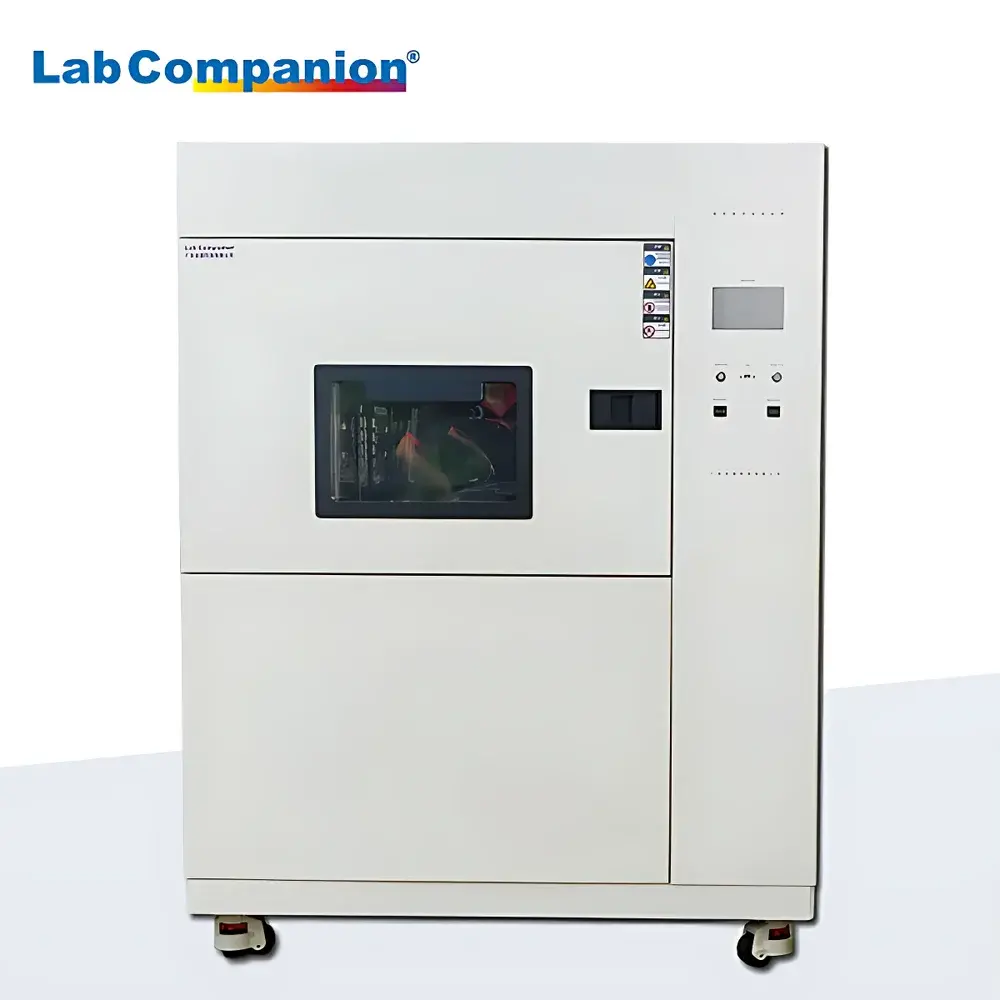
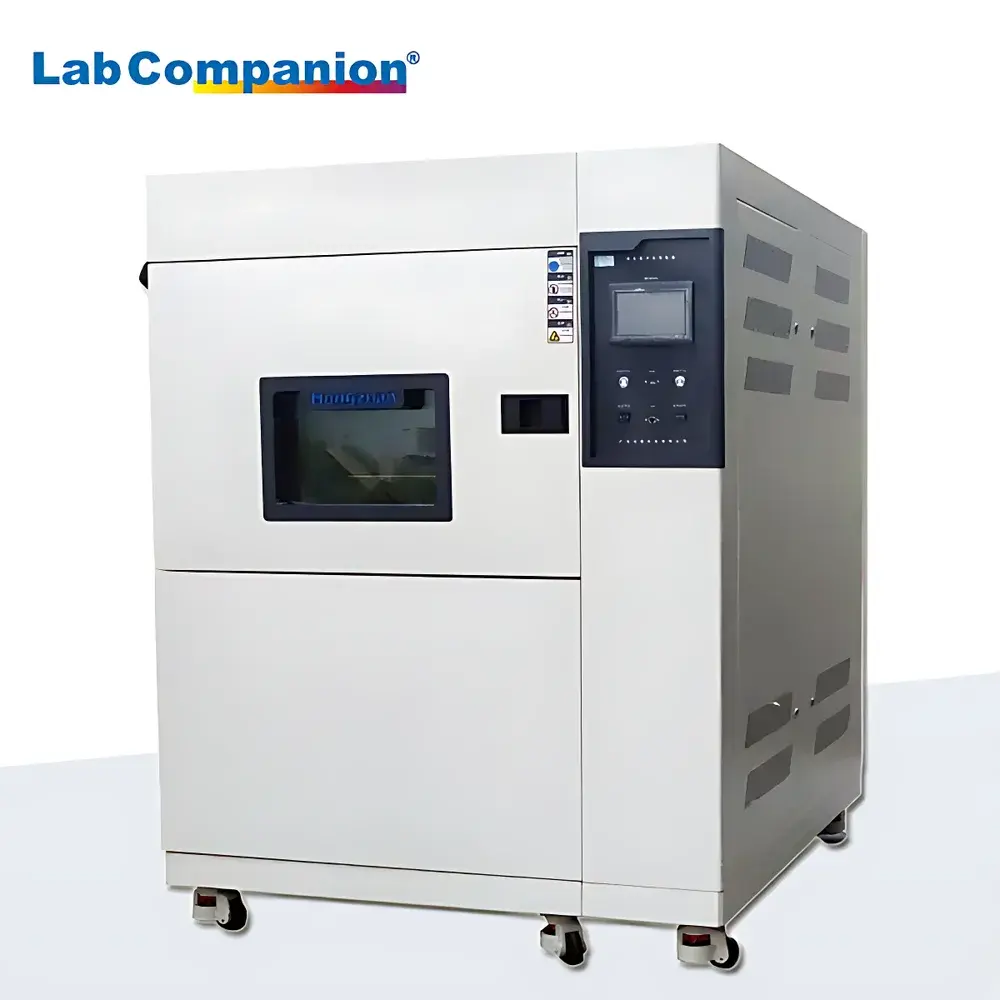
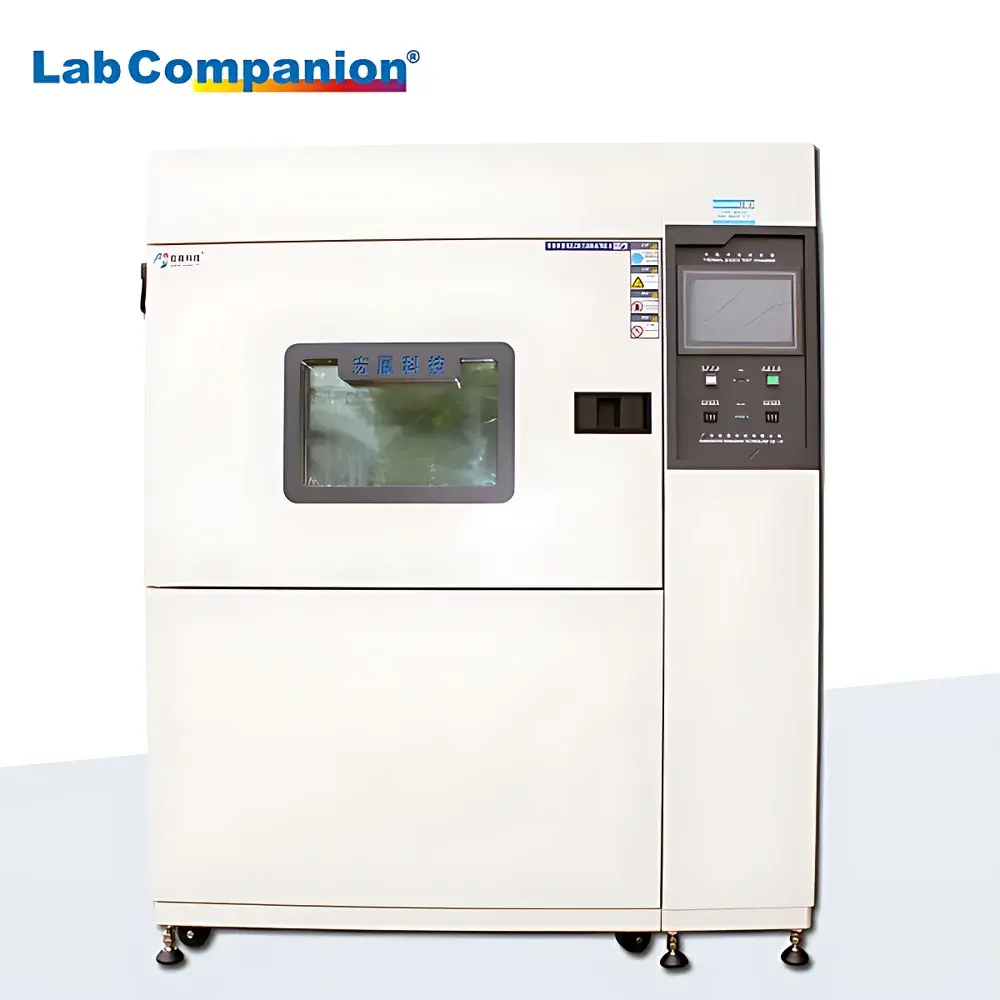
LabCompanion TSU-408A Thermal Shock Test Chamber
| Brand | LabCompanion |
|---|---|
| Origin | Guangdong, China |
| Manufacturer Type | Direct Manufacturer |
| Model | TSU-408A |
| High-Temperature Range | +60 °C to +200 °C |
| Low-Temperature Range | −78 °C to 0 °C |
| Thermal Shock Temperature Range | −40 °C to +150 °C |
| Temperature Stability | ±2 °C |
| Heating Rate | +60 °C to −200 °C ≤ 20 min |
| Cooling Rate | +20 °C to −75 °C ≤ 60 min |
Overview
The LabCompanion TSU-408A Thermal Shock Test Chamber is an engineered environmental stress screening (ESS) system designed for rapid, repeatable thermal cycling between extreme high- and low-temperature zones. It operates on a three-zone architecture—comprising independent high-temperature, low-temperature, and test chambers—enabling precise, programmable thermal shock profiles via pneumatic air-door transfer mechanisms. Unlike single-chamber ramp-based systems, the TSU-408A eliminates thermal inertia by physically moving test specimens between pre-conditioned zones, achieving true step-change transitions with minimal dwell time deviation. This architecture conforms to the fundamental requirements of MIL-STD-810H Method 503.7, IEC 60068-2-14, and JESD22-A104 for accelerated reliability testing of electronic assemblies, plastic-encapsulated microcircuits (PEMs), PCBs, solder joints, and automotive ECUs. Its design prioritizes thermal uniformity, reproducibility, and operational robustness under continuous duty cycles in QA/QC laboratories and reliability engineering facilities.
Key Features
- Three-zone configuration with independently controlled high-temperature (+60 °C to +200 °C) and low-temperature (−78 °C to 0 °C) reservoirs
- Pneumatically actuated stainless-steel air doors ensuring <5 s transfer time and minimal cross-contamination between zones
- Test chamber temperature stability maintained within ±2 °C across full operational range, verified per ISO 17025-compliant calibration protocols
- Rapid thermal transition performance: heating from +60 °C to −200 °C in ≤20 minutes; cooling from +20 °C to −75 °C in ≤60 minutes (chamber-only, no load)
- Internal working volume of 408 L (W850 × H600 × D800 mm), supporting up to 10 kg test samples with 30 kg static shelf loading capacity
- Integrated safety interlocks including over-temperature cutoff, refrigerant pressure monitoring, and door position verification per EN 61000-6-2
Sample Compatibility & Compliance
The TSU-408A accommodates standard JEDEC trays, FR-4 PCB panels, molded IC packages, and automotive control modules. Its thermal shock range of −40 °C to +150 °C aligns with common qualification requirements for AEC-Q200 passive components and IPC-9701 solder joint reliability assessments. All thermal profiles are traceable to NIST-traceable reference sensors installed in each zone. The system supports compliance documentation generation for GLP and GMP environments, including audit-ready calibration logs, alarm history, and cycle execution records. It meets structural and electromagnetic compatibility requirements outlined in IEC 61000-4 series standards and is CE-marked for use within the European Economic Area.
Software & Data Management
Equipped with LabCompanion’s proprietary TC-Link™ control software, the TSU-408A provides intuitive profile programming, real-time multi-zone temperature visualization, and automated data logging at user-defined intervals (1–60 s resolution). Export formats include CSV and XML for integration into LIMS or statistical process control (SPC) platforms such as Minitab or JMP. Audit trail functionality complies with FDA 21 CFR Part 11 requirements—including electronic signatures, user role-based access control, and immutable event logging—making it suitable for regulated pharmaceutical device validation and aerospace component qualification workflows.
Applications
- Accelerated life testing of semiconductor packaging materials under repeated thermal expansion mismatch stress
- Evaluation of adhesive bond integrity in MEMS sensor housings exposed to cyclic cryogenic-to-oven conditions
- Qualification of battery module thermal interface materials (TIMs) used in EV power electronics
- Failure mode analysis of conformal coatings on military-grade printed circuit boards
- Reliability screening of optical transceivers operating in outdoor telecom infrastructure
FAQ
What is the difference between two-zone and three-zone thermal shock configurations?
A three-zone system like the TSU-408A maintains separate, continuously conditioned hot and cold reservoirs, enabling faster, more stable transitions than two-zone designs that rely on chamber reconditioning.
Does the TSU-408A support custom thermal shock profiles with variable dwell times?
Yes—TC-Link™ allows up to 99 segments per profile, with independent dwell, ramp, and transfer parameters configurable per cycle.
Is external chiller water required for operation?
The unit is air-cooled and self-contained; no external chilled water supply is needed for standard operation.
Can the system be integrated into a factory MES or SCADA network?
It supports Modbus TCP and optional Ethernet/IP communication protocols for bi-directional integration with industrial automation systems.
What calibration documentation is provided upon delivery?
Each unit ships with a full factory calibration certificate covering all thermocouple inputs, door actuation timing, and temperature uniformity mapping per IEC 60068-3-5.



