
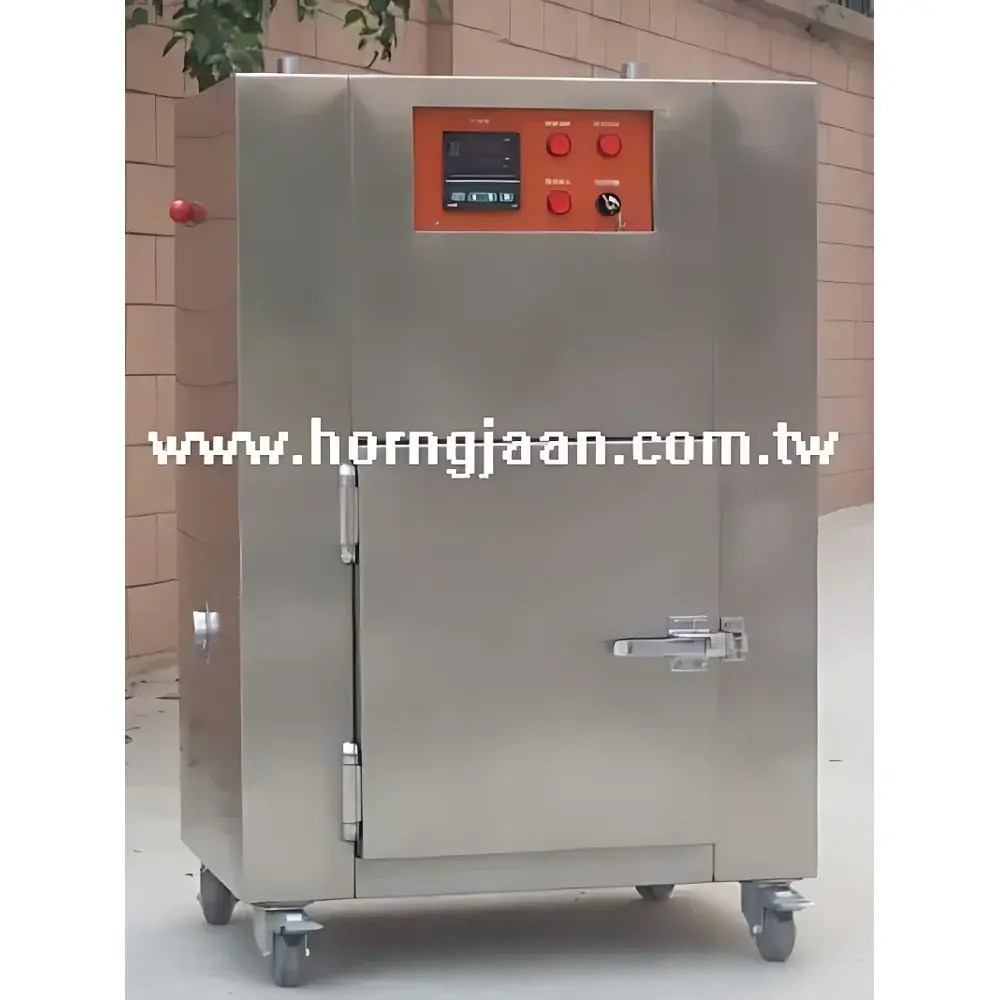
LabCompanion CS101-E Precision Forced-Air Circulating Drying Oven
| Brand | LabCompanion |
|---|---|
| Origin | Guangdong, China |
| Manufacturer Type | Direct Manufacturer |
| Country of Origin | China |
| Model | CS101-E |
| Pricing | Upon Request |
| Temperature Range | R.T.+10°C to 300°C |
| Temperature Uniformity | ±2.5% |
| Temperature Fluctuation | ±0.5°C |
| Heating Rate (to 200°C) | ≤70 min |
| Control Method | PID with PT100 Sensor |
| Display | LED Digital (Set & Actual Temp) |
| Timer Range | 0–999 min |
| Interior Material | SUS304 Mirror-Finish Stainless Steel (BN variant) or Pre-treated Cold-Rolled Steel (EN variant) |
| Insulation | Ultra-Fine Glass Fiber |
| Viewing Window | Double-Layer Heat-Resistant Tempered Glass |
| Air Circulation | Centrifugal Blower with Condenser Motor |
| Heating Element | Nickel-Chromium Alloy Sheathed Heater |
| Safety Features | Independent Over-Temperature Protection, Thermal Cut-Out Circuit Breaker |
| Power Supply | AC 220 V, 50 Hz |
| Rated Power | 1.5 kW |
| Internal Dimensions (W×D×H) | 450×400×400 mm |
| Internal Volume | 72 L |
| Compliant With | JB/T 5520–1991 “Technical Specifications for Drying Ovens” |
Overview
The LabCompanion CS101-E Precision Forced-Air Circulating Drying Oven is an engineered solution for controlled thermal processing in research laboratories, quality control environments, and industrial manufacturing settings. Designed around the principle of uniform convective heat transfer, it employs a high-efficiency centrifugal blower system to maintain consistent airflow across the chamber interior—enabling reproducible drying, baking, sterilization, and aging protocols. Its operational envelope spans from ambient +10°C to 300°C, making it suitable for low-temperature moisture removal as well as high-temperature stress testing of electronic components and advanced materials. The oven’s structural integrity, thermal stability, and sensor-driven feedback loop meet the functional requirements outlined in JB/T 5520–1991, the Chinese national standard governing performance criteria for laboratory drying ovens—including temperature uniformity, fluctuation limits, heating rate verification, and safety interlock validation.
Key Features
- PID-based digital temperature control with industrial-grade PT100 platinum resistance thermometer ensures stable setpoint maintenance and minimal overshoot during ramping cycles.
- Forced-air circulation architecture delivers ±2.5% temperature uniformity across the full working volume, verified under no-load conditions at 23°C ±5°C ambient and 65% RH ±20%.
- Double-layer, heat-resistant tempered glass observation window allows real-time visual monitoring without compromising thermal integrity or operator safety.
- Interior constructed from mirror-finish SUS304 stainless steel (BN version) or high-quality cold-rolled steel with high-temp silver-paint finish (EN version), both resistant to oxidation and chemical exposure during repeated thermal cycling.
- Ultra-fine glass fiber insulation minimizes external surface temperature rise and improves energy efficiency during extended operation.
- Dual-stage safety system includes independent over-temperature cutoff and thermal circuit breaker, compliant with IEC 61000-4 electromagnetic compatibility guidelines and general-purpose electrical safety standards.
Sample Compatibility & Compliance
The CS101-E is intended for non-flammable, non-explosive samples only—commonly used for thermal conditioning of printed circuit boards (PCBs), semiconductor wafers, quartz crystals, passive components (capacitors, resistors), pharmaceutical excipients, polymer films, and ceramic substrates. Its design supports GLP-aligned workflows through traceable temperature logging (when paired with optional RS485 interface), and its construction adheres to material compatibility expectations defined in ISO 17025-accredited calibration labs. While not certified to UL or CE for standalone medical device use, the unit meets mechanical and thermal safety benchmarks referenced in GB/T 2893.1 (safety color coding) and GB 4793.1 (electrical safety for laboratory equipment).
Software & Data Management
The standard configuration features a microprocessor-based controller with LED display showing both setpoint and real-time chamber temperature. Optional upgrades include programmable temperature controllers supporting multi-segment ramp-soak profiles and data export via RS485 serial communication (Modbus RTU protocol). When integrated into networked lab infrastructure, logged temperature histories can be archived in compliance with FDA 21 CFR Part 11 requirements—provided the host software implements user authentication, audit trail generation, and electronic signature capability. No proprietary software is bundled; third-party SCADA or LIMS platforms may interface directly using open communication protocols.
Applications
- Pre-bake and post-reflow moisture removal of PCB assemblies prior to conformal coating or encapsulation.
- Aging tests for LED modules and LCD driver ICs under elevated temperature stress to accelerate failure mode analysis.
- Residual solvent evaporation from thin-film coatings in optical and photovoltaic R&D.
- Thermal stabilization of reference standards in metrology labs requiring long-term isothermal exposure.
- Moisture content determination per ASTM E1868 (standard test method for loss on drying) when used with calibrated analytical balances.
- Low-temperature sterilization of glassware and stainless-steel tools where autoclaving is unsuitable.
FAQ
What is the maximum operating temperature of the CS101-E?
The unit is rated for continuous operation up to 300°C, with thermal cut-out protection activated above this threshold.
Can this oven be used for sterilization of biological materials?
No—it is not designed for microbiological sterilization (e.g., depyrogenation or microbial kill validation); its application scope is limited to physical drying, thermal aging, and non-biological heat treatment.
Is the internal chamber volume validated per ISO/IEC 17025?
Chamber dimensions are factory-measured and documented; however, volumetric calibration certificates require third-party accreditation and are not included by default.
Does the oven support NIST-traceable temperature calibration?
Yes—PT100 sensor inputs are compatible with external calibrators meeting ANSI/NCSL Z540-1 or ISO/IEC 17025 requirements; users must perform periodic verification using accredited reference probes.
Are custom cable ports or additional shelving available as factory-installed options?
Optional cable knockouts (Φ20 mm, Φ30 mm), extra stainless-steel shelves, and reinforced door hinges can be specified at time of order; all modifications undergo pre-shipment functional testing.



