
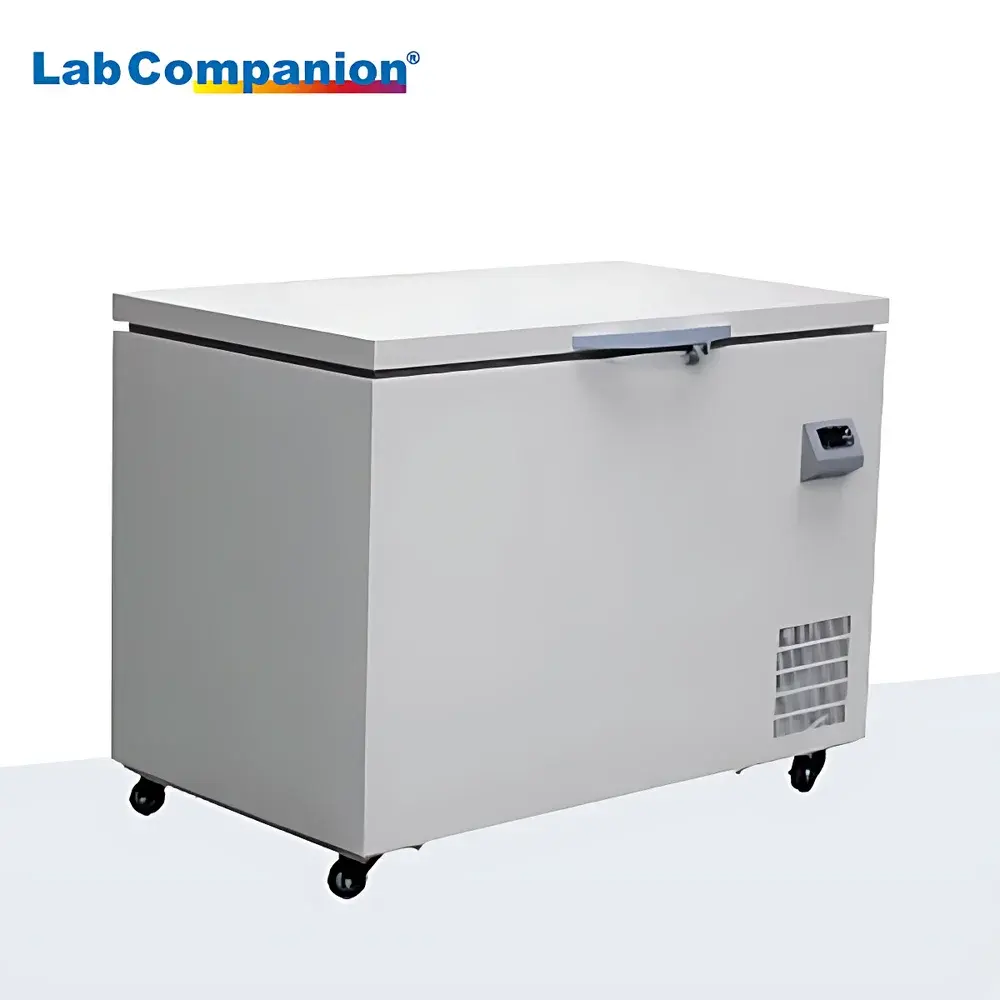
LabCompanion UV3 UV Weathering Test Chamber
| Brand | LabCompanion |
|---|---|
| Origin | Guangdong, China |
| Manufacturer Type | Direct Manufacturer |
| Model | UV3 |
| Temperature Range | RT+10–70 °C |
| Humidity Range | >90% RH |
| Sample-to-Lamp Distance | 50 ± 2 mm |
| Lamp Center-to-Center Spacing | 70 mm |
| Irradiance | UVA-340 @ 0.68 W/m² (295–360 nm), UVB-313 @ 0.60 W/m² (280–315 nm) |
| Internal Chamber Dimensions | 1170 × 450 × 500 mm (W×D×H) |
| External Dimensions | 1300 × 550 × 1380 mm (W×D×H) |
| Construction | Stainless Steel Interior & Exterior, Aluminum Alloy Sample Rack |
| Control System | Intelligent Digital PID Controller with AI Algorithm, Dual-Mode Regulation (On/Off + Adaptive), Real-Time Irradiance Monitoring (Optional UV Radiometer) |
| Compliance | GB/T 16422.3–1997, ASTM G53–88, GB/T 14522–93 |
| Safety Protections | Overcurrent & Short-Circuit Protection, Ground Fault Detection, Overtemperature Cut-off, Low-Water Level Alarm, Compressor High-Pressure & Overload Protection |
Overview
The LabCompanion UV3 UV Weathering Test Chamber is an engineered environmental simulation system designed to replicate the photochemical degradation effects of solar ultraviolet radiation under controlled condensation and thermal cycling conditions. Unlike full-spectrum xenon arc or carbon arc testers, the UV3 employs fluorescent ultraviolet lamp technology—specifically UVA-340 and UVB-313 lamps—to isolate and accelerate the most damaging short-wavelength UV components of natural sunlight (280–360 nm). This approach aligns with internationally accepted accelerated weathering methodologies that prioritize spectral relevance over spectral completeness. The chamber operates on the principle of cyclic UV irradiation followed by dark condensation phases, simulating diurnal exposure patterns where moisture accumulation via surface condensation drives hydrolytic degradation mechanisms in polymeric materials. Its design targets reproducible, traceable, and comparable test outcomes for quality control, formulation development, and regulatory compliance in R&D laboratories and industrial QC departments.
Key Features
- Stainless steel construction (interior and exterior) ensures long-term corrosion resistance and ease of cleaning in high-humidity, UV-exposed environments.
- Dual-lamp compatibility: Pre-calibrated UVA-340 lamps (0.68 W/m² at 340 nm) for realistic solar-spectrum simulation; UVB-313 lamps (0.60 W/m² at 313 nm) for highly accelerated stress testing per ASTM G53–88.
- Precise sample positioning: Fixed 50 ± 2 mm distance from lamp array ensures uniform irradiance distribution across all specimens; 70 mm lamp center spacing minimizes shadowing and hot-spot formation.
- Intelligent digital controller with adaptive AI algorithm enables stable temperature regulation (RT+10 to 70 °C) and real-time monitoring of chamber humidity (>90% RH during condensation phase).
- Condensation cycle implemented via saturated steam environment—no external water spray—reproducing natural dew formation without mechanical erosion or uneven wetting.
- Optional integrated UV radiometer provides closed-loop irradiance control: automatically compensates for lamp aging or voltage fluctuations by modulating power output to maintain setpoint irradiance within ±5% tolerance.
- Comprehensive safety architecture includes independent overtemperature cut-off, low-water-level detection, ground-fault interrupt, compressor pressure monitoring, and automatic mains disconnection upon fault detection.
Sample Compatibility & Compliance
The UV3 accommodates flat-panel specimens up to 1170 mm wide, suitable for standard ISO 4892-3 and ASTM G154-compliant sample holders. It supports rigid and semi-flexible substrates including thermoplastics (e.g., ABS, PC, PP), coatings (automotive clearcoats, architectural paints), elastomers (EPDM, silicone), and fiber-reinforced composites. All operational parameters—including irradiance intensity, black panel temperature, condensation duration, and UV exposure time—are fully configurable to meet test protocols defined in GB/T 16422.3–1997 (equivalent to ISO 4892-3), ASTM G53–88, and GB/T 14522–93. The system’s control firmware logs timestamped environmental data (temperature, humidity, irradiance if equipped) with audit-trail capability, supporting GLP-aligned documentation requirements. No proprietary software lock-in: raw data export is supported via RS-485 or USB interface in CSV format for integration into LIMS or statistical process control platforms.
Software & Data Management
The embedded controller features a menu-driven touchscreen interface with multilingual support (English default), intuitive parameter navigation, and password-protected configuration levels for operator, technician, and administrator roles. Test programs can be saved as named profiles with up to 99-step cycles (UV irradiation / condensation / dark soak). Real-time graphs display chamber temperature, relative humidity, and optional irradiance values. All operational events—including alarm triggers, lamp-on hours, and manual interventions—are time-stamped and stored in non-volatile memory for ≥30 days. Data export is performed via USB flash drive or serial communication using ASCII-based protocol compliant with Modbus RTU standards. While no cloud connectivity is built-in, the device satisfies FDA 21 CFR Part 11 readiness when paired with validated third-party data acquisition software that enforces electronic signatures, audit trails, and role-based access control.
Applications
The UV3 serves as a primary tool for evaluating photostability and hydrolytic durability in materials exposed to outdoor service conditions. Typical use cases include: comparative ranking of pigment systems in automotive OEM coatings; validation of UV stabilizer packages in polyolefin extrusions; assessment of gloss retention and chalking resistance in architectural acrylic latex paints; qualification of encapsulant adhesion in photovoltaic module laminates; and screening of antioxidant efficacy in rubber compounds used in sealing applications. In quality assurance workflows, it supports incoming raw material verification against supplier specifications and batch-to-batch consistency checks prior to production release. Its compact footprint and energy-efficient lamp design make it especially suited for dedicated lab-scale testing where throughput and repeatability outweigh the need for large-volume specimen capacity.
FAQ
What is the difference between UVA-340 and UVB-313 lamp configurations?
UVA-340 lamps emit a spectrum closely matching terrestrial sunlight between 295–360 nm and are recommended for realistic weathering simulations. UVB-313 lamps produce shorter-wavelength UV (280–315 nm) at higher intensities, enabling faster degradation—but with reduced spectral fidelity—making them appropriate for rapid screening rather than predictive lifetime modeling.
Does the UV3 comply with ISO 4892-3?
Yes—the chamber’s optical geometry, irradiance calibration methodology, and control algorithms conform to the technical requirements of ISO 4892-3:2013 for fluorescent UV exposure apparatuses. Full conformance documentation, including lamp spectral power distribution reports and irradiance uniformity maps, is available upon request.
Can I monitor irradiance in real time without the optional sensor?
No—the base configuration uses fixed-output lamp drivers. Real-time irradiance feedback and automatic compensation require installation of the optional UV radiometer kit, which interfaces directly with the main controller.
What maintenance is required for long-term reliability?
Lamp replacement every 1,600–2,000 hours of operation is recommended. Quarterly inspection of condensate collection tray, stainless steel gaskets, and electrical connections is advised. Calibration of temperature and humidity sensors should be verified annually using NIST-traceable references.
Is remote monitoring or Ethernet connectivity supported?
The standard unit does not include Ethernet or Wi-Fi modules. However, RS-485 Modbus RTU output allows integration with building management systems (BMS) or centralized SCADA platforms via industrial gateways.



