
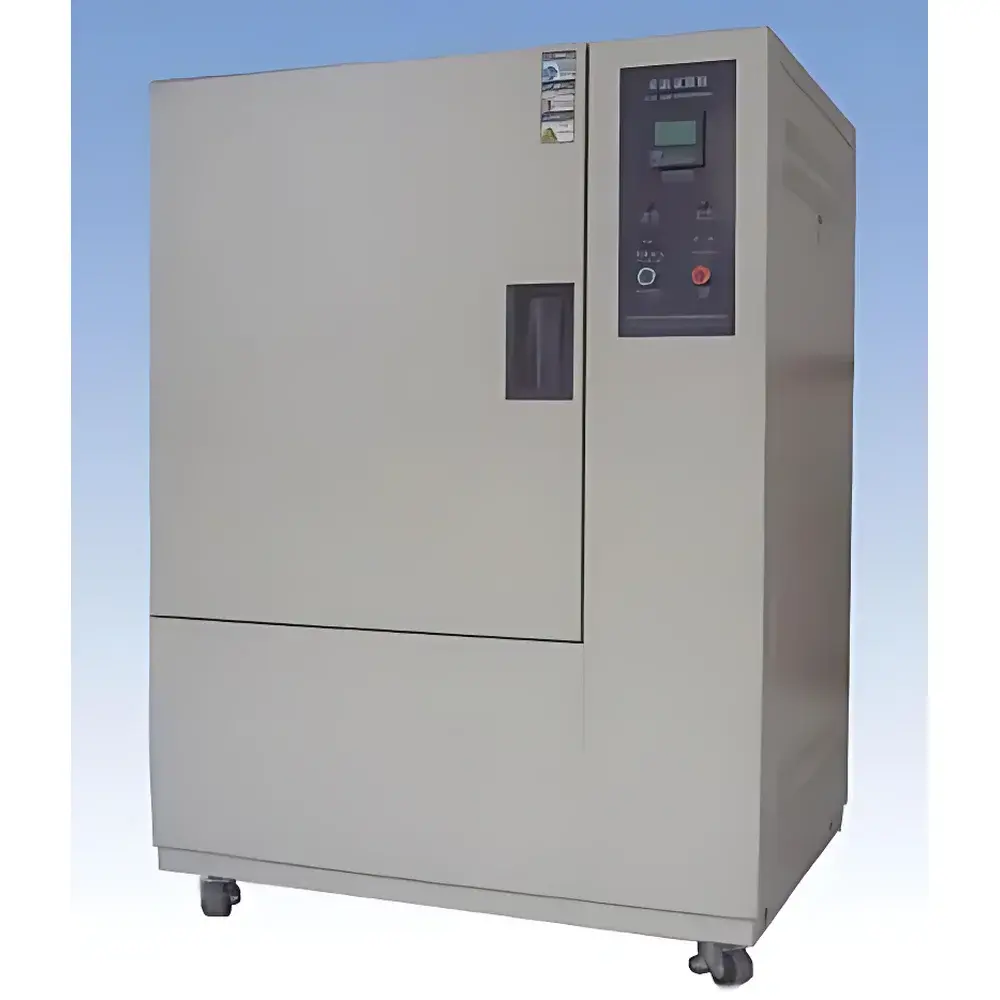
LabCompanion PH Series Precision Forced-Air Drying Oven
| Brand | LabCompanion |
|---|---|
| Model | PH |
| Type | Precision Forced-Convection Drying Oven |
| Temperature Range | Ambient +10°C to 300°C |
| Temperature Uniformity | ±2.5% |
| Temperature Fluctuation | ±0.5°C |
| Internal Dimensions (W×D×H) | 340 × 320 × 320 mm |
| External Dimensions (W×D×H) | 530 × 620 × 490 mm |
| Chamber Material | SUS304 Stainless Steel (≤300°C) or Galvanized Steel |
| Heating Method | Forced-Air Circulation with Nichrome Wire Heaters |
| Control System | Microprocessor-Based PID Controller with PT100 Sensor |
| Timer Range | 0–999 min |
| Power Supply | AC 220 V, 50 Hz |
| Compliance | JB/T 5520–1991 |
Overview
The LabCompanion PH Series Precision Forced-Air Drying Oven is an engineered solution for controlled thermal processing in research laboratories and industrial quality assurance environments. Designed around the principle of forced convection heat transfer, this oven circulates heated air uniformly across the chamber using a centrifugal blower and optimized baffle system—ensuring minimal thermal stratification and high spatial temperature consistency. Its operational range spans from ambient +10°C up to 300°C, making it suitable for applications including moisture removal, pre-baking of substrates, stress-relief annealing of electronic components, and accelerated aging of polymer-based materials. The oven’s architecture adheres to JB/T 5520–1991—the Chinese national standard governing performance, safety, and construction requirements for laboratory drying ovens—while its mechanical and control design reflects internationally recognized practices for thermal stability and repeatability in regulated settings.
Key Features
- Forced-air circulation system with adjustable airflow velocity and directional baffles to minimize thermal gradients and ensure ±2.5% temperature uniformity across the working chamber.
- Microprocessor-based PID temperature controller featuring auto-tuning capability, real-time display of both setpoint and measured temperature (LED), and manual Δ/▽ parameter adjustment without menu navigation.
- Dual-stage overtemperature protection: primary control via PT100 sensor feedback loop and independent mechanical cut-off switch rated for 320°C, compliant with IEC 61000-4-2 ESD immunity and Class II electrical safety standards.
- Chamber constructed from SUS304 stainless steel (standard for ≤300°C operation), offering corrosion resistance, non-reactivity with solvents, and ease of decontamination—critical for pharmaceutical and semiconductor cleanroom-adjacent workflows.
- Insulation composed of high-density mineral wool (≥80 mm thickness) combined with aluminum foil vapor barrier, achieving surface temperature rise <35 K above ambient under full-load conditions at 300°C.
- Integrated casters (4 pcs, two with brakes) and reinforced structural frame enable stable repositioning without compromising vibration isolation or thermal integrity.
Sample Compatibility & Compliance
The PH Series accommodates non-flammable, non-explosive solid and semi-solid samples—including PCB assemblies, ceramic substrates, optical filters, lithium-ion battery electrode coatings, and lyophilized pharmaceutical intermediates. It is explicitly excluded for use with organic solvents, volatile acids, or peroxide-forming compounds unless equipped with optional explosion-proof modifications (not standard). The oven meets JB/T 5520–1991 for thermal accuracy, mechanical durability, and electrical safety. While not certified to ISO/IEC 17025 or ASTM E145 as a standalone metrological instrument, its temperature control architecture supports GLP-compliant validation protocols—including IQ/OQ/PQ documentation, mapping studies per ISO 14644-3, and traceable calibration using NIST-traceable dry-block calibrators. Optional RS485 communication port enables integration into centralized facility monitoring systems compliant with FDA 21 CFR Part 11 data integrity requirements when paired with validated software.
Software & Data Management
The standard configuration includes embedded firmware supporting time-based hold functions, ramp-soak profiles (via optional programmable controller upgrade), and event logging of temperature excursions exceeding user-defined thresholds. All operational parameters—including start time, duration, setpoint, and maximum deviation—are stored in non-volatile memory with timestamping (RTC-backed). When upgraded with the LabCompanion TC-PRO module, the system supports Modbus RTU protocol over RS485, enabling bidirectional communication with LIMS or SCADA platforms. Audit trails record operator ID (via keypad input), parameter changes, and alarm acknowledgments—meeting minimum ALCOA+ principles for attributable, legible, contemporaneous, original, accurate, complete, consistent, enduring, and available records. Data export is available via USB flash drive in CSV format compatible with Excel, JMP, and MATLAB.
Applications
- Electronics manufacturing: Pre-bake of LED encapsulants, curing of conformal coatings, and burn-in testing of passive components (resistors, capacitors, quartz crystals) under tightly controlled thermal soak conditions.
- Materials science: Solvent evaporation from spin-coated thin films, thermal desorption of adsorbed water from metal-organic frameworks (MOFs), and conditioning of reference standards prior to gravimetric analysis.
- Pharmaceutical R&D: Residual solvent removal from active pharmaceutical ingredients (APIs), stability-indicating drying of placebo tablets, and moisture content verification per USP <1208>.
- Academic research: Accelerated oxidation studies of lubricants, thermal aging of elastomers per ASTM D572, and dehydration kinetics modeling of hydrogels using mass-loss tracking.
- Quality control labs: Standardized drying of filter papers per EPA Method 1664, moisture determination in polymers per ISO 62, and pre-conditioning of test specimens per ASTM D618.
FAQ
What is the maximum load capacity for uniform temperature distribution?
The specified temperature uniformity (±2.5%) is validated with ≤70% chamber volume occupied by inert, thermally conductive dummy loads (e.g., stainless steel blocks). Full-load uniformity may degrade to ±3.5% depending on sample geometry and thermal mass.
Can the oven be validated for GMP compliance?
Yes—when equipped with the TC-PRO controller and used with documented IQ/OQ protocols, it supports qualification under EU Annex 15 and WHO TRS 986 guidelines. Calibration certificates traceable to CNAS-accredited labs are available upon request.
Is external data logging supported without optional hardware?
No—real-time external logging requires either the RS485 interface module or analog voltage output option. The base unit logs internally but lacks network or serial export capability.
What maintenance intervals are recommended for long-term accuracy?
PT100 sensor verification every 6 months; blower motor inspection and lubrication annually; door gasket replacement every 24 months or after 500 thermal cycles above 250°C.
Does the oven support nitrogen purging?
Not natively—but optional 1/4″ NPT inlet/outlet ports (Φ50 mm cable entry kit) can be fitted to accommodate inert gas purge setups, provided user-installed flow regulators and O₂ monitors meet local safety codes.
Related Products



