
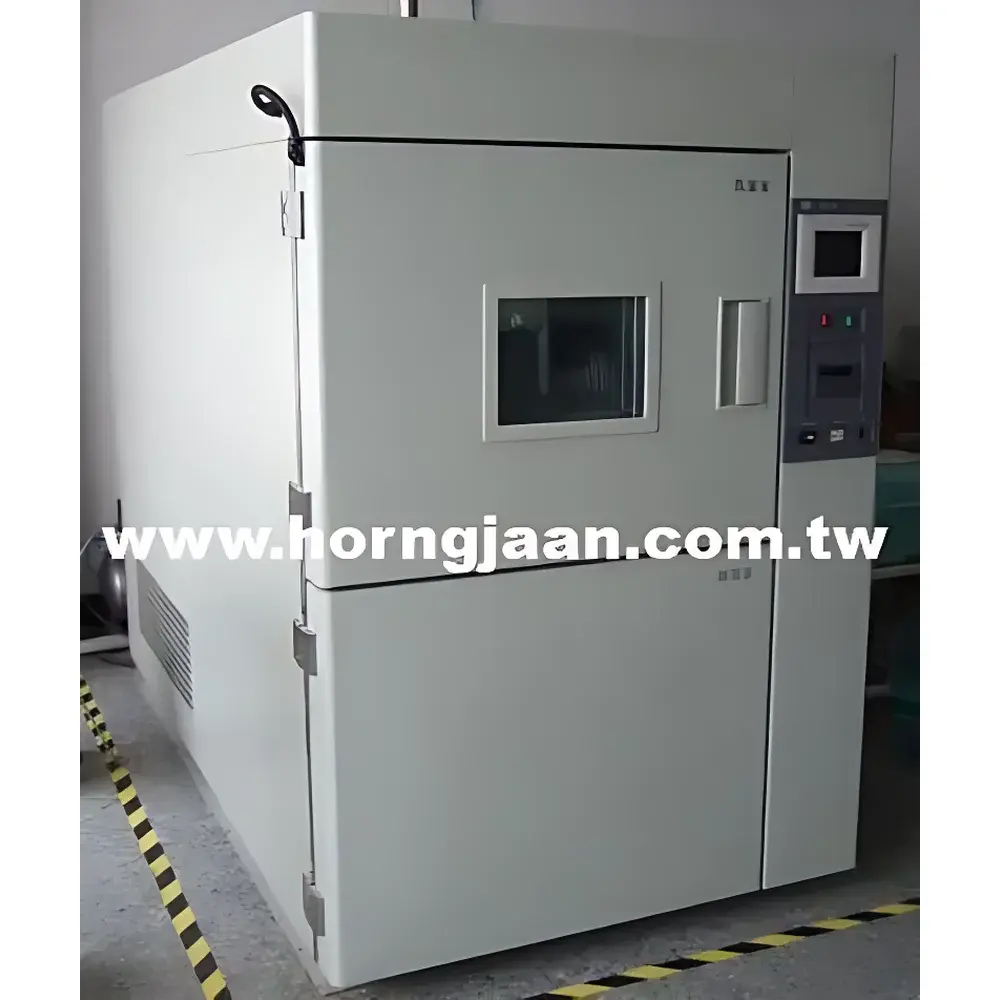
LabCompanion TS Series Thermal Shock Test Chamber
| Brand | LabCompanion |
|---|---|
| Origin | Guangdong, China |
| Manufacturer Type | Direct Manufacturer |
| Model | TS Series |
| Pricing | Upon Request |
| Compliance | Designed for ASTM D5229/D5229M, ISO 11357-5, MIL-STD-810H Method 503.5, IEC 60068-2-14 |
Overview
The LabCompanion TS Series Thermal Shock Test Chamber is an engineered environmental test system designed to evaluate material and component reliability under rapid, repetitive transitions between extreme high and low temperature extremes. Utilizing a two-chamber (hot/cold) moving-basket configuration, this chamber subjects test specimens to abrupt thermal excursions—typically defined as temperature transitions exceeding 10 °C/s—with precise dwell time control at each extreme. The system operates on the principle of accelerated thermal stress induction: by subjecting materials to controlled, cyclical thermal shocks, it reveals latent defects such as interfacial delamination, solder joint fatigue, coating cracking, or microstructural phase instability that may not manifest under steady-state thermal exposure. This methodology is foundational to qualification testing in aerospace, automotive electronics, semiconductor packaging, and medical device manufacturing—where long-term field performance hinges on resistance to thermal cycling-induced degradation.
Key Features
- Two-zone independent chamber architecture with pneumatically actuated transfer basket for rapid specimen movement between hot and cold zones
- Temperature range: −70 °C to +180 °C (standard configuration); optional extended ranges available upon customization
- Precision digital PID temperature controllers with Japanese Uyecon touchscreen interface (Chinese/English bilingual display)
- Programmable test profiles supporting up to 999 cycles, multi-segment ramp/dwell sequences, and user-defined transition timing
- Optimized airflow design with centrifugal circulation fans and baffle-guided air distribution ensures ±1.5 °C uniformity across full working volume
- Integrated safety redundancy: dual-stage overtemperature protection, compressor high-pressure cut-off, phase failure detection, ground fault interruption, and audible/visual alarm system
- Modular structural design with stainless steel inner chamber, high-density polyurethane insulation (≥150 mm), and electrostatically coated carbon steel outer enclosure
- Factory-calibrated sensors traceable to NIST standards; optional validation documentation (IQ/OQ/PQ support available)
Sample Compatibility & Compliance
The TS Series accommodates test specimens up to 500 mm × 500 mm × 500 mm (W×D×H) in standard configurations, with custom internal dimensions available per client requirements. Compatible with PCB assemblies, IC packages, battery modules, optical lenses, polymer composites, and metallic subassemblies. All systems are configured to meet core environmental test standards including ASTM D5229/D5229M (low-temperature impact resistance), ISO 11357-5 (thermal shock behavior of plastics), MIL-STD-810H Method 503.5 (temperature shock), and IEC 60068-2-14 (change of temperature). Optional calibration certificates and GMP-compliant audit trails—including electronic signature capability and 21 CFR Part 11–ready software logs—are available for regulated industries.
Software & Data Management
Equipped with LabCompanion’s proprietary TC-Manager v3.2 software suite, the TS Series supports real-time temperature logging at 1 Hz resolution, remote monitoring via Ethernet/Wi-Fi, and automated report generation in PDF/CSV formats. Data integrity safeguards include cyclic redundancy checksum (CRC) verification, write-protected archive folders, and configurable user access levels (operator, engineer, administrator). All test records include timestamped metadata: chamber setpoints, actual sensor readings, alarm events, door status, and system health diagnostics. Software complies with GLP/GMP data retention guidelines and supports integration into LIMS environments via OPC UA protocol.
Applications
- Qualification of automotive ECUs and ADAS sensors per AEC-Q200 stress requirements
- Reliability screening of wafer-level chip-scale packages (WLCSP) and fan-out stacked die
- Validation of conformal coating adhesion and thermal cycling endurance in avionics enclosures
- Failure mode analysis of lithium-ion battery cells under thermal abuse conditions
- Process window definition for reflow soldering and underfill curing in SMT lines
- Accelerated aging studies of optical adhesives and encapsulants used in LED lighting modules
FAQ
What is the typical temperature transition time between chambers?
Transition time from −40 °C to +125 °C (or vice versa) is ≤15 seconds for standard payload loads (<5 kg), verified per IEC 60068-2-14 Annex B.
Can the chamber be integrated into an automated test line?
Yes—equipped with RS-485 Modbus RTU and optional Ethernet/IP interfaces for PLC synchronization and recipe-based batch control.
Is validation support provided for ISO 17025-accredited labs?
Full IQ/OQ documentation packages—including sensor calibration reports, alarm response verification, and uniformity mapping—are available upon request.
What maintenance intervals are recommended?
Compressor oil and refrigerant filter replacement every 24 months; chamber seal inspection and sensor recalibration annually—or per internal quality schedule.
Does the system support dew point or humidity-controlled thermal shock?
Standard TS models are dry-air thermal shock systems; humidity-capable variants (TS-H series) with integrated desiccant dryers and RH control are available as custom builds.



