
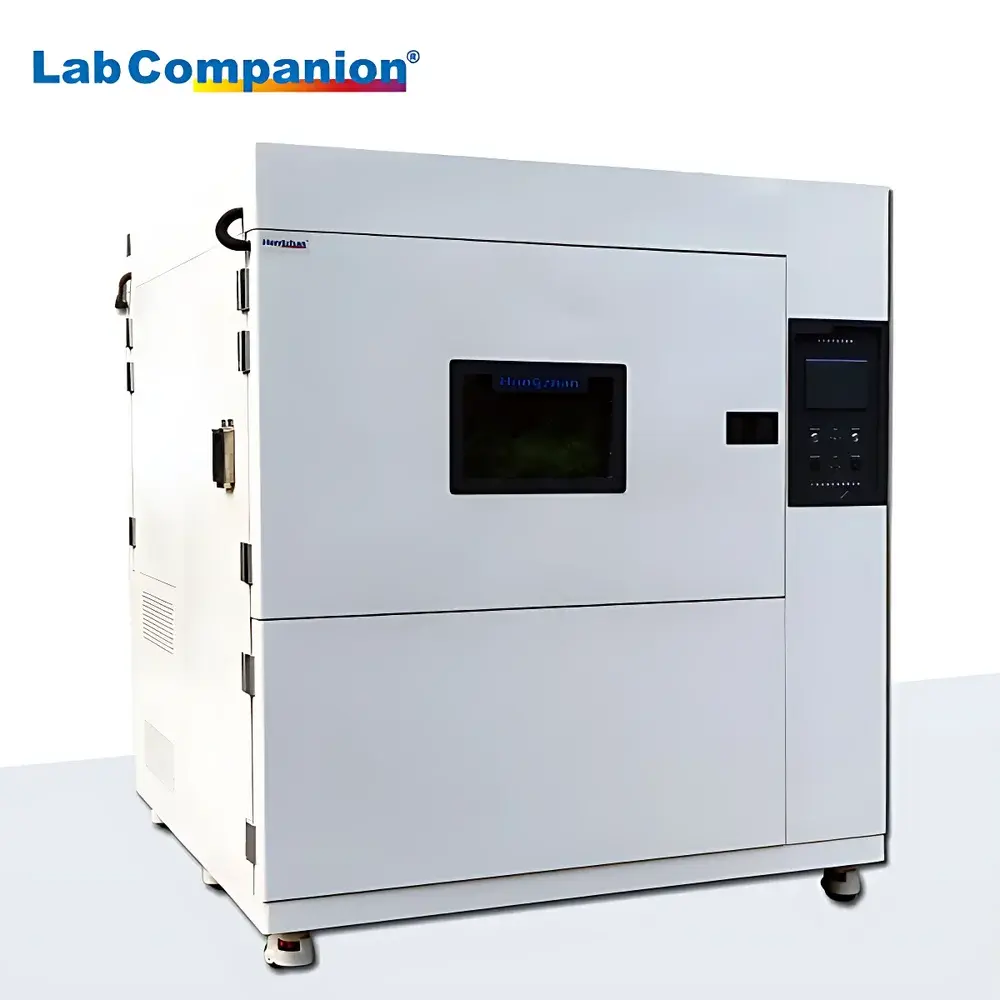
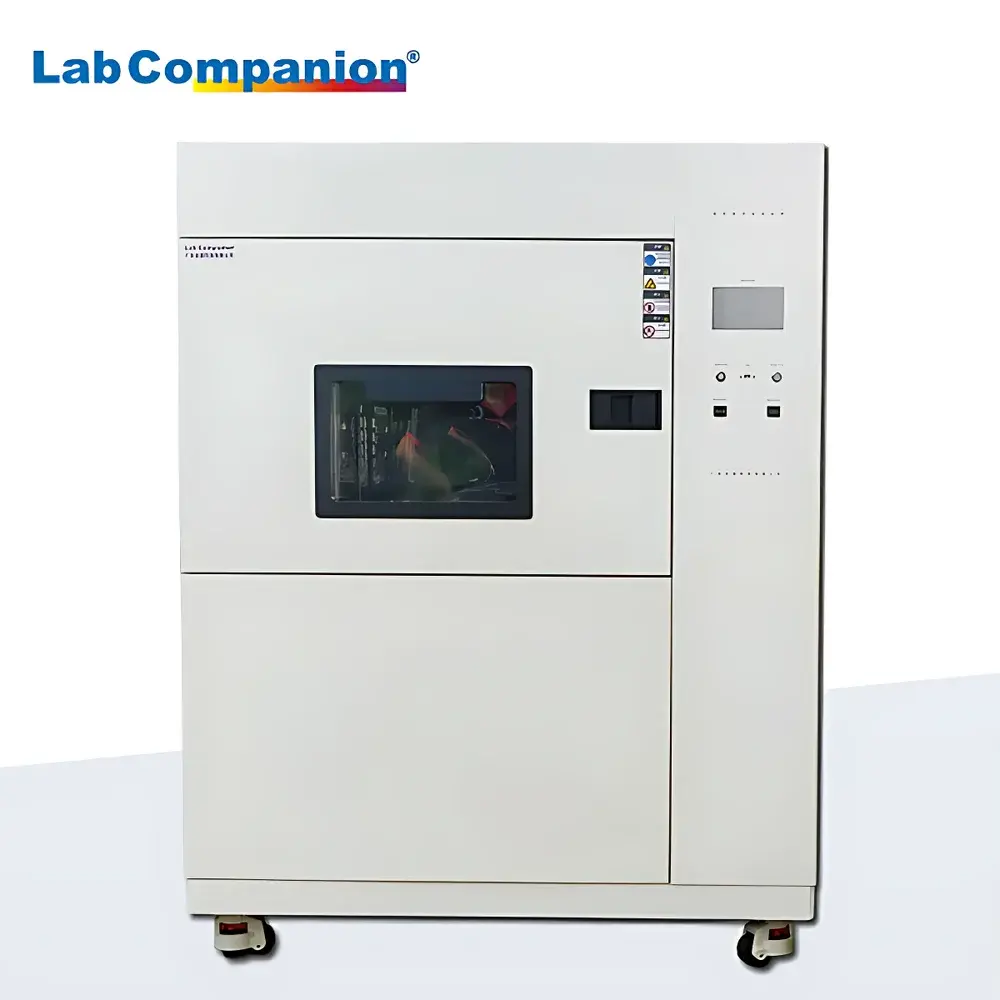
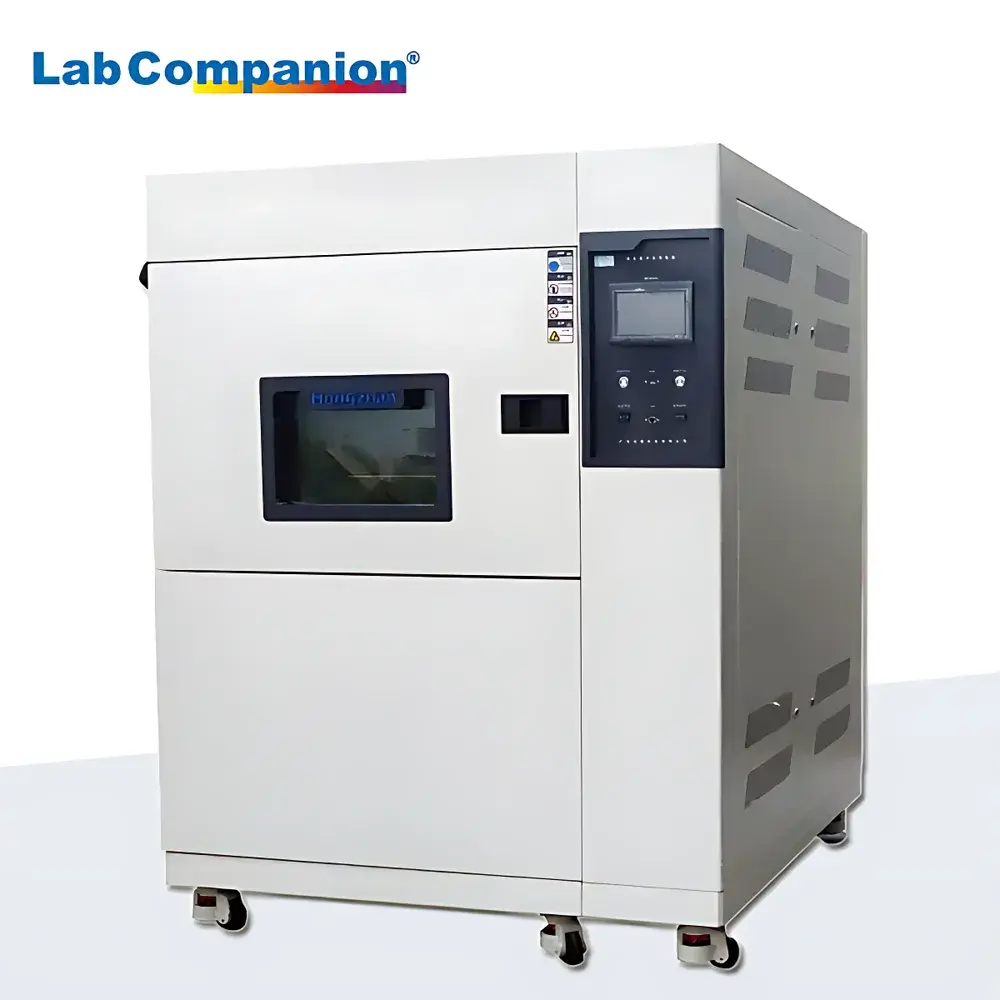
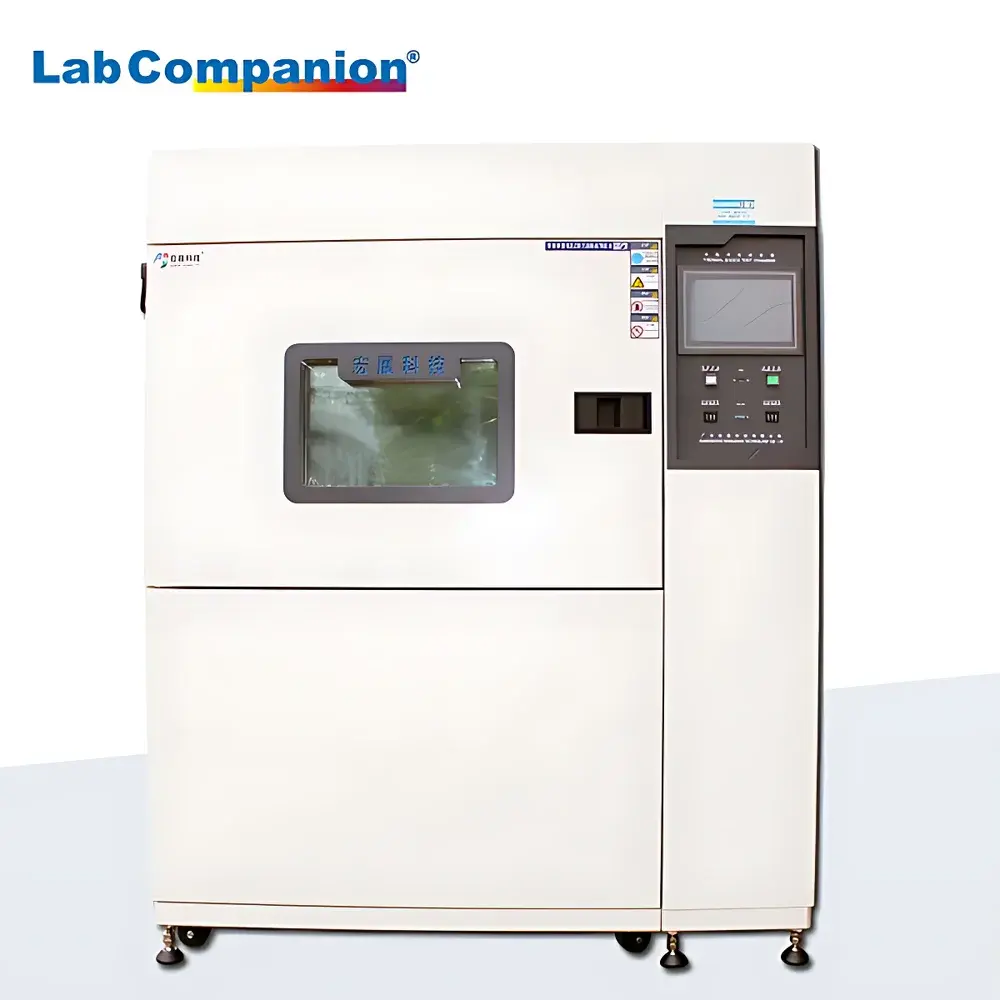
LabCompanion TSL-408A Three-Zone Thermal Shock Test Chamber
| Brand | LabCompanion |
|---|---|
| Origin | Guangdong, China |
| Manufacturer Type | Direct Manufacturer |
| Model | TSL-408A |
| High-Temperature Range | +60 °C to +200 °C |
| Low-Temperature Range | −78 °C to 0 °C |
| Thermal Shock Range | −40 °C to +150 °C |
| Temperature Stability | ±2 °C |
| Heating Rate | +60 °C to +200 °C ≤ 20 min |
| Cooling Rate | +20 °C to −75 °C ≤ 60 min |
Overview
The LabCompanion TSL-408A Three-Zone Thermal Shock Test Chamber is an engineered environmental test system designed for accelerated reliability assessment of electronic components, aerospace materials, automotive modules, and hermetically sealed packages under rapid, repetitive thermal transitions. Unlike dual-chamber (hot/cold) configurations, the TSL-408A employs a true three-zone architecture—comprising independent high-temperature, low-temperature, and test chambers—enabling precise control over dwell times, transfer timing, and thermal equilibrium states. This architecture eliminates cross-contamination between extreme temperature zones and ensures repeatable shock profiles per IEC 60068-2-14, MIL-STD-810H Method 503.7, and JESD22-A104E. The chamber utilizes forced-air convection with optimized airflow distribution and pneumatic door actuation for sub-5-second specimen transfer, minimizing thermal lag and ensuring compliance with stringent temperature recovery time requirements (<5 minutes per test cycle under standard conditions).
Key Features
- Three physically isolated temperature zones: independent hot chamber (+60 °C to +200 °C), cold chamber (−78 °C to 0 °C), and ambient/test chamber (−40 °C to +150 °C operating range)
- Pneumatically actuated transfer mechanism with programmable dwell and transition timing; transfer time <5 seconds between zones
- Temperature stability maintained at ±2 °C across all operational ranges, verified via NIST-traceable PT100 sensor array
- Heating rate of +60 °C to +200 °C in ≤20 minutes (chamber-only, no load); cooling rate of +20 °C to −75 °C in ≤60 minutes (chamber-only, no load)
- Stainless steel 304 interior construction with insulated double-wall design and silicone-sealed viewing window
- Integrated safety interlocks including over-temperature cut-off, refrigerant pressure monitoring, and door-open inhibition during active cycling
- Modular controller with Ethernet interface supporting Modbus TCP and optional RS-485 for integration into centralized lab management systems
Sample Compatibility & Compliance
The TSL-408A accommodates specimens up to 850 mm (W) × 600 mm (H) × 800 mm (D), with a maximum shelf loading capacity of 30 kg and recommended specimen mass ≤10 kg to maintain thermal inertia specifications. Compatible with JEDEC-standard plastic-encapsulated microcircuits (e.g., QFP, BGA, SOIC), PCB assemblies, optical sensors, and polymer-based structural components. All thermal shock profiles adhere to test condition definitions in IEC 60068-2-14 (Change of temperature – Method N: Change of temperature by air), ASTM D5229/D5229M (Low-Temperature Impact Resistance of Polymer Matrix Composites), and US Department of Defense standards for solder joint fatigue validation. The system supports GLP-compliant operation through audit-trail-enabled data logging and user-access-level configuration controls.
Software & Data Management
Control and monitoring are executed via LabCompanion’s proprietary ThermalTest Suite v4.2 software, running on an embedded industrial PC. The interface provides real-time multi-channel temperature visualization, customizable cycle sequencing (including ramp/soak/transfer steps), and automated report generation in PDF/CSV formats. Data integrity meets FDA 21 CFR Part 11 requirements through electronic signatures, role-based access control (admin/operator/viewer), and immutable event logs with timestamped operator actions. Optional cloud synchronization enables remote diagnostics and long-term trend analysis across distributed test facilities. Exported datasets include chamber zone temperatures, specimen surface thermocouple readings (when interfaced), cycle count, and alarm history—structured for import into LIMS or MATLAB-based failure modeling workflows.
Applications
- Qualification testing of semiconductor packaging for consumer electronics and automotive ADAS modules
- Validation of thermal expansion coefficient (CTE) mismatch effects in multi-material assemblies
- Accelerated aging studies of conformal coatings, potting compounds, and die-attach adhesives
- Solder joint reliability screening per IPC-9701A and IPC-J-STD-020D
- Material delamination and interfacial cracking analysis in laminated composites and MEMS devices
- Pre-qualification stress screening prior to HAST or biased humidity testing
FAQ
What distinguishes a three-zone thermal shock chamber from a two-zone system?
A three-zone design isolates the test specimen in a neutral chamber while independently conditioning hot and cold zones. This eliminates thermal carryover, improves repeatability, and enables precise dwell control—critical for evaluating transient thermal stresses in high-reliability applications.
Does the TSL-408A support custom thermal profiles beyond standard shock cycles?
Yes. The controller accepts user-defined sequences with up to 99 segments, including variable ramp rates, soak durations, and conditional branching based on temperature thresholds or elapsed time.
Is calibration documentation provided with shipment?
Each unit ships with a factory calibration certificate traceable to CNAS-accredited standards, covering temperature uniformity, stability, and transition timing across the full operational envelope.
Can the chamber be integrated into an automated test line?
Yes—via digital I/O signals (dry contact and 24 VDC) and Modbus TCP protocol, enabling handshake communication with robotic handlers, barcode scanners, and MES systems.
What maintenance intervals are recommended for sustained performance?
Compressor oil and refrigerant filter replacement every 24 months; annual verification of sensor accuracy and door seal integrity; quarterly cleaning of condenser coils and air intake filters.



