
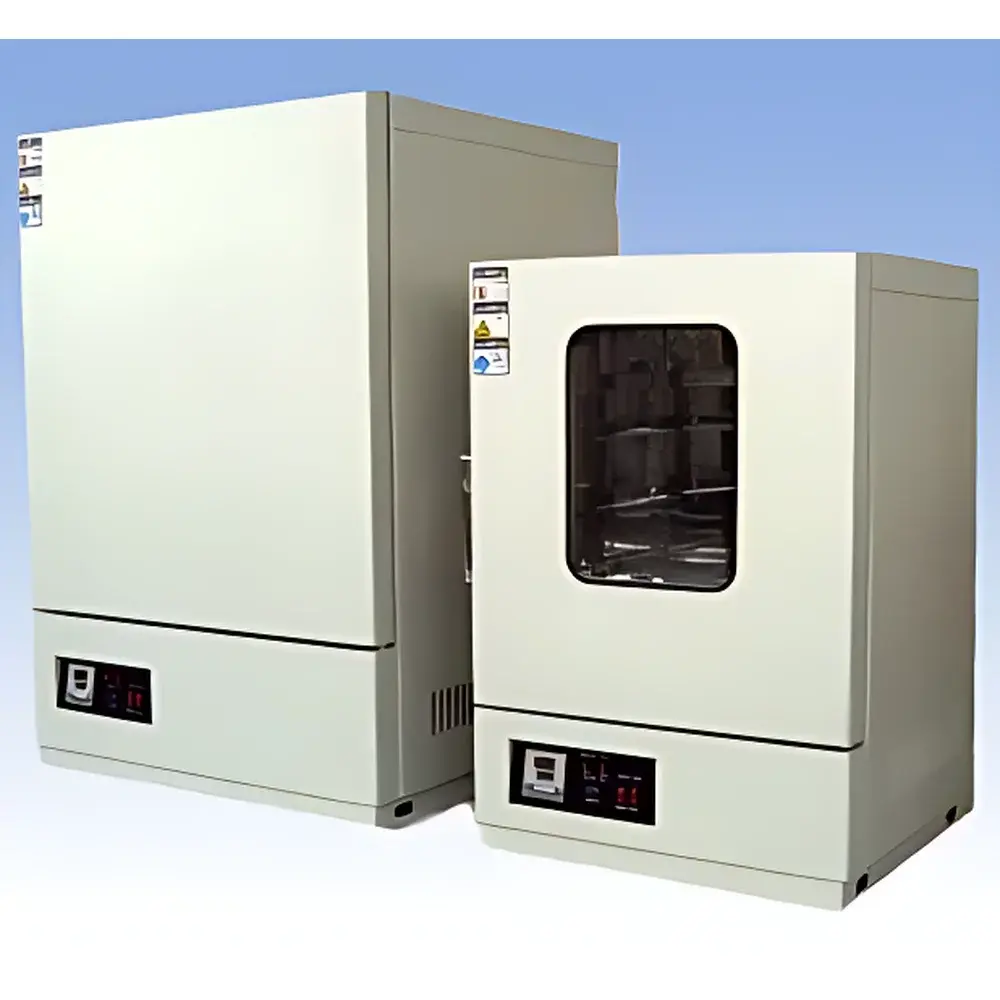
LabCompanion CS101-E Series Precision Forced-Convection Drying Oven
| Brand | LabCompanion |
|---|---|
| Origin | Guangdong, China |
| Manufacturer Type | OEM/ODM Manufacturer |
| Country of Origin | China |
| Model | CS101-E Series (CS101-1EBN / CS101-2EBN / CS101-3EBC) |
| Temperature Range | R.T.+10°C to 300°C |
| Temperature Uniformity | ±2.5% |
| Temperature Fluctuation | ±0.5°C |
| Heating Rate (to 200°C) | ≤70 min |
| Control System | Microprocessor-based PID with Auto-Tuning |
| Temperature Sensor | Industrial-grade PT100 Platinum Resistance Thermometer |
| Heating Element | Nickel-Chromium Alloy Sheathed Heater |
| Air Circulation | Centrifugal Blower with Adjustable Airflow |
| Inner Chamber Material | SUS304 Mirror-Finish Stainless Steel (BN models) or Pre-Painted Cold-Rolled Steel with High-Temp Silver Paint (EN models) |
| Outer Casing | Powder-Coated Cold-Rolled Steel |
| Insulation | High-Density Ultra-Fine Glass Fiber (≥100 mm thickness) |
| Viewing Window | Double-Layer Tempered Heat-Resistant Glass |
| Door Seal | Environmentally Compliant Silicone Rubber Gasket |
| Exhaust Port | Φ45 mm × 1 (rear-mounted) |
| Safety Features | Independent Over-Temperature Cut-Off, Thermal Fuse, and Circuit Breaker with Over-Current Protection |
| Power Supply | AC 220 V, 50 Hz |
| Rated Power | 1.5 kW / 2.5 kW / 3.0 kW |
| Internal Volume | 72 L / 137.5 L / 234 L |
| Standard Accessories | 2 Stainless Steel Shelving Plates + 4 Adjustable Shelf Supports + Full Technical Manual |
| Optional Upgrades | Programmable Ramp-Soak Controller, RS485 Modbus Interface, Cable Entry Ports, Additional Shelving Kits |
Overview
The LabCompanion CS101-E Series Precision Forced-Convection Drying Oven is an engineered solution for laboratory and industrial thermal processing applications requiring stable, repeatable, and traceable temperature control. Based on the principle of forced-air convection—where a centrifugal blower actively circulates heated air across the chamber interior—the CS101-E ensures rapid thermal equilibration and minimized spatial temperature gradients. Designed in strict compliance with JB/T 5520–1991 “Technical Specifications for Drying Ovens,” this series meets the fundamental performance criteria expected in GLP-compliant laboratories and ISO 17025-accredited testing environments. Its operational envelope spans from ambient +10°C to 300°C, supporting drying, baking, curing, sterilization (non-steam), thermal aging, and post-processing stabilization of non-flammable, non-explosive samples. The oven’s architecture prioritizes structural integrity, energy efficiency, and long-term calibration stability—critical for QC/QA workflows in electronics manufacturing (e.g., LED/LCD component burn-in), pharmaceutical excipient drying, polymer film conditioning, and ceramic sintering pre-treatment.
Key Features
- Microprocessor-controlled PID temperature regulation with auto-tuning capability, enabling dynamic compensation for load-induced thermal inertia and ambient drift.
- Independent dual-stage over-temperature protection: primary electronic cut-off at user-defined limit + secondary mechanical thermal fuse (fail-safe redundancy).
- High-fidelity PT100 sensor mounted within the working zone—calibrated per IEC 60751 Class B—provides real-time feedback with <±0.3°C measurement uncertainty under standard conditions.
- Optimized airflow path design featuring rear-mounted centrifugal fan and perforated stainless steel baffle plates, achieving ≤±2.5% temperature uniformity across full load volume (per ASTM E145 Annex A3 methodology).
- Double-glazed, argon-filled observation window constructed from heat-resistant tempered glass (maximum service temperature: 400°C), minimizing radiant heat loss while permitting continuous visual monitoring without door opening.
- Modular chamber construction using either electropolished SUS304 stainless steel (BN variants) or high-emissivity coated carbon steel (EN variants), both resistant to oxidation and organic residue buildup after repeated thermal cycling.
- Energy-efficient insulation system comprising ≥100 mm thick ultra-fine glass fiber with low thermal conductivity (<0.04 W/m·K at 200°C), reducing standby power consumption by up to 35% versus conventional mineral wool designs.
Sample Compatibility & Compliance
The CS101-E accommodates a broad spectrum of sample formats—including Petri dishes, crucibles, glassware, PCB trays, and bulk powder containers—without compromising thermal homogeneity. Its non-pressurized, atmospheric operation makes it suitable for moisture removal from hygroscopic materials (e.g., lithium battery cathode precursors), residual solvent evaporation from thin-film coatings, and microbiological media dehydration where steam sterilization is unnecessary. All models comply with electromagnetic compatibility requirements per EN 61326-1 and electrical safety standards per EN 61010-1. For regulated environments, optional RS485 Modbus RTU interface supports integration into centralized SCADA systems, enabling audit-ready data logging aligned with FDA 21 CFR Part 11 requirements when paired with compliant software platforms. Routine verification follows ISO/IEC 17025 clause 6.4.10 for equipment calibration and performance qualification.
Software & Data Management
While the base CS101-E operates via intuitive front-panel keypad navigation (Δ/▽ keys for parameter entry), optional programmable controllers extend functionality to multi-step thermal profiles with ramp/soak sequences, event-triggered alarms, and timestamped data export via USB or serial interface. Logged parameters include chamber setpoint, measured temperature (PT100), elapsed time, and fault codes—all stored with millisecond resolution in non-volatile memory. Exported CSV files are compatible with common statistical process control (SPC) tools and LIMS integrations. Firmware updates maintain backward compatibility and incorporate traceable revision history per internal change control SOPs.
Applications
- Electronics: Aging tests for capacitors, resistors, quartz crystals, and SMD components under controlled thermal stress (per MIL-STD-202 Method 107).
- Pharmaceuticals: Moisture content reduction in APIs and excipients prior to tablet compression; validation of dry-heat depyrogenation cycles (≤250°C).
- Materials Science: Pre-drying of ceramic green bodies, binder burnout in metal injection molding feedstocks, and thermal conditioning of composite laminates.
- Academic Research: Kinetic studies of solvent evaporation, thermal degradation profiling of polymers (TGA pre-conditioning), and humidity-controlled desiccation experiments.
- Food & Agriculture: Low-temperature dehydration of botanical samples for proximate analysis; enzyme inactivation studies at sub-boiling temperatures.
FAQ
What is the recommended calibration frequency for the CS101-E series?
Annual calibration against NIST-traceable reference standards is advised; however, interval adjustments may be justified based on usage intensity and internal quality protocols.
Can the CS101-E be used for sterilization purposes?
No—it is not designed for microbial kill validation. While capable of dry-heat depyrogenation at ≥250°C for specified durations, formal sterilization requires adherence to ISO 17665 and validation per EN 554.
Is the oven suitable for use with volatile organic solvents?
Not without modification. Standard configurations lack explosion-proof certification (ATEX/IECEx). Solvent-laden atmospheres require intrinsically safe ventilation upgrades and dedicated hazardous-area classification.
How does the CS101-E handle door-opening disturbances?
The PID controller dynamically adjusts heater duty cycle upon detection of rapid temperature drop, recovering to setpoint within ≤3 minutes (tested at 150°C with 10-second door exposure).
Are custom internal dimensions or voltage configurations available?
Yes—LabCompanion offers OEM engineering support for dimensional adaptations, 110 V / 60 Hz variants, and specialized chamber linings (e.g., aluminized steel for high-reflectivity applications).



