
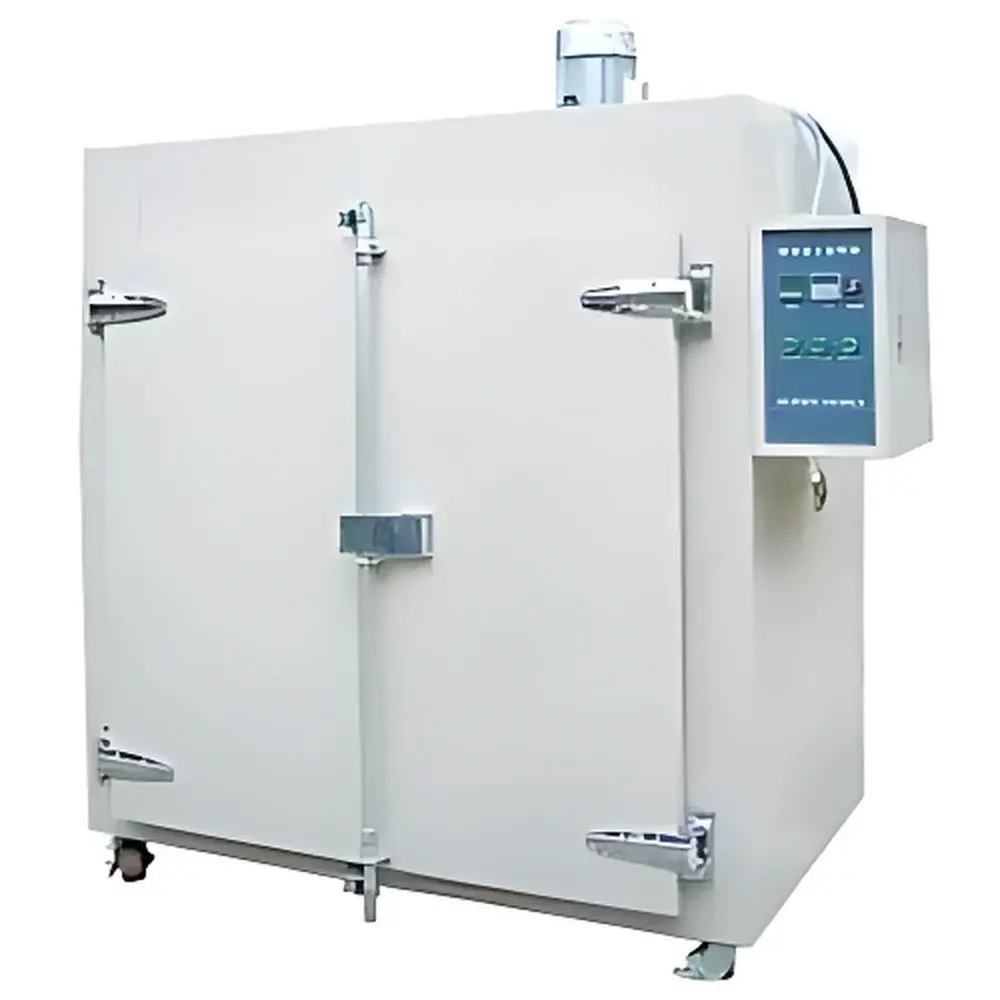
LabCompanion WG Series High-Temperature Environmental Test Chamber
| Brand | LabCompanion |
|---|---|
| Model | WG Series |
| Temperature Range | RT+20°C to +200°C or +400°C |
| Temperature Uniformity | ≤2.0°C at +200°C / ≤7.0°C at +400°C |
| Temperature Fluctuation | ≤±0.5°C |
| Internal Volume | 90 L to 300 L |
| Heating Method | Nickel-Chromium Alloy Heaters |
| Air Circulation | Forced-air, Triple-Side Airflow Duct System |
| Controller | Microprocessor-Based PID with PT100 Sensor |
| Safety | Independent Over-Temperature Protection, Over-Current Circuit Breaker |
| Compliance | GB/T 11158–1989, GB/T 2423.2–1989 |
Overview
The LabCompanion WG Series High-Temperature Environmental Test Chamber is an engineered solution for controlled thermal exposure of materials, components, and electronic devices under sustained elevated temperature conditions. Designed around the principles of convective heat transfer and thermal equilibrium validation, this chamber delivers precise, repeatable, and traceable thermal environments essential for reliability testing, accelerated aging, and process qualification. Unlike general-purpose ovens, the WG Series adheres to internationally recognized environmental test standards—including GB/T 11158–1989 (Technical Requirements for High-Temperature Test Chambers) and GB/T 2423.2–1989 (Test B: Dry Heat)—ensuring metrological integrity in both R&D and production QA/QC workflows. Its dual-range capability (RT+20°C to +200°C or +400°C) supports diverse applications—from polymer annealing and ceramic sintering pre-tests to high-temperature burn-in of PCB assemblies—without requiring separate instrumentation.
Key Features
- Triple-side forced-air circulation system ensures uniform thermal distribution across the working volume, minimizing axial and radial gradients per ISO 16750-4 and IEC 60068-2-2 requirements.
- Microprocessor-based PID temperature controller with PT100 platinum resistance sensor enables stable setpoint maintenance with ≤±0.5°C fluctuation and verified uniformity of ≤2.0°C at +200°C and ≤7.0°C at +400°C (measured per GB/T 11158 Annex B).
- Dual-layer thermal insulation using high-density glass wool and rock wool minimizes external surface temperature rise and improves energy efficiency during extended dwell cycles.
- Stainless steel SUS304 interior chamber and epoxy-coated cold-rolled steel exterior provide corrosion resistance and long-term structural stability in laboratory and industrial settings.
- Independent mechanical over-temperature cut-off circuit—physically isolated from the main controller—complies with Class II safety requirements per IEC 61000-6-2 and prevents thermal runaway under fault conditions.
- Standard 50 mm cable port with removable blanking plug facilitates integration with external monitoring systems, data loggers, or load-cell interfaces without compromising chamber integrity.
Sample Compatibility & Compliance
The WG Series accommodates non-volatile, non-explosive, and non-corrosive specimens including printed circuit boards, semiconductor packages, encapsulated sensors, metal alloys, thermoplastics, and ceramic substrates. It is explicitly not rated for flammable solvents, volatile organic compounds (VOCs), or battery cells undergoing charge/discharge cycling. All models meet national standard GB/T 2423.2–1989 (equivalent to IEC 60068-2-2:2007 Ed. 3.0) for dry heat testing protocols, supporting test profiles used in automotive electronics (e.g., AEC-Q200), aerospace component qualification (SAE ARP4761), and industrial control system validation. Optional RS485/RS232 interfaces enable audit-ready data export compliant with GLP and GMP documentation frameworks.
Software & Data Management
While the base configuration features a standalone LED-display PID controller with fixed-setpoint operation, optional programmable controllers support up to 99 segments and 999 cycles, enabling complex thermal profiles such as ramp-hold-soak sequences required by MIL-STD-810H Method 501.5. Logged temperature data—including real-time chamber air temperature, setpoint deviation, and alarm events—is timestamped and exportable via serial interface for traceability. When integrated with third-party SCADA or LIMS platforms, the system supports 21 CFR Part 11-compliant user access controls, electronic signatures, and immutable audit trails—critical for regulated manufacturing environments.
Applications
- Accelerated life testing of passive components (resistors, capacitors, inductors) per JIS C 5003 and IPC-TM-650.
- Thermal aging of elastomeric seals, gaskets, and adhesives in accordance with ASTM D573 and ISO 188.
- Dry-out and pre-bake cycles for moisture-sensitive devices prior to conformal coating or hermetic sealing.
- Material compatibility screening for high-temperature solder pastes, flux residues, and underfill epoxies.
- Calibration verification of thermocouples, RTDs, and infrared pyrometers under stabilized thermal loads.
- Pre-conditioning of test fixtures and reference standards prior to mechanical or electrical performance evaluation.
FAQ
What is the maximum allowable ambient temperature for reliable operation?
The chamber is specified for use in environments maintained at 23°C ±2°C and 65% RH ±20%. Operation outside this range may affect temperature uniformity and calibration stability.
Can the WG Series be used for humidity-controlled high-temperature testing?
No. This is a dry-heat-only chamber. Humidity control requires a combined temperature/humidity chamber (e.g., LabCompanion TH Series) meeting IEC 60068-2-30.
Is NIST-traceable calibration documentation available?
Yes. Factory calibration certificates with uncertainty budgets are provided upon request; on-site verification services follow ISO/IEC 17025 procedures.
What maintenance intervals are recommended for the heating system and airflow components?
Visual inspection of heater elements and fan blades every 500 operating hours; replacement of silicone door gaskets every 24 months or after 10,000 thermal cycles.
Does the chamber support remote monitoring via Ethernet or Wi-Fi?
Not natively. Ethernet connectivity requires the optional RS485-to-Ethernet gateway module and compatible middleware software.



