
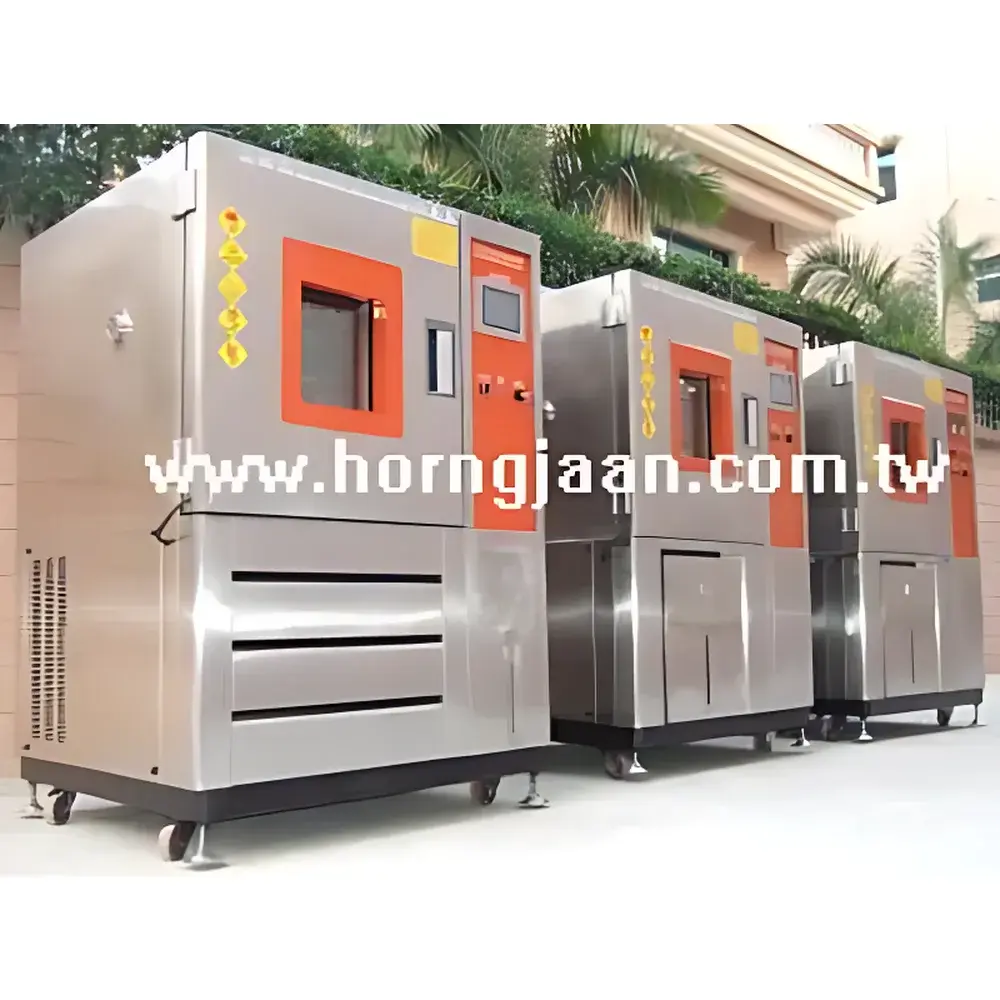
LabCompanion LT-150 LED-Specific High-Low Temperature & Humidity Environmental Test Chamber
| Brand | LabCompanion |
|---|---|
| Model | LT-150 |
| Temperature Range | –40 °C to +150 °C |
| Humidity Range | 10–98 %RH |
| Control Accuracy | ±0.3 °C / ±2 %RH |
| Uniformity | ±0.1 °C / ±4 %RH |
| Construction | SUS#304 Stainless Steel Interior & Exterior |
| Insulation | High-Density PU Foam + Silicone Sponge Gasket |
| Heating System | Stainless Steel Sheathed Immersion Heater |
| Humidification | Steam Generator (PID-Controlled) |
| Refrigeration | Imported High-Efficiency Compressor |
| Controller | Programmable Digital PID with LCD Interface |
| Power Supply | AC 3-Phase 380 V, 50/60 Hz |
| Compliance | Designed per IEC 60068-2 series, ASTM D4332, ISO 16750-4, and JEDEC JESD22-A101 for LED reliability validation |
Overview
The LabCompanion LT-150 is a purpose-engineered environmental test chamber optimized for the accelerated reliability assessment of LED lighting modules, drivers, and optoelectronic assemblies under combined thermal and hygrothermal stress. Unlike generic climate chambers, the LT-150 integrates LED-specific operational constraints—such as low-thermal-mass sample mounting, non-condensing humidity ramp profiles, and minimized radiant heat interference—into its core architecture. It operates on the principle of controlled thermodynamic cycling: precise regulation of air temperature via dual-stage refrigeration and steam-based humidification enables reproducible simulation of real-world service environments—including tropical storage, automotive under-hood conditions, and outdoor streetlight duty cycles. The chamber’s airflow design ensures uniform thermal distribution across the test volume without turbulent disruption to delicate LED phosphor layers or lens adhesives. Its structural integrity, built around seamless SUS#304 stainless steel construction and high-density polyurethane insulation, guarantees long-term dimensional stability and minimal thermal leakage—critical for maintaining traceable test conditions over extended qualification runs (e.g., 1,000-hour HALT or JEDEC JESD22-A104 compliant testing).
Key Features
- LED-optimized thermal profile management: programmable ramp rates (0.5–10 °C/min) and hold times with <±0.3 °C temperature control accuracy and <±2 %RH humidity precision at setpoint
- Dual-stage refrigeration system with imported compressors, enabling stable operation down to –40 °C without oil migration or frost accumulation on critical sensor surfaces
- Steam-type humidification with deionized water feed and automatic drain cycle—eliminates mineral deposition on LED optics and prevents nozzle clogging during prolonged 95 %RH exposure
- Programmable digital PID controller with 128-step sequence capability, user-defined alarm thresholds, and real-time deviation logging (±0.1 °C uniformity across working volume)
- Triple-sealed vacuum-viewing window with anti-fog heating element, permitting continuous optical inspection of LED lumen maintenance or color shift during active thermal cycling
- Integrated analog output (0–10 V DC) for temperature and humidity signals—compatible with external data loggers meeting FDA 21 CFR Part 11 audit trail requirements
- Comprehensive safety architecture: independent mechanical over-temperature cutoff, auto-shutoff on low-water-level detection, compressor overload protection, and phase-loss monitoring
Sample Compatibility & Compliance
The LT-150 accommodates standard LED test boards (up to 400 mm × 400 mm), COB modules, and complete luminaires using adjustable stainless steel shelf supports with non-reactive silicone grommets. Its internal geometry avoids localized condensation zones that could induce electrochemical migration in PCB traces—a known failure mode in high-RH LED applications. The chamber conforms to key industry standards governing photometric and reliability testing: IEC 60068-2-1 (cold), -2 (dry heat), -14 (change of temperature), -30 (damp heat cyclic), and -78 (condensation). It further supports test execution per JEDEC JESD22-A101 (steady-state damp heat), A104 (temperature cycling), and A110 (highly accelerated temperature and humidity stress test—HAST), making it suitable for qualifying LED packages against AEC-Q102 automotive requirements. All control firmware implements GLP-compliant event logging with timestamped operator actions and parameter changes.
Software & Data Management
The embedded controller provides native RS-485 Modbus RTU and optional Ethernet TCP/IP connectivity for integration into centralized lab management systems (LIMS). Data export is supported in CSV format with millisecond-resolution timestamps for post-test correlation with photometric degradation metrics (e.g., L70 lifetime estimation). Optional software add-ons include automated report generation aligned with ISO/IEC 17025 documentation requirements, including calibration certificate linkage, uncertainty budgeting per GUM, and electronic signature support compliant with 21 CFR Part 11 Annex 11. Raw sensor data (Pt100 RTD, capacitive RH sensor) is sampled at 2 Hz and filtered using median+low-pass algorithms to suppress EMI-induced noise from adjacent switching power supplies—common in LED driver validation labs.
Applications
- Accelerated life testing of GaN-based white LEDs under combined thermal-hygric stress to model lumen depreciation and chromaticity drift
- Qualification of silicone encapsulants and phosphor conversion layers against moisture-induced delamination at elevated temperatures
- Validation of thermal interface materials (TIMs) used between LED junctions and heatsinks under cyclic thermal loading
- Environmental screening of LED drivers per MIL-STD-810G Method 502.6 (low temperature), 507.5 (humidity), and 506.5 (temperature shock)
- Pre-compliance testing for ENERGY STAR SSL V2.1 and DLC Premium program requirements related to thermal management robustness
- Root cause analysis of early-life failures in outdoor LED signage exposed to diurnal humidity swings and solar thermal loading
FAQ
What is the maximum allowable sample power load inside the LT-150 chamber?
The chamber supports up to 500 W of internal heat dissipation from powered LED samples without compromising temperature uniformity—verified per IEC 60068-3-5 Annex B.
Can the LT-150 perform rapid temperature transitions required for LED thermal shock testing?
Yes—it achieves 20 °C/min ramp rates between –40 °C and +150 °C within specification limits, meeting JEDEC JESD22-A106B for solder joint fatigue evaluation.
Is the humidification system compatible with deionized water only?
Yes. Use of DI water (resistivity ≥1 MΩ·cm) is mandatory to prevent scaling and ensure long-term steam generator reliability.
Does the controller support remote monitoring and alarm notification?
Standard Ethernet option enables SNMP trap alerts, email notifications on deviation exceedance, and secure HTTPS-based web interface access.
What calibration documentation is provided with shipment?
Each unit ships with NIST-traceable factory calibration certificates for temperature (–40 °C to +150 °C) and humidity (10–98 %RH), plus uncertainty budgets calculated per ISO/IEC 17025:2017 Clause 7.6.



