
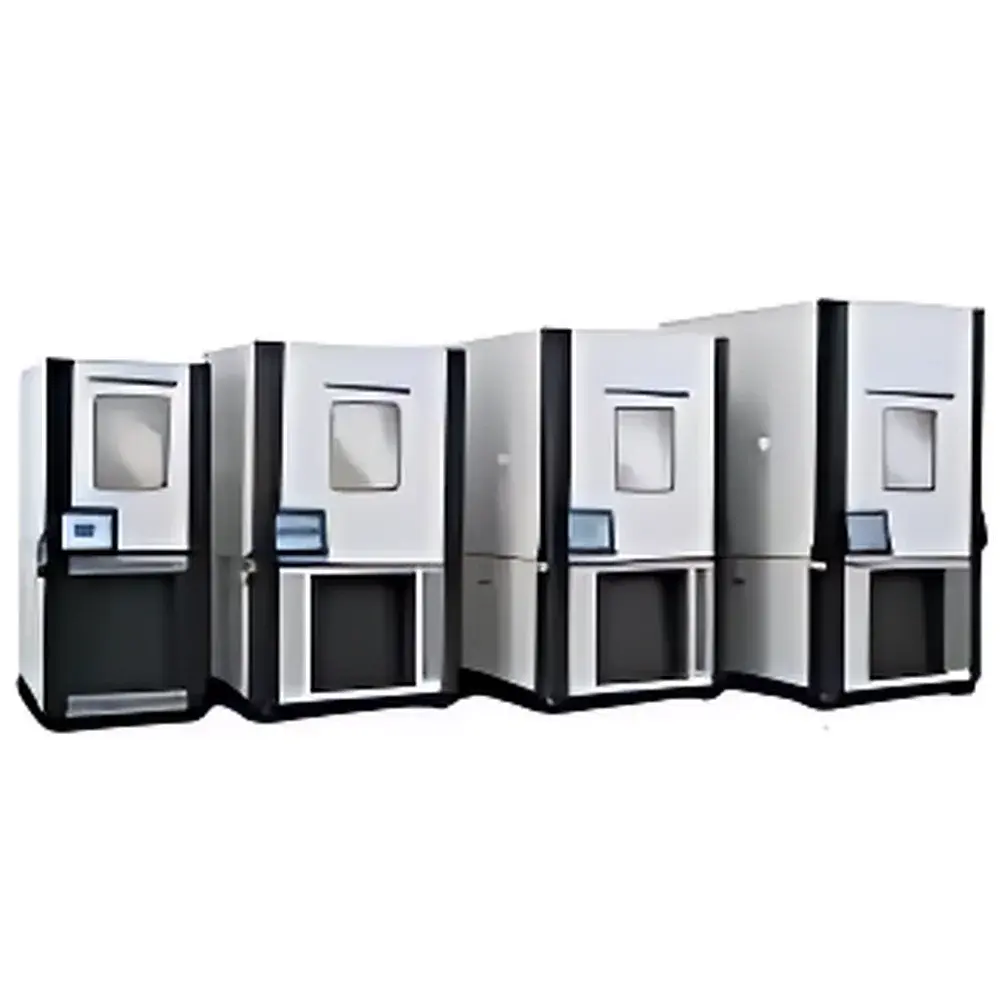
LabCompanion CS101-E Forced-Air Drying Oven
| Brand | LabCompanion |
|---|---|
| Model | CS101-E |
| Type | Forced-Air Circulating Drying Oven |
| Temperature Range | R.T.+10°C to 300°C |
| Temperature Uniformity | ±2.5% |
| Temperature Fluctuation | ±0.5°C |
| Heating Rate (to 300°C) | ≤70 min |
| Control System | Microprocessor-based PID Controller with Self-Tuning |
| Temperature Sensor | Industrial Platinum RTD (PT100) |
| Interior Material | SUS304 Mirror-Finish Stainless Steel (BN variant) or Pre-treated Cold-Rolled Steel (EN variant) |
| Insulation | High-Density Ultra-Fine Glass Fiber |
| Viewing Window | Double-Layer Heat-Resistant Tempered Glass |
| Safety Features | Independent Over-Temperature Protection, Over-Current Circuit Breaker |
| Power Supply | AC 220 V, 50 Hz |
| Rated Power | 1.5 kW (CS101-1EBN), 2.5 kW (CS101-2EBN), 3.0 kW (CS101-3EBC) |
| Internal Volume | 72 L / 137.5 L / 234 L |
| Compliance | JB/T 5520–1991 Technical Specification for Drying Ovens |
Overview
The LabCompanion CS101-E is a precision-engineered forced-air circulating drying oven designed for laboratory and industrial applications requiring stable thermal environments for drying, baking, sterilization, curing, and aging processes. Operating on the principle of convection-driven heat transfer, the unit employs a centrifugal blower and optimized internal airflow ducting to ensure uniform temperature distribution across the working chamber—critical for reproducible thermal treatment of sensitive components such as semiconductors, passive electronic elements (e.g., capacitors, resistors, quartz crystals), and optoelectronic assemblies (LEDs, LCDs). Its microprocessor-based PID temperature controller enables dynamic compensation and self-tuning capability, minimizing steady-state error and maintaining thermal stability within ±0.5°C fluctuation under no-load conditions. The oven meets the mechanical and performance requirements specified in JB/T 5520–1991, China’s national standard for drying ovens, and serves as a foundational thermal platform compatible with broader quality management frameworks including ISO/IEC 17025, GLP, and GMP-aligned process validation protocols.
Key Features
- Forced-air circulation architecture with forward-curved centrifugal fan and directional air baffles for enhanced thermal homogeneity (±2.5% uniformity across chamber volume)
- Dual-stage temperature safety system: primary PID-controlled heating + independent mechanical over-temperature cut-off switch (fail-safe redundancy)
- High-resolution LED display showing both setpoint and real-time PT100-sensed chamber temperature simultaneously
- User-programmable timer (0–999 minutes) with automatic termination and audible alert upon completion
- Modular vertical assembly design maximizing floor-space efficiency while supporting structural rigidity and thermal isolation
- Double-layer heat-resistant tempered glass observation window enabling non-intrusive visual monitoring without thermal leakage
- Energy-efficient insulation using ultra-fine glass fiber (≥80 mm thickness) and environmentally compliant silicone door gasketing
- Standard configuration includes two adjustable stainless steel shelves and four support rods; optional accessories include programmable controllers, RS485 communication modules, and cable ports
Sample Compatibility & Compliance
The CS101-E is validated for use with non-flammable, non-explosive solid and granular samples—including printed circuit boards, polymer films, pharmaceutical excipients, ceramic precursors, and metal oxide powders. It excludes volatile organic solvents, reactive metals, or oxygen-sensitive materials unless operated under inert gas purging (requires optional modification). Chamber construction adheres to material compatibility standards for cleanroom-adjacent environments: SUS304 interior (BN series) resists corrosion from mild acidic vapors and repeated thermal cycling, while EN-series cold-rolled steel interiors undergo high-temperature silver-powder coating for oxidation resistance. All electrical components conform to IEC 61000-6-3 (EMC emission limits) and IEC 61000-6-2 (immunity requirements). The unit supports audit-ready documentation for regulatory submissions where thermal process traceability is mandated (e.g., FDA 21 CFR Part 11-compliant data logging via optional RS485 interface).
Software & Data Management
While the base CS101-E operates via standalone hardware controls, its optional RS485 serial interface enables integration into centralized laboratory information management systems (LIMS) or SCADA networks. When paired with LabCompanion’s optional programmable temperature controller (PCT-2000 series), users gain access to multi-segment ramp-soak profiles, event-triggered data logging, and password-protected parameter locking—features essential for IQ/OQ/PQ validation workflows. All temperature records generated through the optional module include timestamped metadata (setpoint, actual reading, deviation, alarm status), supporting ALCOA+ principles (Attributable, Legible, Contemporaneous, Original, Accurate, Complete, Consistent, Enduring, Available) for GLP/GMP compliance. Firmware updates are performed via secure USB upload; no cloud dependency or third-party vendor lock-in is required.
Applications
- Electronics manufacturing: Burn-in testing and moisture removal for SMT components prior to encapsulation
- Materials science: Pre-drying of ceramic green bodies, solvent evaporation from thin-film coatings, and post-sintering annealing
- Pharmaceutical R&D: Moisture content reduction in active pharmaceutical ingredients (APIs) and excipients under controlled thermal stress
- Academic research: Accelerated aging studies of polymeric insulators, battery electrode materials, and composite laminates
- Quality assurance labs: Standardized drying per ASTM D2240 (Shore hardness) sample conditioning or ISO 527 tensile specimen preparation
- Food safety testing: Dehydration of microbiological swab media and residual moisture analysis in packaged goods
FAQ
What is the maximum operating temperature of the CS101-E?
The CS101-E is rated for continuous operation up to 300°C, with thermal stability maintained across the full range per JB/T 5520–1991 specifications.
Can this oven be used for sterilization of glassware?
Yes—when operated at ≥160°C for ≥2 hours, it achieves dry-heat sterilization efficacy equivalent to ISO 17665-1 Annex B guidelines for depyrogenation of heat-stable equipment.
Is the PT100 sensor calibrated and traceable to NIST standards?
The factory-installed PT100 sensor is calibrated against reference standards accredited to CNAS (China National Accreditation Service), with optional NIST-traceable calibration certificates available upon request.
Does the oven support vacuum operation?
No—the CS101-E is not designed for vacuum environments; vacuum drying requires dedicated vacuum oven models (e.g., LabCompanion VO series) with reinforced chamber walls and sealing mechanisms.
How often should preventive maintenance be performed?
Recommended maintenance includes quarterly inspection of fan bearings, biannual verification of door seal integrity, and annual recalibration of temperature control loop—documented in the included maintenance log template.



