
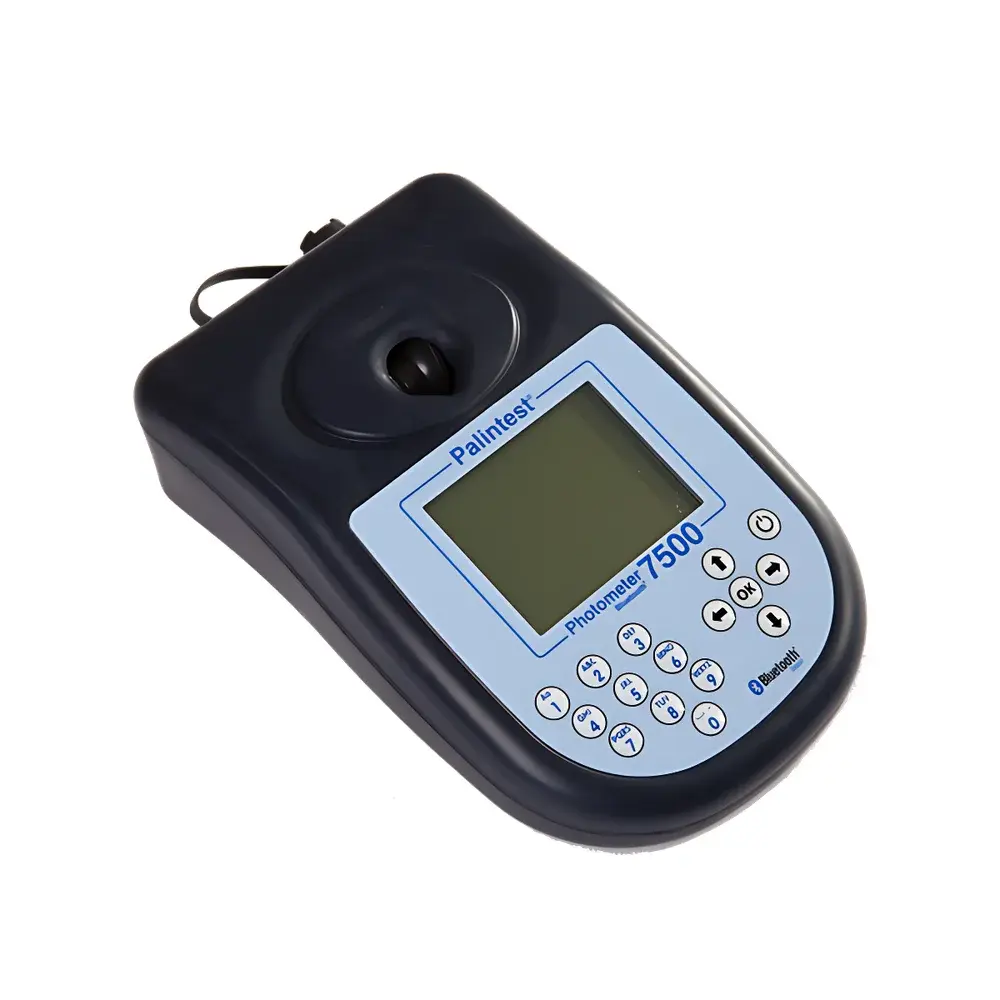
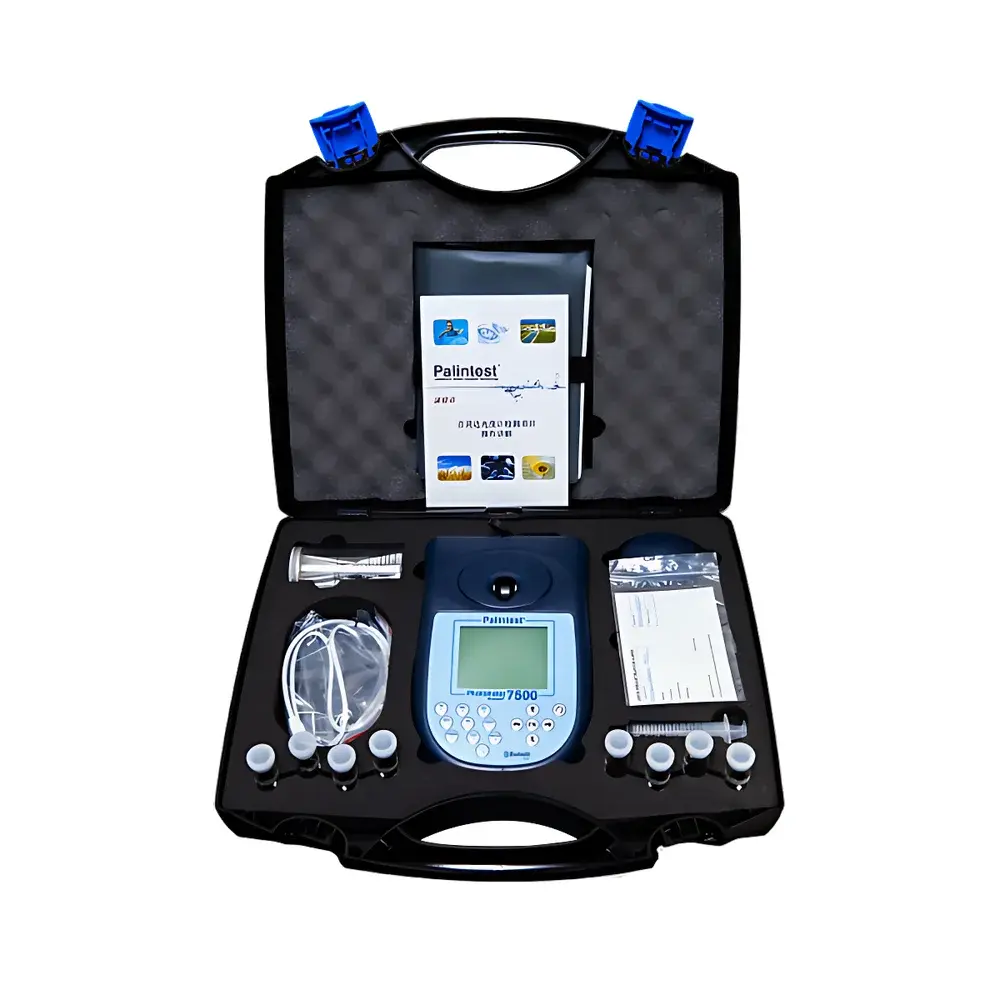
Palintest PTBH7500 Portable Multi-Parameter Photometer
| Brand | Palintest |
|---|---|
| Origin | United Kingdom |
| Model | PTBH7500 |
| Instrument Type | Portable photometer |
| Detection Methods | DPD, colorimetric, spectrophotometric |
| Wavelengths | 450 nm, 500 nm, 550 nm, 570 nm, 600 nm, 650 nm |
| Optical Resolution | 0.001 AU |
| Photometric Accuracy | ±1% T |
| Protection Rating | IP67 |
| Display | Backlit LCD with multi-language support (English, Chinese) |
| Memory Capacity | 500 test results with timestamp, parameter ID, and sample ID |
| Custom Calibration Curves | Up to 30 user-defined curves |
| Data Interface | Waterproof USB port and Bluetooth 4.0 |
| Power Supply | 3 × AA batteries or USB bus power |
| Dimensions | 150 × 250 × 70 mm |
| Weight | 975 g |
| Certifications | CE, CPA (UK Water Regulations Advisory Scheme) |
Overview
The Palintest PTBH7500 Portable Multi-Parameter Photometer is a field-deployable, high-precision colorimetric analyzer engineered for rapid, reliable quantification of over 100 water quality parameters across environmental monitoring, public health, industrial process control, and regulatory compliance applications. As the original developer of the DPD (N,N-diethyl-p-phenylenediamine) method for chlorine analysis, Palintest integrates decades of photometric methodology expertise into this instrument’s optical architecture. The PTBH7500 operates on fixed-wavelength photometry—utilizing six discrete LED sources (450, 500, 550, 570, 600, and 650 nm)—to eliminate spectral drift and ensure consistent absorbance measurement across diverse reagent chemistries. Its sealed optical path, temperature-compensated detector, and auto-zeroing algorithm deliver high reproducibility (±1% transmittance) under variable ambient conditions. Designed for rugged field use, the unit meets IP67 ingress protection standards, enabling operation in rain, dust, or high-humidity environments without performance degradation.
Key Features
- IP67-rated enclosure with shock-absorbing elastomer overmold for drop resistance and immersion tolerance up to 1 m for 30 minutes
- Dual communication interface: waterproof USB port compliant with USB 2.0 specifications and Bluetooth 4.0 Low Energy for secure wireless data transfer to desktop or mobile platforms
- Onboard memory stores 500 complete test records—including parameter name, measured value, date/time stamp, sample ID, dilution factor, and operator code
- Support for up to 30 user-defined calibration curves using external standard solutions; curve types include linear, quadratic, and polynomial fits
- Multi-language UI (English and Chinese) with configurable display settings: date format (DD/MM/YYYY or MM/DD/YYYY), concentration units (mg/L, ppm, µg/L), and sample coding protocols
- Optimized cuvette chamber accommodates standard 12–20 mm round glass or plastic tubes; automatic tube-diameter detection ensures correct pathlength compensation
- Battery-powered operation (3 × AA alkaline cells) with >2,000 measurements per set; USB bus-power mode enables continuous operation during data download or firmware updates
Sample Compatibility & Compliance
The PTBH7500 supports both solid reagent tablets and liquid reagent kits validated per ISO 7027 (turbidity), ISO 6777 (ammonia), ISO 8467 (COD), ISO 11908 (phosphate), and EN ISO 15586 (nitrate/nitrite). It is routinely deployed in laboratories and field teams adhering to EPA Method 334.0 (chlorine), APHA Standard Methods 4500-Cl G (DPD), and WHO Guidelines for Drinking-water Quality (4th ed.). All pre-formulated reagents are manufactured under ISO 9001-certified processes and supplied with lot-specific Certificate of Analysis. The instrument itself carries UK CPA (Drinking Water Inspectorate) approval for statutory testing of potable supplies and CE marking per Directive 2014/30/EU (EMC) and 2014/35/EU (LVD). Its audit-ready data structure—including immutable timestamps, operator IDs, and full traceability of calibration events—supports GLP and ISO/IEC 17025 laboratory accreditation requirements.
Software & Data Management
Data export is facilitated via Palintest’s proprietary PC software (compatible with Windows 10/11), which enables batch report generation in PDF or CSV formats, statistical trend analysis, and LIMS integration through ODBC-compliant database drivers. Raw absorbance values, blank-subtracted readings, and curve-fitting residuals are retained alongside final concentrations. For mobile workflows, the Palintest Connect app (iOS/Android) provides real-time synchronization, geotagging of field measurements, and push notifications for out-of-spec results. All firmware updates are digitally signed and verified at boot time to maintain integrity. Audit trail functionality complies with FDA 21 CFR Part 11 requirements when used with appropriate system configuration controls—including electronic signatures, role-based access, and tamper-evident log files.
Applications
- Drinking water utilities: routine verification of residual disinfectants (free/total chlorine, chloramine, ozone), turbidity, fluoride, nitrate, and hardness
- Wastewater treatment plants: monitoring of ammonia, total phosphorus, COD (low- and high-range), iron, manganese, and sulfide in influent, effluent, and sludge streams
- Swimming pool & spa management: simultaneous assessment of free chlorine, cyanuric acid, pH, bromine, and copper—critical for compliance with EN 15288 and PWTAG standards
- Industrial cooling water systems: quantification of phosphate (corrosion inhibitor), molybdate, zinc, and total alkalinity to optimize biocide dosing and scale inhibition
- Environmental field surveys: rapid screening of surface water, groundwater, and stormwater for nutrients (TN, TP), heavy metals (Cr⁶⁺, Ni, Cu), and organic contaminants (COD, phenols)
- Public health laboratories: confirmatory testing for WHO-recommended parameters in emergency response or outbreak investigations
FAQ
What reagent formats does the PTBH7500 support?
It accepts both Palintest’s proprietary solid reagent tablets (e.g., PM-series) and liquid reagent kits (PL-series), including mercury-free COD methods certified to ISO 8467. Reagent compatibility is managed via embedded assay library codes.
Can the instrument be calibrated traceably to NIST standards?
Yes—using the optional PT 804 Photometer Verification Kit, which includes NIST-traceable neutral density filters and a UKAS-accredited calibration certificate for optical path validation.
Is Bluetooth pairing secure against unauthorized access?
Bluetooth 4.0 LE implements AES-128 encryption and requires manual pairing confirmation on both device and host, preventing passive eavesdropping or spoofing.
How is data integrity maintained during USB transfer?
All exported datasets include SHA-256 checksums; the software verifies file integrity before import and logs any mismatch event in the audit trail.
Does the PTBH7500 meet drinking water regulatory reporting requirements in the EU and USA?
Yes—it satisfies UK DWI CPA criteria, German TrinkwV Annex 3 analytical validity clauses, and US EPA-approved methods for chlorine, nitrate, and phosphate when used with certified reagents and documented SOPs.
Related Products







