
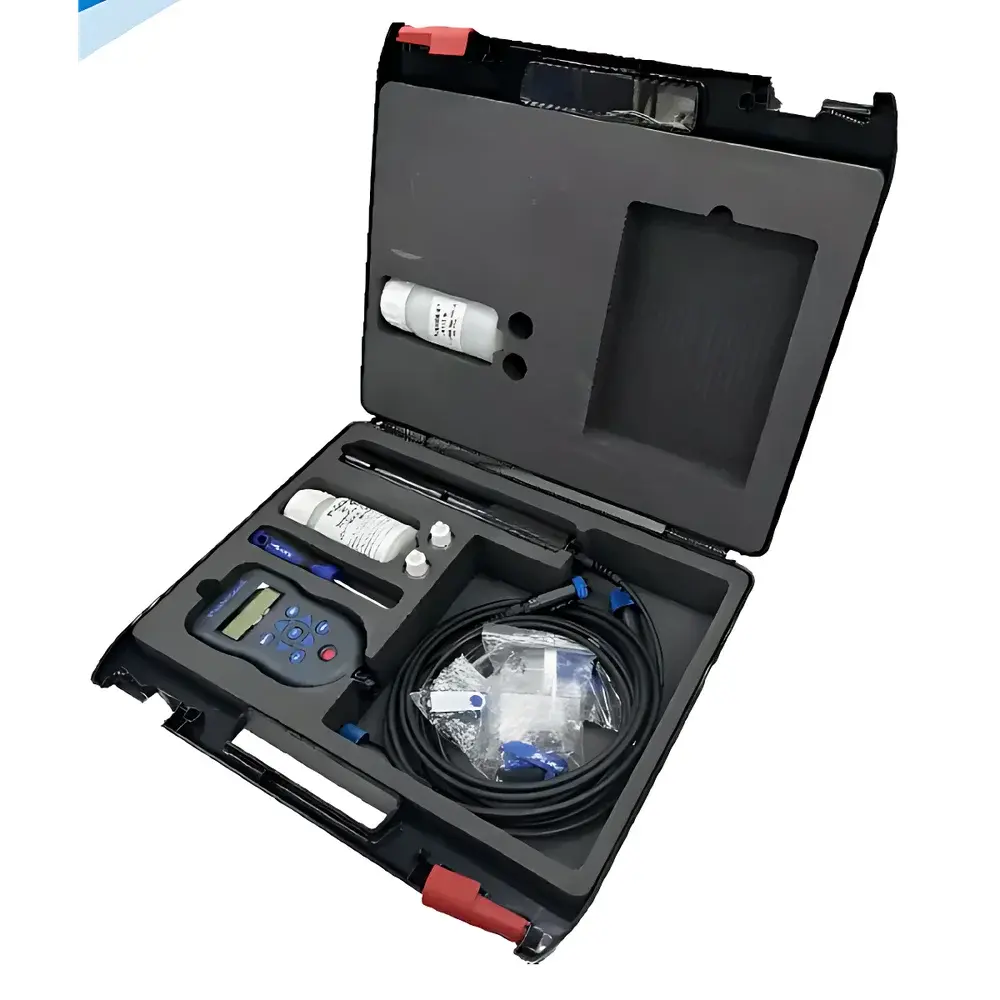
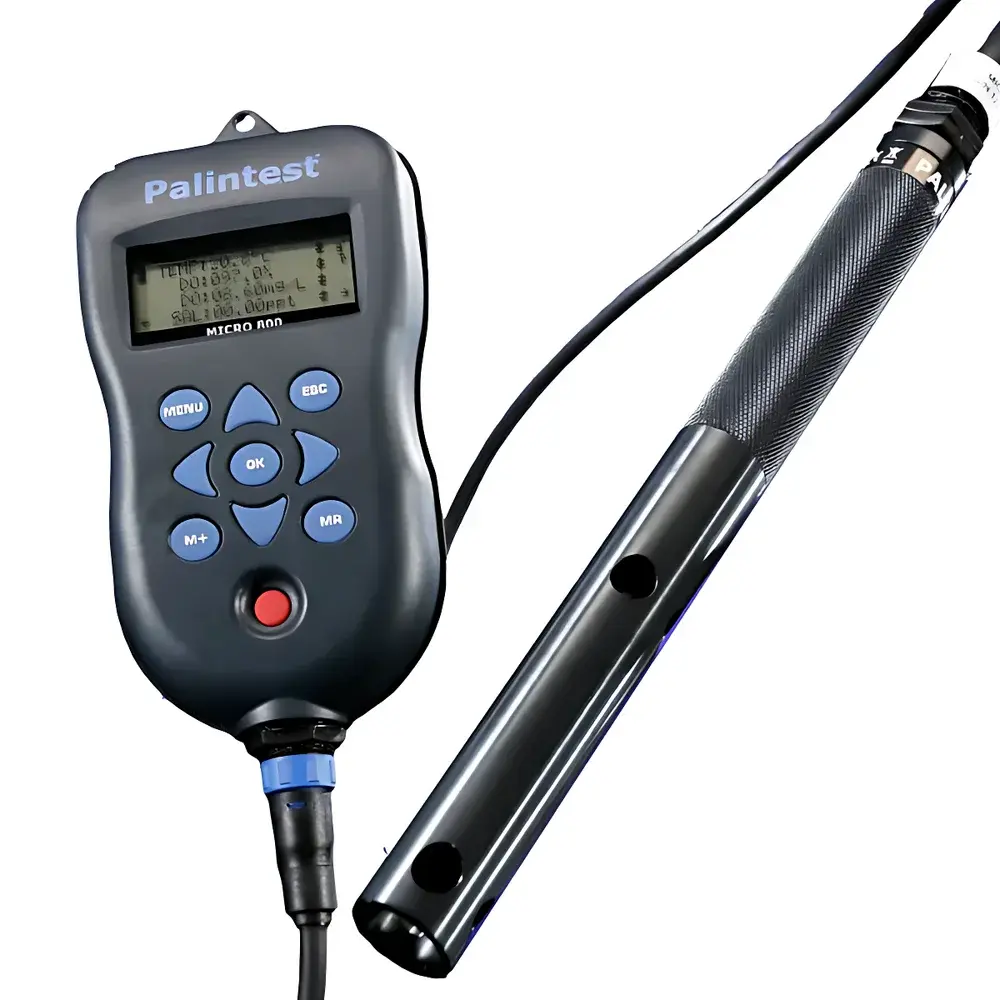
Palintest Macro 900-AP700 Portable Multiparameter Water Quality Analyzer
| Brand | Palintest |
|---|---|
| Origin | United Kingdom |
| Model | AP-700 |
| Instrument Type | Portable / Handheld Water Quality Analyzer |
| Measured Parameters | Conductivity, Dissolved Oxygen (DO), Oxidation-Reduction Potential (ORP), pH, Resistivity, Salinity, Total Dissolved Solids (TDS), Seawater Specific Gravity (σt), Temperature |
| Detection Principle | Electrochemical (membrane-based DO, combination pH/ORP electrodes, conductivity cell) and Thermistor-based temperature sensing |
| Connectivity | GPS-integrated handheld host with 3 m cable |
| Probe Architecture | Modular multi-sensor probe with 4 expansion ports (2 for ISEs, 2 for optical sensors) |
| Cleaning System | Dual-motor brush cleaning mechanism |
| Compliance | Designed for field-deployable GLP-aligned data collection |
Overview
The Palintest Macro 900-AP700 Portable Multiparameter Water Quality Analyzer is an engineered field instrument designed for simultaneous, real-time measurement of nine core water quality parameters—conductivity, dissolved oxygen (DO), oxidation-reduction potential (ORP), pH, resistivity, salinity, total dissolved solids (TDS), seawater specific gravity (σt), and temperature—in a single immersion event. Its measurement architecture integrates electrochemical transduction principles: membrane-covered polarographic DO sensing, combination glass-body pH/ORP electrodes, four-electrode conductivity cells, and precision thermistors. The system operates on the principle of direct analog signal acquisition, digitized via high-resolution ADCs (16-bit minimum), with automatic range switching to maintain optimal signal-to-noise ratio across wide dynamic spans. Unlike benchtop analyzers optimized for controlled lab environments, the AP-700 is purpose-built for ambient deployment in rivers, lakes, estuaries, groundwater wells, and coastal zones—where mechanical robustness, thermal stability, and resistance to biofouling are critical operational requirements.
Key Features
- Modular probe design with integrated 9-parameter sensor array—no manual probe swapping required during sequential measurements.
- Dual-motor brush cleaning system enables autonomous probe surface maintenance between readings, significantly reducing drift during extended unattended deployments (e.g., 72+ hr continuous monitoring).
- Four expansion ports support up to two additional ion-selective electrodes (ISEs) and two optical sensors—enabling configurable extension to ammonium, nitrate, chloride, fluoride, calcium, turbidity, chlorophyll-a, phycocyanin, phycoerythrin, rhodamine WT, oil-in-water, or fluorescein detection.
- Integrated GPS module geotags every data point with WGS84 coordinates and UTC timestamp, ensuring spatial traceability required for regulatory reporting and watershed mapping.
- Auto-ranging electronics dynamically select optimal measurement ranges for conductivity (0–9999 µS/cm, 10.00–99.99 mS/cm, 100.0–200.0 mS/cm), resistivity (5–9999 Ω·cm, 10.0–1000.0 kΩ·cm), and TDS (0–9999 mg/L, 10.00–100.00 g/L), eliminating user-induced range errors.
- Ruggedized IP67-rated handheld host with sunlight-readable transflective display, programmable sampling intervals (1 sec–24 hr), and internal 8 GB non-volatile memory supporting >1 million records.
Sample Compatibility & Compliance
The AP-700 is validated for use across freshwater, brackish, and marine matrices—including low-conductivity upland streams (≥5 µS/cm), eutrophic reservoirs, tidal estuaries (up to 70 PSU), and hypersaline lagoons. All electrochemical sensors comply with ISO 5814 (DO), ISO 7888 (conductivity), and ASTM D1293 (pH) test methodologies. Calibration protocols adhere to EPA Method 150.1 (conductivity/TDS), 365.1 (pH), and 360.1 (DO), with documented traceability to NIST-traceable reference standards. Data integrity meets GLP and GMP expectations through mandatory calibration logging (date, operator ID, standard used, deviation), electronic signature capability, and tamper-evident file structure. While not FDA 21 CFR Part 11 certified out-of-box, its audit trail functionality satisfies pre-approval data governance requirements for environmental impact assessments and discharge permit compliance.
Software & Data Management
Data export occurs via USB-C or Bluetooth 5.0 to Palintest AquaLink Desktop Software (Windows/macOS), which provides automated QA/QC flagging—including outlier detection based on user-defined parameter correlation thresholds (e.g., inverse DO–temperature relationship). Raw .csv and .xlsx outputs include metadata headers (probe serial number, firmware version, GPS accuracy estimate, battery voltage). The software supports batch calibration curve generation using multi-point standard series, with residual error reporting per electrode. Field firmware updates are delivered via signed .bin packages, verified through SHA-256 checksum validation prior to installation—ensuring device integrity across distributed monitoring networks.
Applications
- Regulatory surface water surveillance under EU WFD Article 8 or US Clean Water Act Section 305(b) reporting frameworks.
- Groundwater plume tracking during remediation projects, leveraging ORP/pH/conductivity triad to identify redox boundaries and contaminant migration fronts.
- Aquaculture site optimization—real-time DO/pH/salinity feedback enables automated aeration and dosing control integration via optional 4–20 mA analog output module.
- Wastewater effluent compliance verification at discharge points, particularly for TDS and conductivity limits specified in local permits.
- Academic limnology studies requiring high-temporal-resolution profiling across vertical water columns using optional depth-rated probe housings (up to 100 m).
FAQ
What is the recommended calibration frequency for field deployments?
Calibration is required before each sampling day when operating under ISO/IEC 17025 or EPA-compliant protocols; for long-term unattended use, in-situ calibration checks every 72 hours are advised using portable check standards.
Can the AP-700 be deployed continuously for online monitoring?
Yes—when mounted in a fixed housing with external power and telemetry (e.g., cellular or LoRaWAN gateway), it functions as a permanent node; the dual-brush system extends service intervals to ≥14 days without manual intervention.
Is sensor replacement performed in-field or only at authorized service centers?
All electrochemical sensors—including pH, ORP, DO membrane caps, and conductivity cells—are user-replaceable using standard Torx tools; optical sensor modules require factory recalibration post-installation.
Does the system support third-party ISEs or optical sensors?
No—only Palintest-certified ISEs and optical modules are electrically and mechanically compatible due to proprietary pinout, gain calibration, and firmware handshake protocols.
How is temperature compensation applied across parameters?
Temperature compensation is applied algorithmically per parameter: conductivity uses EN 27888 polynomial, DO applies Stern–Volmer correction, and pH employs Nernstian slope adjustment—all referenced to the integrated thermistor’s 0.01 °C resolution reading.
Related Products







