
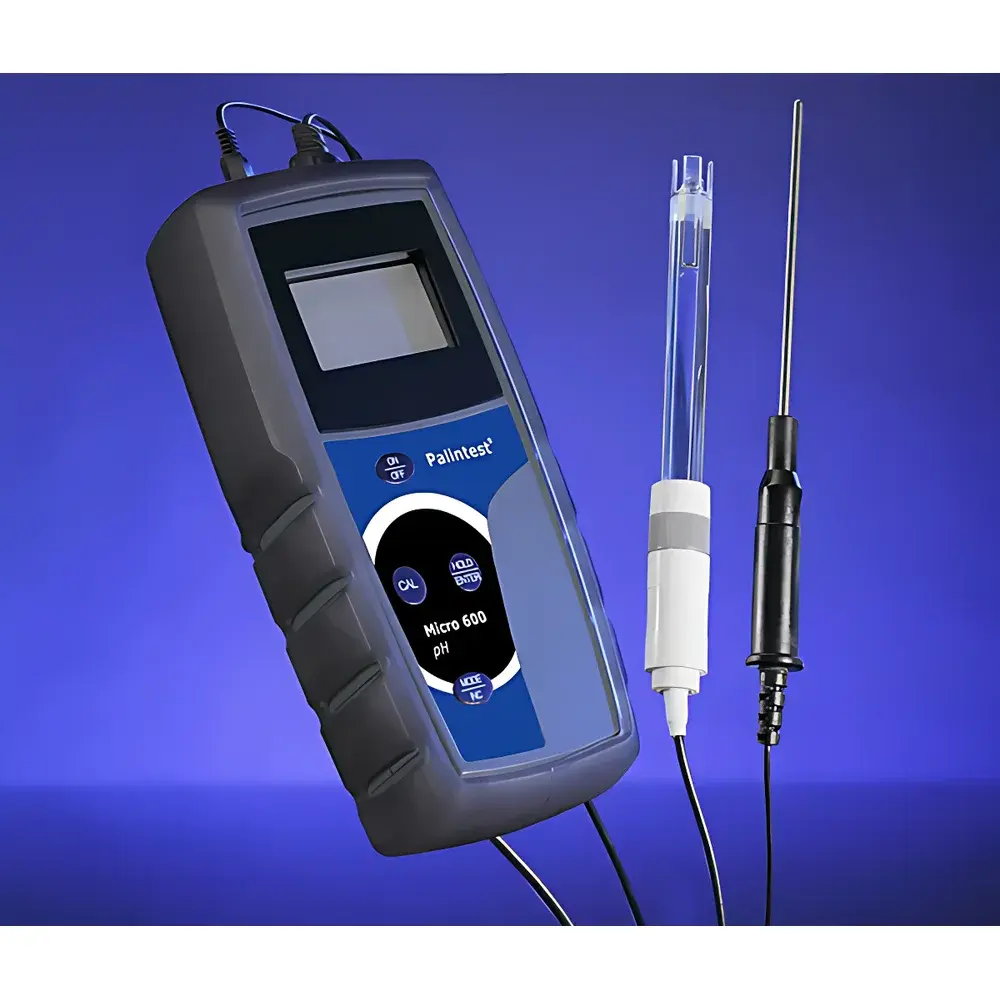
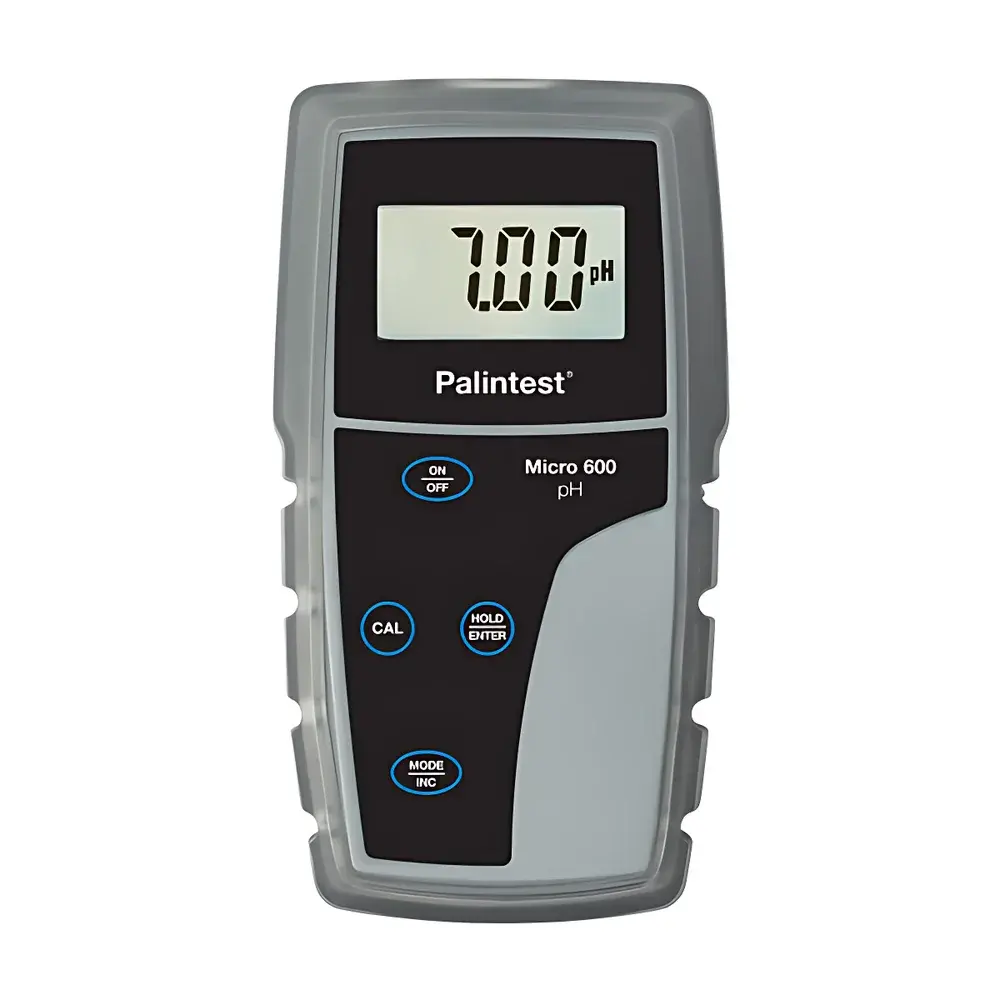
Palintest Micro 600 Portable pH/ORP Meter
| Brand | Palintest |
|---|---|
| Origin | United Kingdom |
| Model | Micro 600 pH |
| Instrument Type | Portable |
| Parameter Types | Dual (pH + Temperature) |
| pH Measurement Range | 0.00–14.00 pH |
| pH Resolution | 0.01 pH |
| pH Accuracy | ±0.01 pH |
| pH Calibration Points | 1–5 points |
| Recognized Buffers | NIST-traceable (pH 1.68, 4.01, 6.86, 9.18, 12.45) and USP/ASTM (pH 1.68, 4.01, 7.00, 10.01, 12.45) |
| Slope Acceptance Range | 80–120% |
| Temperature Range | 0.0–100.0 °C |
| Temperature Resolution | 0.1 °C |
| Temperature Accuracy | ±0.5 °C |
| Temperature Compensation | Automatic or Manual (0–100 °C) |
| mV Range | −1000 to +1000 mV |
| mV Resolution | 1 mV |
| mV Accuracy | ±2 mV |
| Display | Single-line LCD |
| Power | 4 × AAA alkaline batteries (>100 h operation) |
| Dimensions | 140 × 70 × 35 mm |
| Weight | 200 g |
| Auto-off | After 17 min inactivity |
Overview
The Palintest Micro 600 Portable pH/ORP Meter is a field-deployable, dual-parameter electrochemical analyzer engineered for precision and reliability in demanding water quality assessment environments. Based on potentiometric measurement principles, the instrument determines hydrogen ion activity (pH) via a glass electrode and reference junction, while simultaneously measuring redox potential (ORP) when equipped with a compatible platinum or gold electrode. Its design adheres to fundamental electrochemical standards including ISO 3696 (water for analytical laboratory use), ASTM D1293 (standard test method for pH of water), and EN ISO 10523 (water quality — determination of pH). The Micro 600 integrates automatic temperature compensation (ATC) using an integrated thermistor or optional external temperature probe (PT 140/4), ensuring pH readings are corrected to 25 °C per NIST-recommended algorithms. Unlike benchtop meters, its compact form factor and battery-powered architecture make it suitable for routine monitoring in wastewater treatment plants, environmental field surveys, aquaculture operations, swimming pool maintenance, and industrial process water control—where portability, robustness, and traceable calibration are non-negotiable.
Key Features
- True dual-parameter capability: simultaneous pH and temperature measurement with optional ORP extension via PT 110/3B electrode
- Intelligent buffer recognition: auto-detects and validates NIST- and USP-compliant calibration standards (pH 1.68, 4.01, 6.86, 9.18, 12.45) during multi-point calibration
- Calibration diagnostics: real-time slope calculation (80–120%) and offset verification ensure electrode health and measurement integrity
- Flexible calibration modes: supports both manual and automatic 1–5 point calibration; user-selectable calibration sequence and buffer order
- Dual display modes: toggles between pH units and millivolt output for direct electrode response evaluation or redox troubleshooting
- Low-power architecture: 4×AAA alkaline cells deliver >100 hours of continuous operation; auto-power-off after 17 minutes of inactivity conserves battery life
- Rugged handheld enclosure: IP65-rated housing resists dust and water splashes; ergonomic dimensions (140 × 70 × 35 mm) and 200 g mass enable one-handed operation in confined or wet locations
Sample Compatibility & Compliance
The Micro 600 is validated for aqueous samples across a broad conductivity range (≥50 µS/cm), including drinking water, surface water, effluent, cooling tower water, and hydroponic nutrient solutions. It complies with GLP-aligned data integrity practices through uneditable calibration logs stored in non-volatile memory. While the device itself does not provide electronic audit trails required under FDA 21 CFR Part 11, its calibration records—including date/time stamp, buffer IDs, slope, offset, and temperature at time of calibration—can be manually transcribed into LIMS or QA documentation systems. Electrode compatibility follows ISE (ion-selective electrode) conventions: standard BNC connectors accept Palintest PT 110/1B (refillable gel-filled pH electrode), PT 110/3B (ORP electrode), and third-party electrodes meeting DIN 19265 / IEC 60746-2 mechanical and electrical specifications.
Software & Data Management
The Micro 600 operates as a standalone, firmware-driven instrument without PC connectivity or proprietary software. All configuration, calibration, and measurement functions are managed via intuitive front-panel key navigation. Calibration history—including up to five recent sessions—is retained in persistent memory and accessible via the “CAL LOG” menu. No firmware updates or driver installations are required; however, users are advised to maintain version consistency by referencing Palintest Technical Bulletin TB-MICRO600-REV3 (current as of Q2 2024) for electrode conditioning protocols, buffer storage guidelines, and temperature compensation algorithm notes. For regulated environments requiring full traceability, laboratories must supplement instrument outputs with handwritten or LIMS-entered metadata (analyst ID, sample ID, ambient conditions, electrode lot number).
Applications
- Environmental field testing: rapid pH and ORP profiling of rivers, lakes, and groundwater per EPA Method 150.1 and ISO 5667-3
- Wastewater process control: monitoring neutralization basins, anaerobic digesters, and disinfection contact tanks
- Swimming pool & spa management: verifying compliance with WHO Guidelines for Safe Recreational Water Environments and national bathing water directives
- Food & beverage production: spot-checking rinse water, brine solutions, and CIP (clean-in-place) return streams
- Educational laboratories: teaching core concepts of acid-base equilibria, Nernst equation derivation, and electrode kinetics
- Aquaculture and hydroponics: maintaining optimal pH stability for nitrifying bacteria and nutrient uptake efficiency
FAQ
Does the Micro 600 support GLP-compliant electronic signatures or audit trails?
No. The instrument stores calibration metadata but lacks password-protected user roles, electronic signature capture, or 21 CFR Part 11–compliant audit logging. It is intended for non-GxP environments or as a secondary verification tool within GMP frameworks.
Can I use non-Palintest pH electrodes with this meter?
Yes—provided the electrode features a standard BNC connector and complies with IEC 60746-2 output impedance and mV/pH slope specifications (typically 59.16 mV/pH at 25 °C). Performance validation against Palintest-certified electrodes is recommended.
What is the recommended recalibration frequency for field use?
Per ISO 7888 and Palintest Application Note AN-M600-01, recalibrate before each sampling session, after electrode cleaning, and whenever ambient temperature changes exceed ±5 °C from the last calibration point.
Is the PT 140/4 temperature sensor mandatory for accurate pH measurement?
No—but strongly recommended. Without ATC, pH readings remain uncorrected for solution temperature deviation from 25 °C, introducing systematic error exceeding ±0.03 pH per 10 °C difference in typical aqueous matrices.
How should I store the PT 110/1B pH electrode between uses?
Submerge the sensing bulb and junction in Palintest PT 105/4 storage solution (3 M KCl saturated with AgCl) or, alternatively, in pH 4 buffer. Never store dry or in distilled water, as dehydration or leaching degrades response time and reproducibility.




