
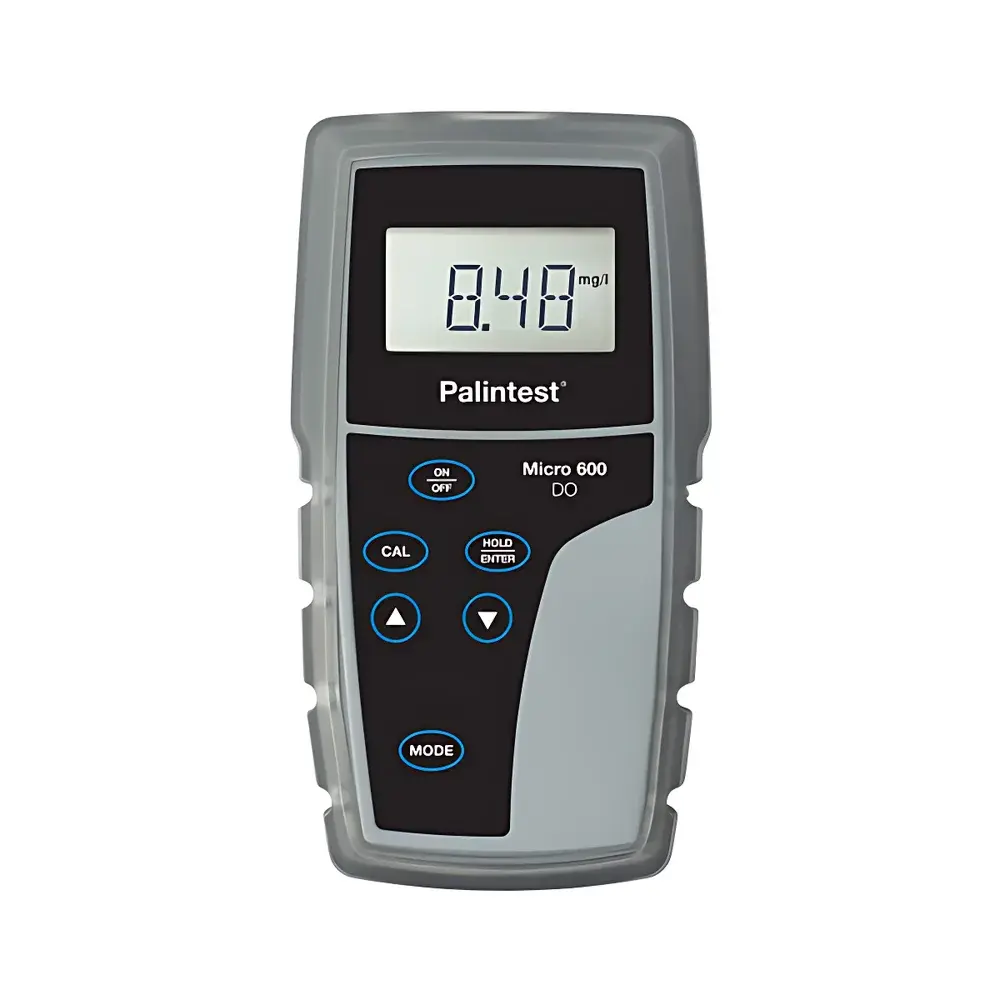
Palintest Micro 600 Dissolved Oxygen Meter
| Brand | Palintest |
|---|---|
| Origin | United Kingdom |
| Model | Micro 600 |
| Instrument Type | Portable |
| Measurement Principle | Galvanic Cell Electrochemical Probe |
| Measurement Range | 0.00–20.00 mg/L |
| Resolution | 0.01 mg/L (DO), 0.1% (saturation), 0.1 °C (temperature) |
| Accuracy | ±1.5% FS (DO and saturation), ±0.3 °C (temperature) |
| Salinity Compensation Range | 0.0–50.0 g/L |
| Atmospheric Pressure Compensation Range | 500–1499 mmHg (66.6–199.9 kPa) |
| Temperature Compensation | Automatic, 0–50 °C |
| Power Supply | 4 × AAA alkaline batteries |
| Battery Life | >100 hours |
| Dimensions | 140 × 70 × 35 mm |
| Weight | 200 g |
Overview
The Palintest Micro 600 Dissolved Oxygen Meter is a field-deployable, galvanic cell-based electrochemical instrument engineered for high-reproducibility dissolved oxygen (DO) quantification in aqueous environments. Unlike polarographic sensors requiring external polarization voltage, the Micro 600 employs a self-powered galvanic cell architecture—comprising a silver cathode and lead anode immersed in a proprietary electrolyte—which generates a current proportional to molecular oxygen diffusion through a gas-permeable membrane. This principle ensures stable zero-point integrity, minimal warm-up time (<30 seconds), and immunity to power supply fluctuations during extended field operation. Designed for routine monitoring across aquaculture, wastewater treatment plants, environmental compliance sampling, and industrial process water systems, the instrument delivers traceable measurements compliant with ISO 5814:2012 (Water quality — Determination of dissolved oxygen — Electrochemical probe method) and supports audit-ready documentation under GLP frameworks.
Key Features
- Galvanic cell sensor technology with integrated temperature thermistor for real-time thermal compensation (0–50 °C)
- Simultaneous dual-mode display: dissolved oxygen concentration (mg/L) and percent saturation (%DO), both auto-compensated for salinity (0.0–50.0 g/L) and barometric pressure (500–1499 mmHg)
- Manual entry interface for site-specific salinity and atmospheric pressure values, enabling precise correction per ASTM D888-22 Section 7.3 guidelines
- Two-point calibration protocol: air-saturation (100% DO at local conditions) and zero-oxygen standard (using Palintest PT 125/3 anoxic solution)
- Backlit monochrome LCD screen with single-screen layout optimized for glove-compatible operation and low-light field conditions
- Ruggedized housing (IP67-rated when sealed) with ergonomic form factor (140 × 70 × 35 mm; 200 g) for extended handheld use
- Energy-efficient design powered by four standard AAA alkaline cells, delivering >100 hours of continuous measurement runtime
Sample Compatibility & Compliance
The Micro 600 is validated for use with freshwater, brackish water, seawater, activated sludge supernatants, and industrial cooling tower make-up water. Its galvanic probe (PT 148/3) features a Teflon®-based hydrophobic membrane resistant to fouling from organic colloids and suspended solids typical in effluent streams. All calibration and measurement procedures align with ISO/IEC 17025:2017 general requirements for competence of testing and calibration laboratories. While not inherently 21 CFR Part 11-compliant due to lack of electronic signature or audit trail functionality, raw data outputs support manual transcription into LIMS or ELN platforms meeting FDA-regulated documentation standards. CE marking confirms conformity with EU Directive 2014/30/EU (EMC) and 2011/65/EU (RoHS).
Software & Data Management
The Micro 600 operates as a standalone field instrument without embedded Bluetooth, USB, or cloud connectivity. All measurement records—including timestamp (user-entered), DO value, saturation %, temperature, salinity, and pressure inputs—are retained solely on-device for immediate visual verification. For regulatory traceability, users are advised to log readings manually into bound laboratory notebooks or digital systems adhering to ALCOA+ principles (Attributable, Legible, Contemporaneous, Original, Accurate, Complete, Consistent, Enduring, Available). Optional accessories such as the PT 148/2 maintenance kit (including replacement membranes, O-rings, electrolyte solution, and calibration tools) ensure long-term sensor performance stability and inter-laboratory comparability.
Applications
- Aquaculture pond management: Monitoring DO minima during nocturnal respiration cycles to prevent hypoxia-induced mortality
- Wastewater treatment: Tracking aeration basin efficiency via DO gradient profiling across oxidation ditches and SBR tanks
- Environmental impact assessments: Conducting EPA Method 360.1-compliant grab sampling at surface, mid-depth, and benthic zones
- Industrial boiler feedwater surveillance: Verifying deaerator performance prior to condensate return lines
- Educational laboratories: Teaching fundamental concepts of aquatic respiration, biochemical oxygen demand (BOD) kinetics, and redox potential relationships
FAQ
Does the Micro 600 support automatic pressure or salinity detection?
No—it requires manual input of local barometric pressure and sample salinity prior to measurement to enable algorithmic compensation.
What is the recommended recalibration frequency for field deployments?
Daily calibration is advised when operating across variable environmental conditions; otherwise, verify before each sampling session using air-saturation and zero-oxygen standards.
Can the PT 148/3 probe be used in viscous or high-solids wastewater?
Yes—its robust membrane and low-flow design minimize clogging; however, periodic cleaning with mild detergent and inspection for membrane integrity are essential per Palintest Technical Bulletin TB-MICRO600-02.
Is temperature measurement independent of the DO sensor?
No—the thermistor is integrated within the probe body, ensuring synchronous thermal compensation without offset error between DO and temperature readings.
How does the Micro 600 handle altitude-related pressure variation?
By accepting user-input pressure values in mmHg or kPa, it applies Nernst-equation-derived corrections to maintain accuracy up to 3000 m elevation, consistent with ISO 5814 Annex C guidance.







