
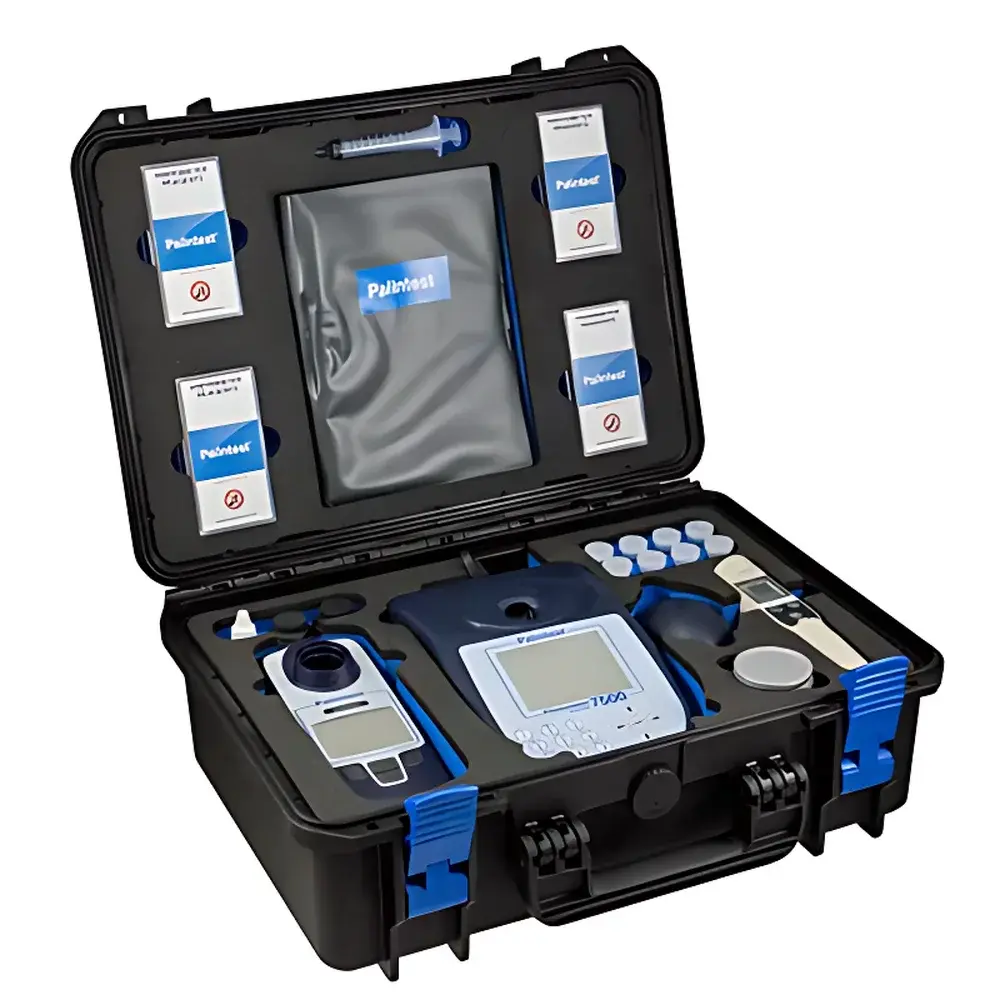
Palintest Potacheck 2 Portable Water Quality Analysis Laboratory (Basic Edition)
| Brand | Palintest |
|---|---|
| Origin | United Kingdom |
| Model | Potacheck 2 |
| Instrument Type | Portable/HANDHELD Water Quality Analyzer |
| Measured Parameters | Free Chlorine, Chlorine Dioxide, Fluoride, Ammonia-N, Nitrate, Nitrite, Turbidity, Color, TDS, pH, Conductivity |
| Optical System (Turbidimeter) | QuadoptiX™ dual 860 nm LED sources & dual silicon photodiode detectors |
| Turbidity Range | 0–1050 NTU |
| Turbidity Accuracy | ≤2% |
| Turbidity Resolution | 0.01 NTU (≤9.99), 0.1 NTU (10.0–99.9), 1% of reading (>100) |
| Turbidity Repeatability | ±1% |
| Turbidity Compliance | ISO 7027 |
| Photometer Wavelengths | 450, 500, 550, 570, 600, 650 nm (auto-selected per method) |
| Photometer Accuracy | ±1% T |
| Photometer Resolution | 0.001 AU |
| Data Storage | 100 turbidity records / 500 photometric results |
| Connectivity | USB + Bluetooth 4.0 |
| Protection Rating | IP67 (all main units) |
| Power | AA/AAA batteries (varies by module) |
| Operating Environment | 0–50 °C, ≤90% RH |
Overview
The Palintest Potacheck 2 Portable Water Quality Analysis Laboratory (Basic Edition) is an integrated, field-deployable analytical platform engineered for rapid, reliable, and standardized on-site water quality assessment. Unlike single-parameter handheld meters, the Potacheck 2 combines three independently validated measurement modules—7500 Series spectrophotometer, CT12 turbidimeter, and a multi-parameter pocket probe—into a unified, ruggedized system compliant with international water testing protocols. Its core architecture implements established physical and photometric principles: absorbance-based colorimetry (per ASTM D1253, ISO 8467, ISO 10530), nephelometric turbidity measurement (ISO 7027), and potentiometric/polarographic sensing for pH, conductivity, TDS, and salinity. Designed for operational continuity across variable environmental conditions—including municipal distribution networks, wastewater treatment outfalls, industrial process streams, and emergency response scenarios—the system delivers laboratory-grade reproducibility without requiring fixed infrastructure.
Key Features
- Triple-module integration: 7500 photometer (6-wavelength auto-select, 0.001 AU resolution), CT12 turbidimeter (QuadoptiX™ dual-source/dual-detector optics), and pocket probe (pH/conductivity/TDS/salinity with auto-ranging and temperature compensation)
- IP67-rated enclosure for all primary instruments—dust-tight and submersible to 1 m for 30 minutes—enabling use in rain, mud, high-humidity zones, or near open water bodies
- Compliance-ready optical design: CT12 meets ISO 7027 for turbidity; photometer supports method-specific calibration per EPA 180.1, APHA 2540D, and WHO Guidelines for Drinking-water Quality
- Unified data management: Bluetooth 4.0 and USB connectivity enable synchronized upload to AQUAPAL software—supporting audit trails, user-defined curve storage (up to 30), and GLP-compliant metadata tagging (time/date/sample ID/dilution factor)
- Field-optimized ergonomics: All components—including reagent packs, calibration standards, cuvettes, and power supplies—are pre-organized within a shock-absorbing, lockable hard-shell transport case
- Battery longevity and redundancy: CT12 operates >5,000 readings on two AA cells; 7500 photometer supports both battery (3× AA) and USB-powered operation; pocket probe uses four AAA cells with low-power sleep mode
Sample Compatibility & Compliance
The Potacheck 2 accommodates raw, filtered, chlorinated, and highly colored water matrices without dilution for most parameters—enabled by adaptive optical pathlength correction (photometer) and dual-detector ratioing (turbidimeter). It supports standard sample vessels: 12–20 mm round glass or plastic cuvettes (ASTM D5116-compliant), 10 mm square cells, and direct immersion with the pocket probe. Regulatory alignment includes full traceability to ISO/IEC 17025 requirements for field instrumentation, with built-in features supporting FDA 21 CFR Part 11 compliance (electronic signatures, audit logs, data integrity controls via AQUAPAL). Calibration verifiability is ensured through NIST-traceable turbidity standards (Formazin or AMCO AEPA) and certified pH/conductivity reference solutions (PT 105/5, PTC 090). The system satisfies WHO Tier 1 field testing criteria and is routinely deployed under national drinking water surveillance programs aligned with EU Directive 98/83/EC and US EPA Safe Drinking Water Act Field Screening Protocols.
Software & Data Management
AQUAPAL desktop and mobile software serves as the central hub for configuration, calibration, reporting, and regulatory documentation. It enforces structured data capture—including operator ID, location GPS stamp (via paired smartphone), instrument serial number, and method version—and generates PDF reports compliant with ISO 14001 environmental monitoring templates. The software supports configurable pass/fail thresholds, automated QC flagging (e.g., drift >2% between calibrations), and export to LIMS via CSV or direct SQL push. Audit trail functionality records all parameter changes, calibration events, and result modifications with timestamps and user attribution—meeting GLP/GMP data integrity expectations for accredited laboratories and third-party auditors.
Applications
- Municipal water utilities: Routine verification of disinfectant residual (free Cl₂, ClO₂), turbidity compliance at entry points, and source water screening for nitrate/nitrite contamination
- Wastewater facilities: Effluent monitoring per NPDES permit limits, including ammonia-N and total suspended solids (TSS) estimation from turbidity correlation
- Food & beverage production: Rinse water validation, CIP solution concentration checks, and ingredient water quality pre-screening
- Emergency response: Rapid deployment during natural disasters or contamination incidents—providing actionable data within 90 seconds per parameter
- Research & education: Field-based environmental science curricula, watershed health assessments, and student-operated water quality mapping initiatives
FAQ
Does the Potacheck 2 meet ISO 7027 for turbidity measurement?
Yes—the CT12 turbidimeter employs QuadoptiX™ dual 860 nm LED sources and matched silicon photodiodes, fully conforming to ISO 7027’s geometric and spectral requirements.
Can photometric methods be customized for non-standard analytes?
Yes—users may store up to 30 custom calibration curves using absorbance vs. concentration data, with optional wavelength selection and polynomial fit options.
Is Bluetooth pairing compatible with iOS and Android devices?
Yes—AQUAPAL Mobile supports Bluetooth 4.0 LE on iOS 12+ and Android 8.0+, enabling real-time data streaming and remote firmware updates.
What is the recommended recalibration frequency for field use?
Per ISO 8467 and Palintest technical guidelines: photometer zero/check standard before each sampling session; turbidimeter 4-point calibration daily if used >20 samples; pocket probe 3-point pH and conductivity calibration prior to first use and after every 10 field measurements.
Are reagents supplied with expiration tracking and lot-number traceability?
Yes—all Palintest reagent kits (e.g., CT 12 turbidity standards, 7500 chlorine test packs) include printed lot numbers, manufacture dates, and shelf-life indicators compliant with ISO/IEC 17025 Clause 5.6.3.







