
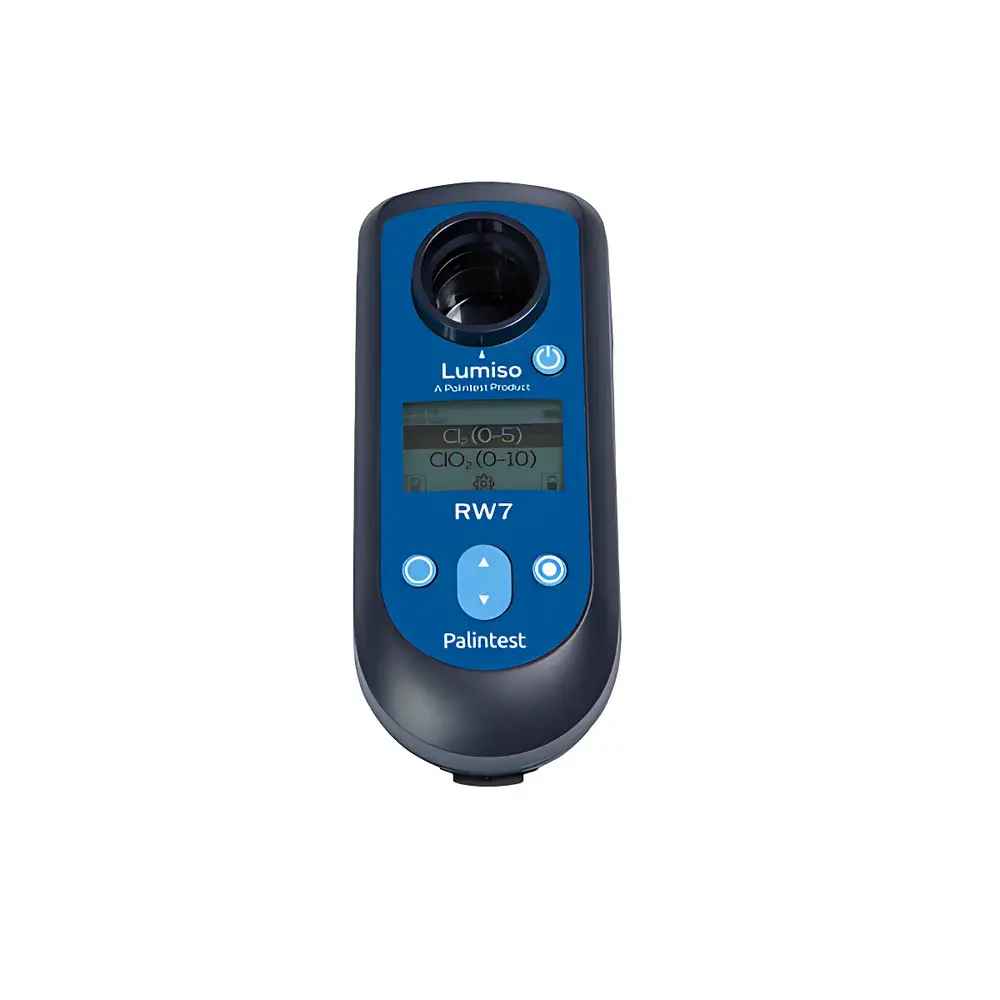
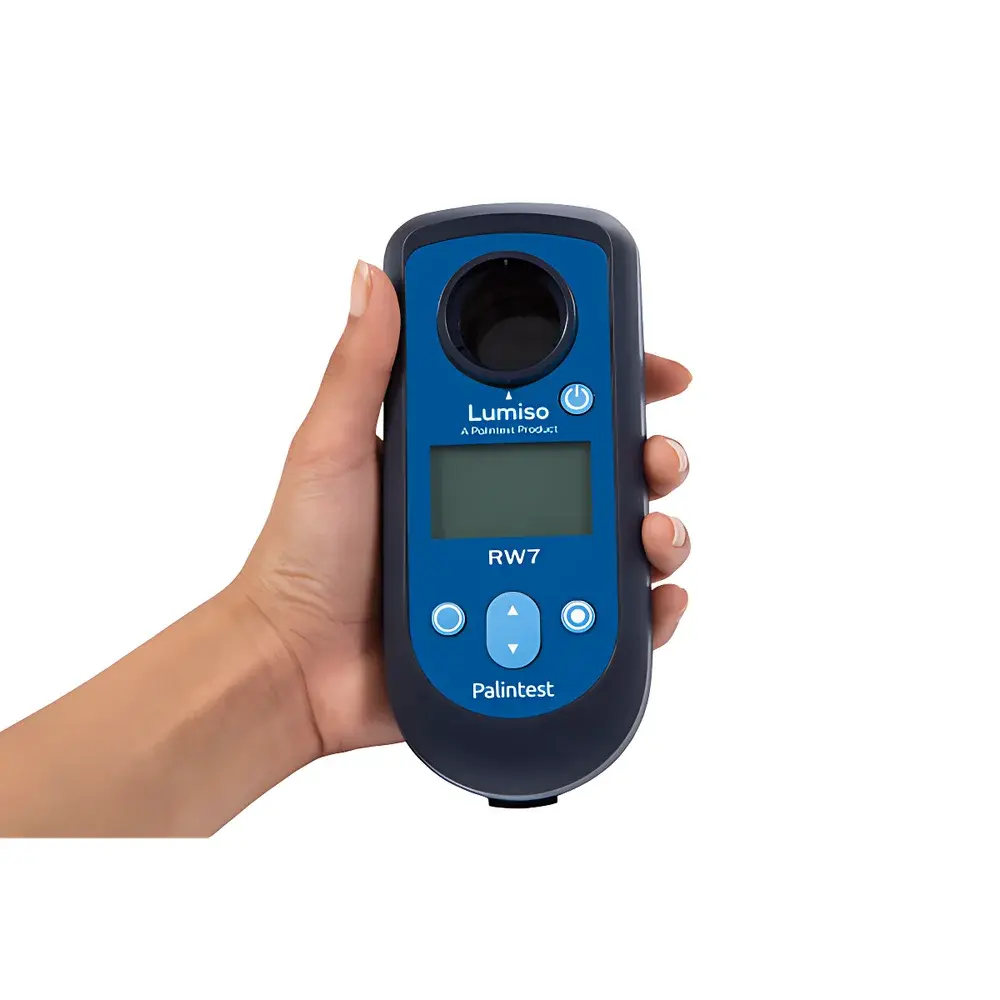
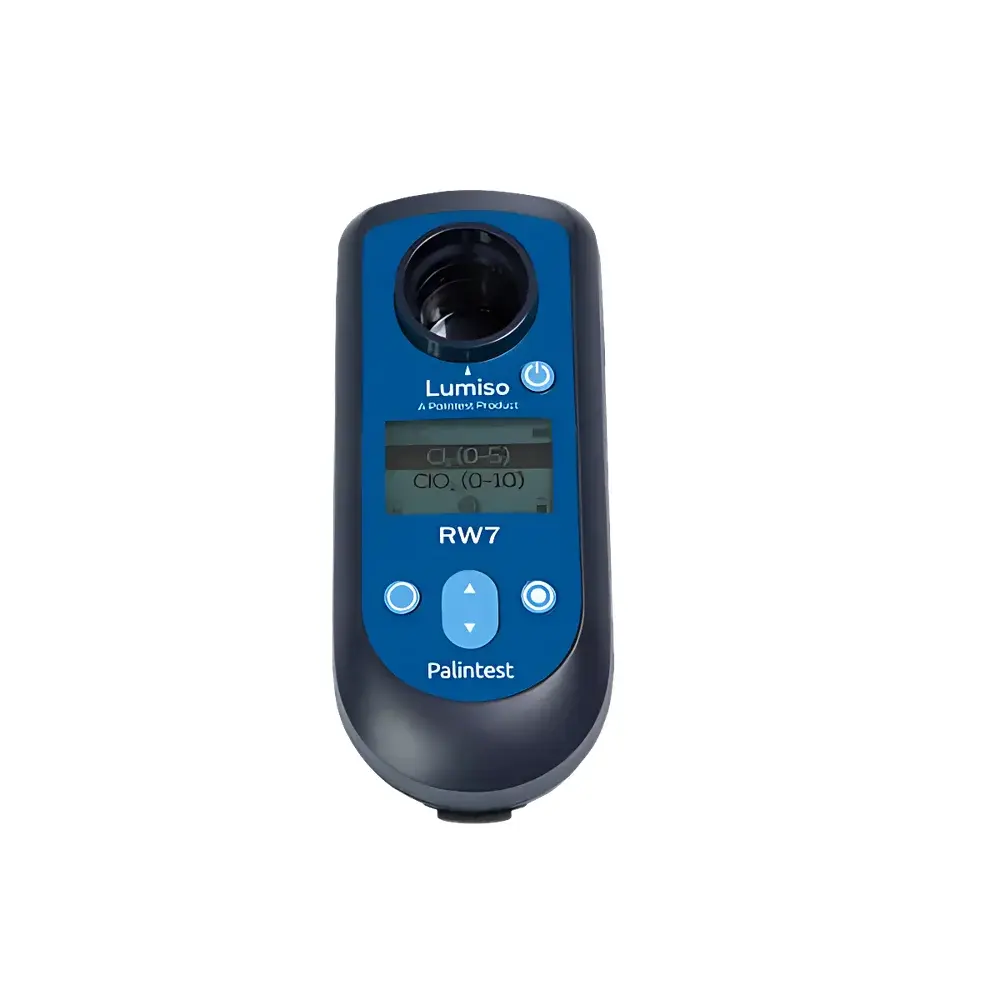
Palintest Lumiso RW7 Portable 7-Parameter Water Quality Analyzer
| Brand | Palintest |
|---|---|
| Origin | United Kingdom |
| Model | Lumiso RW7 |
| Instrument Type | Portable Photometer |
| Measurement Principle | DPD-based Spectrophotometry |
| Measured Parameters | Free Chlorine, Total Chlorine, Chlorine Dioxide, Total Hardness, Ozone, Color, pH, Permanganate Index (COD<sub>Mn</sub>) |
| Wavelengths | 465 nm & 575 nm |
| Optical Bandwidth | 10 nm |
| Wavelength Accuracy | ±2 nm |
| Display | Backlit LCD |
| Data Storage | 10 recent results |
| Power Supply | 2 × AA batteries |
| Operating Temperature | 0–50 °C |
| Enclosure Rating | IP67 |
| Dimensions | 150 × 65 × 42 mm |
| Weight | 200 g |
Overview
The Palintest Lumiso RW7 is a field-deployable, digital photometric analyzer engineered for rapid, reliable quantification of eight critical water quality parameters—including free chlorine, total chlorine, chlorine dioxide, total hardness (as CaCO₃), ozone, color (in Hazen units), pH, and permanganate index (CODMn)—using standardized DPD (N,N-diethyl-p-phenylenediamine) spectrophotometric methods. As the original inventor of the DPD method, Palintest Ltd. (Newcastle upon Tyne, UK) has integrated over four decades of method validation and optical sensor refinement into this handheld platform. The instrument operates at two fixed wavelengths—465 nm (optimized for chlorine and chlorine dioxide detection) and 575 nm (optimized for color and permanganate index)—with a narrow 10 nm optical bandwidth and ±2 nm wavelength accuracy to ensure high spectral specificity and inter-laboratory reproducibility. Designed explicitly for compliance with routine monitoring requirements under ISO 7888, ISO 8211, ISO 9297, APHA Standard Methods 4500-Cl G & H, and US EPA Method 334.0, the Lumiso RW7 delivers traceable, auditable results in field or mobile lab environments without requiring external calibration standards or benchtop infrastructure.
Key Features
- IP67-rated enclosure: Fully dust-tight and submersible up to 1 m for 30 minutes—validated per IEC 60529—enabling operation in rain, humid chambers, or near open water bodies.
- Dual-wavelength optical system: Independent 465 nm and 575 nm LED sources with matched interference filters eliminate cross-spectral interference during multi-analyte analysis.
- Pre-programmed, factory-calibrated methods: All assays—including the China-specific permanganate index (CODMn) protocol aligned with HJ 502–2009—feature embedded calibration curves traceable to NIST-traceable reference materials.
- Zero/blank memory retention: Users may store a user-defined blank value in non-volatile memory for repeated use across multiple sampling events, reducing procedural variability.
- Low-power architecture: Two AA alkaline batteries support ≥2,000 measurements; auto-shutdown activates after 5 minutes of inactivity to extend operational life.
- Ergonomic, one-handed operation: Compact form factor (150 × 65 × 42 mm, 200 g) with tactile keypad and high-contrast backlit LCD ensures legibility under low-light or outdoor conditions.
Sample Compatibility & Compliance
The Lumiso RW7 is validated for use with Palintest’s certified solid reagent tablets and powder packs—including AP031 (free/total chlorine), AP130 (pH), AP011/PT549 (chlorine dioxide), AP254 (total hardness), AP056 (ozone), PM970 (color, 50 tests), and PM295 (permanganate index, 100 tests). All reagents comply with ISO 8466-1 for calibration curve linearity and APHA 2022 Edition specifications for DPD stability and oxidation selectivity. The instrument supports GLP-compliant workflows through manual entry of sample IDs and operator codes; while it does not feature built-in electronic audit trails or 21 CFR Part 11 compliance, its deterministic measurement logic and immutable firmware ensure data integrity for ISO/IEC 17025-accredited laboratories performing field verification prior to accredited testing.
Software & Data Management
The Lumiso RW7 stores the ten most recent test records—including parameter name, numeric result, unit, date/time stamp, and blank reference ID—in non-volatile memory. Results are displayed numerically with automatic unit annotation and configurable decimal precision (e.g., 0.01 mg/L for chlorine, 0.1°H for color). Though the device lacks Bluetooth or USB connectivity in its base configuration, all stored results can be manually transcribed into LIMS or spreadsheet platforms. For integration into centralized QA/QC systems, Palintest recommends pairing the RW7 with the optional Lumiso Connect cable kit (sold separately), enabling serial output (RS-232) compatible with legacy laboratory data acquisition software.
Applications
- Drinking water distribution networks: On-site verification of residual disinfectant levels (free/total chlorine, ClO₂) and oxidative capacity (ozone, CODMn) pre- and post-booster chlorination.
- Surface and source water assessment: Field screening of organic load via permanganate index (CODMn) in rivers, reservoirs, and groundwater abstraction points per Chinese national standard HJ 502–2009.
- Swimming pool and spa maintenance: Simultaneous measurement of free chlorine, pH, and total hardness to maintain balanced water chemistry within WHO and EN 15288 guidelines.
- Wastewater effluent monitoring: Rapid estimation of oxidant residuals prior to discharge consent verification, supporting regulatory reporting under EU Urban Wastewater Treatment Directive Annex I.
- Emergency response: Deployment during contamination events where immediate detection of chlorine demand shifts or disinfectant decay kinetics informs dosing adjustments.
FAQ
Is the Lumiso RW7 compliant with ISO or ASTM standards for chlorine measurement?
Yes—the instrument implements DPD methodology in full alignment with ISO 7888 (chlorine), ISO 9297 (chlorine dioxide), and ASTM D1253/D3370 (residual oxidants), with optical performance verified against ISO 8466-2 photometer validation protocols.
Can the permanganate index (CODMn) function be used outside China?
While optimized for HJ 502–2009, the CODMn assay is chemically identical to ISO 8467 and APHA 5210 B; users outside China may apply it for low-COD freshwater monitoring where dichromate-based COD is impractical.
Does the device require annual recalibration by an authorized service center?
No—optical path integrity and wavelength accuracy are factory-set and drift-stabilized; only routine verification using Palintest-certified check standards (e.g., CL-STD-01) every 6 months is recommended per ISO/IEC 17025 Clause 6.5.
Are reagent tablets supplied with the instrument?
No—reagents are ordered separately by catalog number (e.g., AP031, PM295); each kit includes lot-specific calibration certificates and shelf-life indicators compliant with ISO 17034.
What is the measurement uncertainty for free chlorine at 0.5 mg/L?
Based on Palintest’s internal validation per ISO/IEC 17025:2017 Annex A.3, expanded uncertainty (k=2) is ±0.04 mg/L at that concentration level, derived from repeatability, reagent batch variance, and photometric noise characterization.
Related Products







