
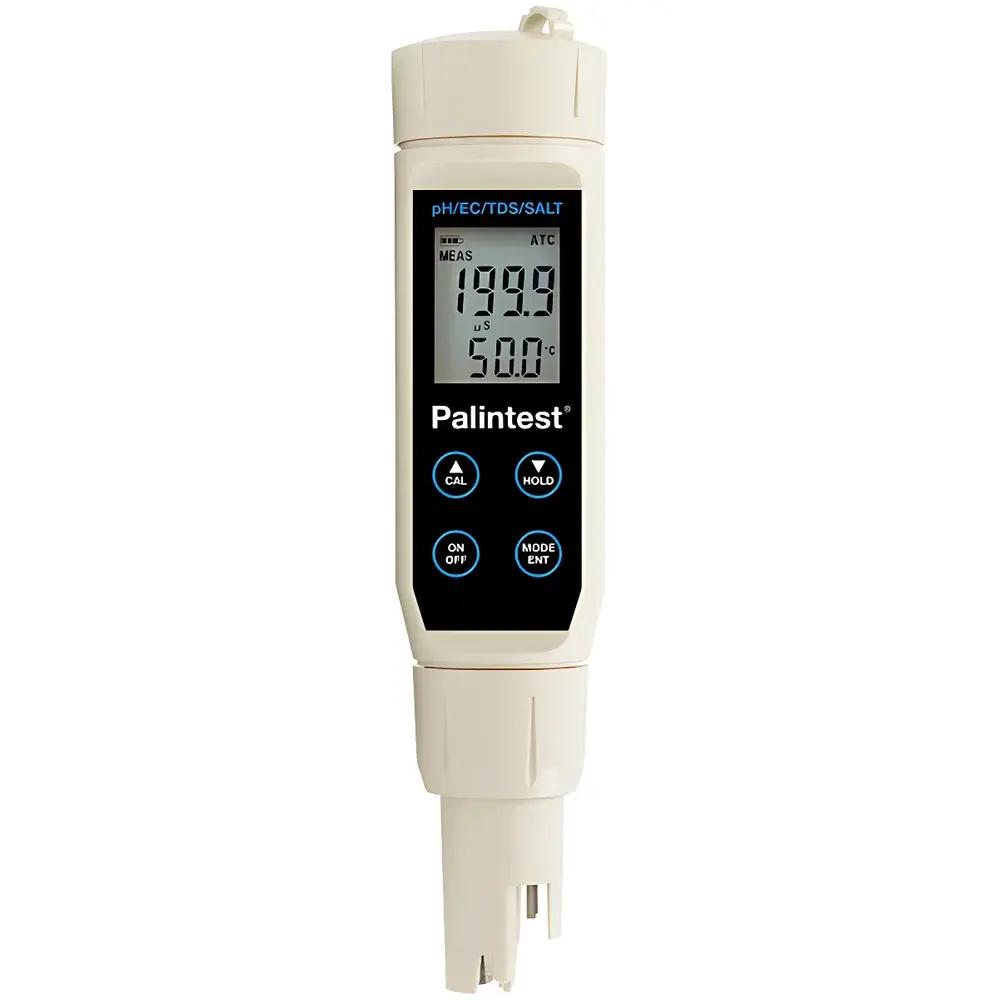
Palintest PT 162 Pocket-Sized Multiparameter Meter
| Brand | Palintest |
|---|---|
| Model | PT 162 |
| Origin | United Kingdom |
| Instrument Type | Pen-style Portable Meter |
| Parameter Types | pH, TDS, Conductivity, Salinity, Temperature |
| Calibration Standard | NIST-traceable solutions |
| IP Rating | IP67 |
| Power Supply | 4 × 1.5 V button cells (typical battery life >150 h |
| Operating Temperature | 0–50 °C |
| Automatic Temperature Compensation (ATC) | Yes |
| Measurement Ranges | pH 0.00–14.00 (±0.01) |
| Resolution | pH 0.01 |
| Calibration | Up to 5-point pH auto-calibration |
| TDS Conversion Factor | Adjustable 0.40–1.00 |
Overview
The Palintest PT 162 Pocket-Sized Multiparameter Meter is a field-deployable, pen-style electrochemical analyzer engineered for rapid, reliable measurement of five critical water quality parameters—pH, total dissolved solids (TDS), electrical conductivity, salinity, and temperature—in a single handheld unit. Based on potentiometric (pH), conductimetric (conductivity/TDS/salinity), and thermistor-based (temperature) sensing principles, the PT 162 delivers laboratory-grade accuracy in an industrial-grade package. Its compact form factor, IP67 ingress protection, and robust low-power architecture make it suitable for routine monitoring across municipal water distribution, wastewater treatment plants, cooling tower management, aquaculture operations, food & beverage processing lines, and environmental field surveys. The instrument implements automatic temperature compensation (ATC) across all electrochemical channels using an integrated high-stability NTC thermistor, ensuring measurement integrity under variable ambient and sample conditions without manual correction.
Key Features
- True multiparameter capability: Simultaneous real-time display of pH, TDS, conductivity, salinity, and temperature with auto-ranging across three conductivity/TDS/salinity scales
- NIST-traceable calibration support: Compatible with certified reference standards including pH 4.01/7.00/10.01 buffers and conductivity solutions at 74 µS/cm, 1412 µS/cm, and 12.88 mS/cm
- High-precision electrochemical sensing: ±0.01 pH accuracy, ±1% full-scale error for conductivity/TDS/salinity, and ±0.5 °C thermal accuracy over 0–50 °C operating range
- Intelligent calibration architecture: Up to 5-point pH auto-calibration with slope/mV offset diagnostics; 3-point manual calibration per parameter range with user-accessible calibration history logging
- Ruggedized field design: IP67-rated housing resists dust ingress and immersion up to 1 m for 30 minutes; optimized ergonomics for one-handed operation in gloves or wet environments
- Energy-efficient operation: Powered by four standard 1.5 V button cells with >150 hours of continuous use; intelligent auto-power-down after 8.5 minutes of inactivity
Sample Compatibility & Compliance
The PT 162 is validated for aqueous samples across a broad spectrum of ionic strength and temperature profiles—from low-conductivity surface water (e.g., rainwater, deionized process water) to high-salinity brines and industrial effluents. Its interchangeable sensor interface supports Palintest’s modular electrode ecosystem, enabling configuration-specific optimization without hardware modification. While not classified as a GLP/GMP-compliant analytical instrument per se, the PT 162 meets functional requirements aligned with ASTM D1125 (Standard Test Methods for Electrical Conductivity and Resistivity of Water), ISO 7888 (Water Quality — Determination of Electrical Conductivity), and USP (Electrical Conductivity of Water for Pharmaceutical Use) for field screening applications. Calibration traceability to NIST standards satisfies ISO/IEC 17025 preconditions for method validation in accredited laboratories performing preliminary assessments.
Software & Data Management
The PT 162 operates as a standalone field instrument with no embedded data logging or PC connectivity. All measurements are displayed in real time on a high-contrast LCD with dual-parameter view mode. Calibration settings—including TDS conversion factor (adjustable 0.40–1.00), electrode slope, offset, and date/time stamp—are retained in non-volatile memory. Though lacking USB or Bluetooth interfaces, its consistent calibration protocol and stable analog signal conditioning support audit-ready documentation when paired with standardized field notebooks or LIMS-integrated manual entry workflows. For regulatory environments requiring electronic records, users may integrate PT 162 readings into validated data capture systems compliant with FDA 21 CFR Part 11 via secondary transcription protocols verified under internal SOPs.
Applications
- Municipal drinking water quality verification at point-of-entry and distribution points
- Industrial boiler feedwater and cooling water chemistry control (Langelier Saturation Index estimation)
- Aquaculture pond and recirculating aquaculture system (RAS) health monitoring
- Farm runoff and irrigation water salinity assessment
- Food processing rinse water validation and sanitation verification
- Environmental field screening for EPA Region 10 or EU WFD compliance indicators
- Educational laboratory instruction in fundamental water chemistry principles
FAQ
Does the PT 162 support GLP-compliant audit trails?
No—the device lacks timestamped electronic calibration logs or user authentication. It is intended for field screening, not regulated release testing.
Can the TDS conversion factor be adjusted per sample matrix?
Yes—users may manually set the TDS multiplier between 0.40 and 1.00 to align with known ion composition (e.g., NaCl vs. CaCO₃-dominated waters).
Is the electrode replaceable, and what is its expected service life?
The integrated sensor module is field-replaceable via the PT 162/1 accessory; typical electrode lifespan exceeds 12 months under normal use with proper storage and cleaning.
What calibration standards are required for routine operation?
Minimum requirement: pH 7.00 buffer + one conductivity standard matching the expected sample range (e.g., 1412 µS/cm for potable water). Full validation requires pH 4.01/7.00/10.01 and three conductivity standards.
How does automatic temperature compensation function across parameters?
A single high-accuracy NTC thermistor measures sample temperature in real time and applies linear or non-linear compensation coefficients—pre-programmed per parameter—to raw sensor outputs before final display.




