

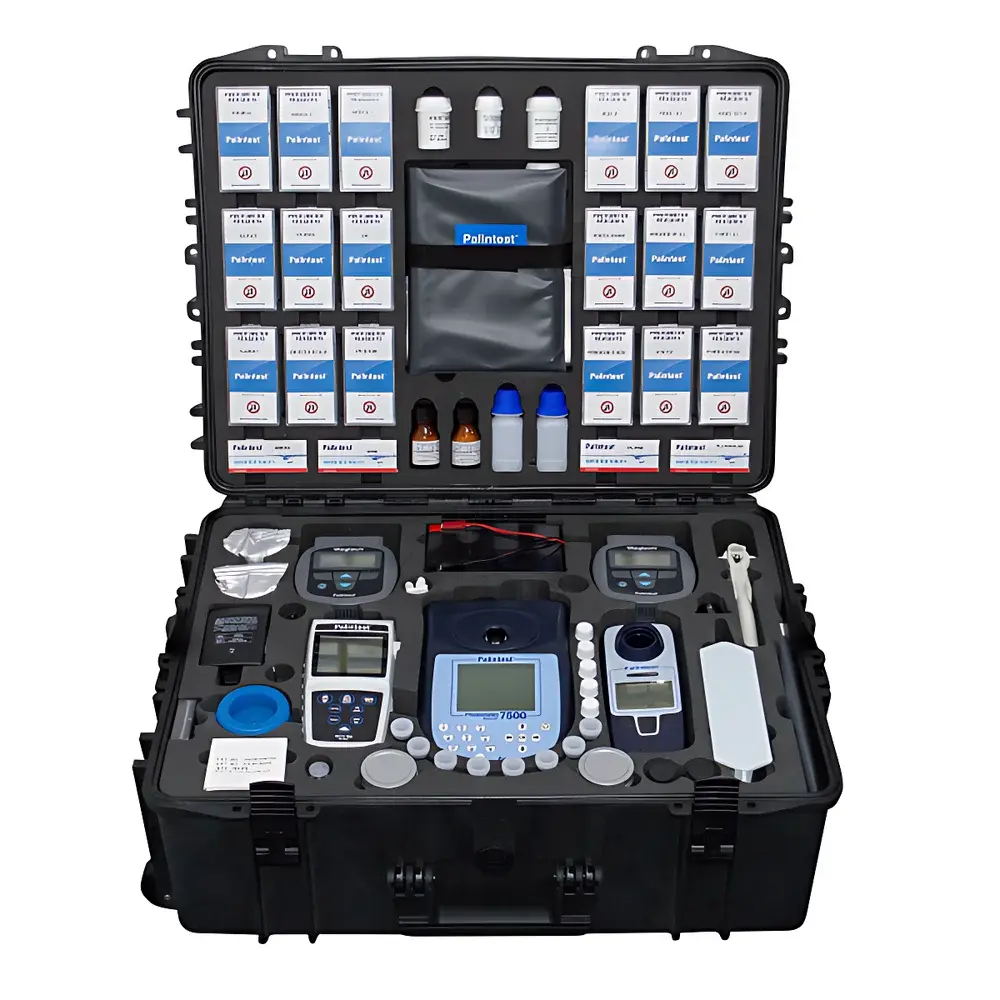
Palintest Potalab RW Mobile Integrated Water Quality Laboratory for Rural Drinking Water Safety
| Brand | Palintest |
|---|---|
| Origin | United Kingdom |
| Model | Potalab RW |
| Instrument Type | Portable, Field-Deployable Integrated Water Quality Laboratory |
| Detection Parameters | Total Coliforms, Fecal Coliforms, Free Chlorine, Ammonia-Nitrogen, Fluoride, Nitrate, Nitrite, Turbidity, pH, Conductivity, TDS |
| Additional Expandable Parameters | Arsenic, Mercury, Chromium, Cadmium, COD, Chloride, Manganese, Iron |
| Compliance | Designed to meet requirements of GB 5749–2022 (China’s Standard for Drinking Water Hygiene), WHO Guidelines for Drinking-water Quality (4th Ed.), and ISO/IEC 17025-aligned field testing practices |
Overview
The Palintest Potalab RW is a fully integrated, vehicle-transportable water quality analysis laboratory engineered specifically for decentralized, resource-constrained environments—particularly rural drinking water supply systems in low- and middle-income regions. Unlike conventional benchtop analyzers or single-parameter handheld devices, the Potalab RW implements a hybrid analytical architecture combining membrane filtration microbiology, colorimetric photometry, electrochemical sensing, and turbidimetric measurement—all within a ruggedized, climate-stabilized mobile platform. Its design philosophy centers on field-deployable compliance: enabling on-site sample collection, processing, incubation, and quantification without reliance on fixed laboratory infrastructure. The system adheres to core principles of ISO 9001-certified manufacturing and aligns with WHO’s “Water Safety Planning” framework by supporting hazard identification, critical control point monitoring, and real-time verification of disinfection efficacy and source contamination.
Key Features
- Modular, plug-and-play configuration: separates microbiological analysis (membrane filtration + temperature-controlled incubation) from physicochemical measurement (multi-parameter photometer, turbidimeter, pH/conductivity/TDS meter) while maintaining electrical, data, and reagent interoperability.
- Pre-formulated, lyophilized reagent kits: eliminates manual preparation, minimizes operator error, extends shelf life (>24 months unopened at 4–30 °C), and ensures batch-to-batch reproducibility per ISO 8694 and APHA Standard Methods 2022 protocols.
- On-board 12 V rechargeable incubator (35–44 °C range, ±0.5 °C stability) with dual-cassette holder: enables simultaneous enumeration of total coliforms and fecal coliforms using membrane filtration, compliant with ISO 9308-1 and EPA Method 1603.
- Integrated power management: supports AC (220–240 V), DC (12 V vehicle battery), and portable battery operation—ensuring uninterrupted function during extended off-grid deployments.
- Field-validated detection limits: meets or exceeds GB 5749–2022 thresholds for free chlorine (0.02–5.0 mg/L), fluoride (0.1–1.5 mg/L), ammonia-nitrogen (0.05–10 mg/L), turbidity (0.1–100 NTU), and pH (6.5–8.5), with trace metal expansion modules validated per ISO 11969 for arsenic (1–50 µg/L) and cadmium (0.1–10 µg/L).
Sample Compatibility & Compliance
The Potalab RW accepts raw, filtered, or disinfected surface water, groundwater, and piped distribution samples (10–500 mL volume range). All microbiological assays utilize sterile, pre-assembled filter membranes (0.45 µm pore size, mixed cellulose ester) and nutrient media conforming to ISO 7704 and EN ISO 9308-1. Physicochemical tests comply with ISO 7027 (turbidity), ISO 10523 (pH), ISO 7888 (conductivity), and ISO 6059 (ammonia via Nesslerization). The entire workflow supports GLP-aligned documentation: each test run logs operator ID, GPS-tagged location, timestamp, instrument serial number, reagent lot code, and calibration status—facilitating audit readiness under WHO PQ-WASH, UNICEF WASH Monitoring Framework, and national regulatory inspections.
Software & Data Management
Data acquisition is managed via the Palintest Connect mobile application (iOS/Android), which interfaces wirelessly with the 7500 Multi-Parameter Photometer, Micro 800 meter, and CT 12 turbidimeter. The app enforces structured entry, auto-calculates MPN indices per ISO 9308-2, applies built-in correction algorithms for interferences (e.g., bromide in chlorine assays, humic acid in nitrate measurements), and exports encrypted CSV or PDF reports compliant with FDA 21 CFR Part 11 (electronic signatures, audit trails, user access controls). Cloud synchronization enables centralized dashboard monitoring across multiple field units, with role-based permissions for technicians, supervisors, and public health authorities.
Applications
- Rural water safety surveillance programs mandated under national drinking water regulations.
- Post-disaster emergency response: rapid assessment of microbial contamination and disinfectant residual after flood or earthquake events.
- Small-scale water utility QA/QC: routine monitoring of source, treatment, and distribution points without outsourcing to central labs.
- Academic field research: longitudinal studies on seasonal pathogen dynamics, disinfection by-product formation, or heavy metal leaching in shallow aquifers.
- Community-led total sanitation (CLTS) verification: objective validation of water point functionality and safety prior to certification.
FAQ
Does the Potalab RW require external laboratory support for calibration or maintenance?
No—full self-calibration routines are embedded in all instruments; only annual verification by an ISO/IEC 17025-accredited service provider is recommended for regulatory reporting.
Can the system detect E. coli specifically—not just fecal coliforms?
Yes, optional chromogenic substrate media (e.g., Colilert-18 equivalent) enable specific E. coli enumeration when paired with the incubator module.
Is training provided for non-specialist operators?
Palintest offers standardized WHO-endorsed field operator certification courses (3-day intensive), including SOP adherence, interference recognition, and report generation.
How is data integrity ensured during offline operation?
All measurements are time-stamped and locally cached with SHA-256 hashing; sync occurs automatically upon network restoration, with version-controlled conflict resolution.
What is the expected service life under daily field use?
With scheduled preventive maintenance (every 6 months), the system maintains metrological validity for ≥7 years—validated by Palintest’s global field deployment data across 23 countries since 2018.
Related Products







