
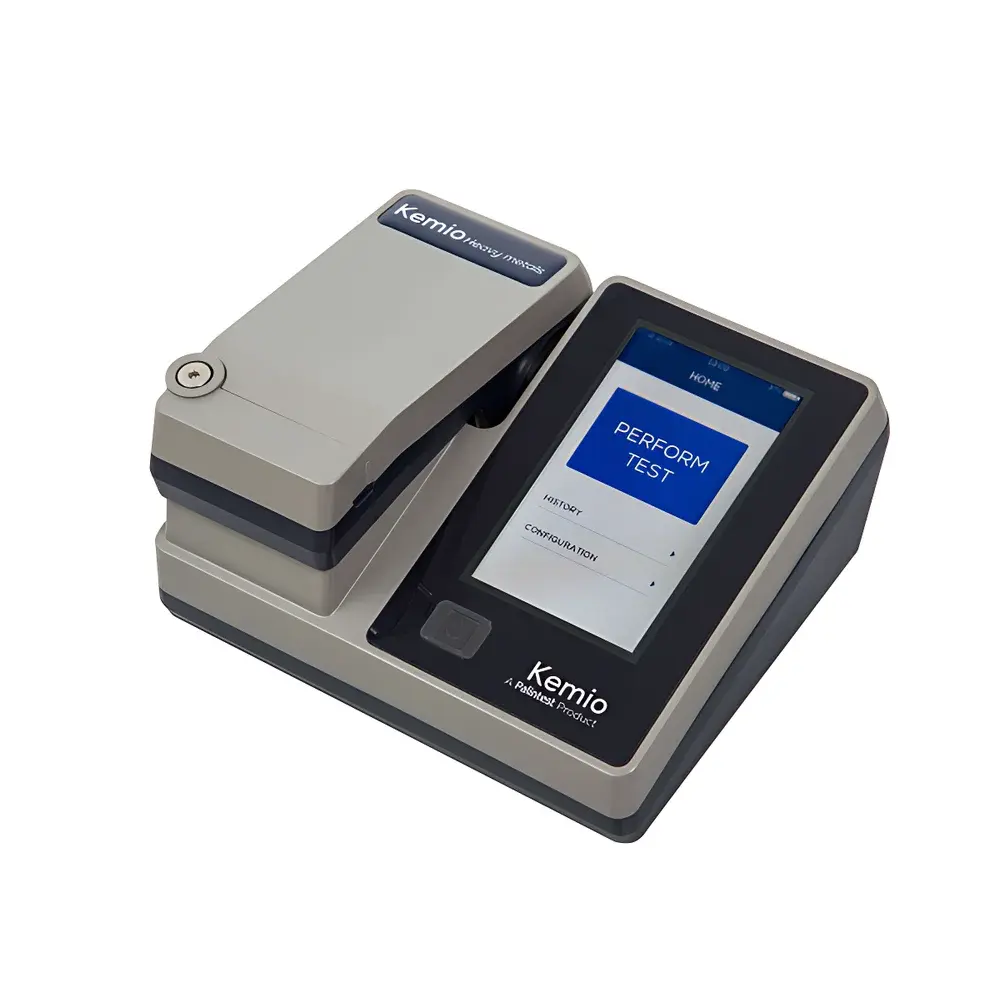
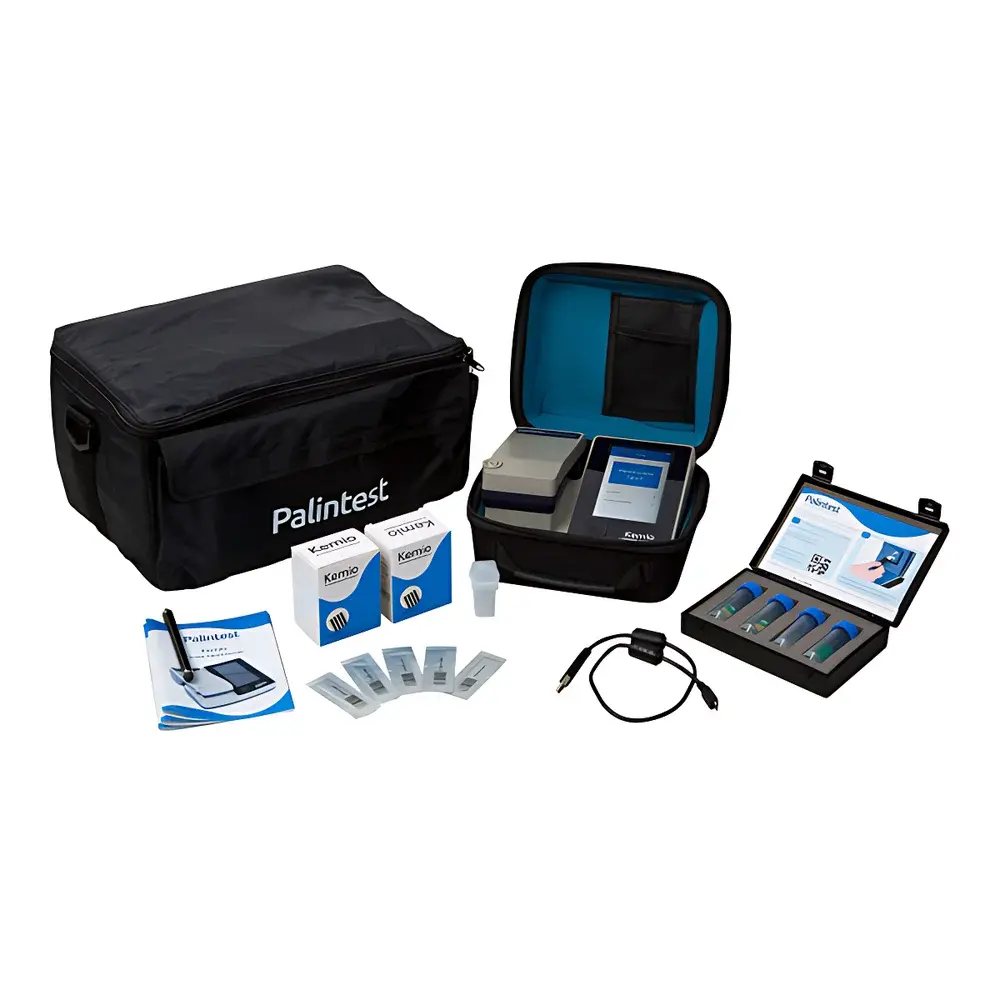
Palintest Kemio HM Heavy Metals Detection Platform
| Brand | Palintest |
|---|---|
| Origin | United Kingdom |
| Model | Kemio HM |
| Instrument Type | Portable |
| Detection Principle | Anodic Stripping Voltammetry (ASV) |
| Detectable Metals | Lead (Pb), Cadmium (Cd), Copper (Cu), Arsenic(III), Arsenic(V), Total Arsenic |
| Measurement Range | Pb 1–100 µg/L, Cd 0.2–10 µg/L, Cu 100–2000 µg/L, As(III)/As(V)/Total As 2–250 µg/L |
| Operating Temperature | 5–35 °C (sample), 0–50 °C (ambient) |
| Display | High-contrast LCD with touch interface |
| Data Storage | 10,000 test records with full metadata |
| Dimensions & Weight | 156 × 180 × 95 mm, 1012 g |
| Battery | 2300 mAh NiMH rechargeable (Palintest-certified only) |
| Ingress Protection | IP67 |
| Connectivity | USB, QR code scanning, on-device keypad |
| Languages | English, French, Spanish, Simplified Chinese |
Overview
The Palintest Kemio HM Heavy Metals Detection Platform is a field-deployable electrochemical analyzer engineered for regulatory-grade quantification of priority toxic metals in water matrices. It employs anodic stripping voltammetry (ASV)—a well-established, trace-level electroanalytical technique—where target metal ions are first preconcentrated onto a disposable screen-printed carbon electrode via controlled reduction, then oxidized (stripped) under a precisely ramped potential. The resulting current peak is directly proportional to analyte concentration. Unlike optical methods (e.g., colorimetry or ICP-MS), ASV is inherently insensitive to sample turbidity, color, suspended solids, or moderate organic interference—eliminating the need for filtration, digestion, or dilution in most routine applications. Designed and manufactured in the UK, the Kemio HM meets the operational rigor required by environmental monitoring agencies, drinking water utilities, industrial effluent managers, and field-based compliance officers working under ISO/IEC 17025 or EPA Method 7000B-aligned protocols.
Key Features
- Patented disposable electrochemical sensor cartridges—pre-calibrated, single-use, and factory-validated—ensure batch-to-batch reproducibility and eliminate cross-contamination.
- True walk-up usability: intuitive touchscreen interface with graphical step-by-step guidance; no operator training required for basic operation.
- IP67-rated enclosure: fully sealed against dust ingress and submersion up to 1 m for 30 minutes—suitable for wastewater channels, riverbanks, treatment plant floors, and remote sampling sites.
- No glassware, no hazardous reagents: all consumables—including pre-dosed reagent tablets, grinding rods, and sample cups—are non-toxic, non-corrosive, and generate zero chemical waste.
- Integrated temperature compensation across 5–35 °C sample range ensures metrological stability without external thermostating.
- Dual-chemistry capability for arsenic speciation: simultaneous quantification of As(III), As(V), and total arsenic using chemically selective deposition potentials and post-reduction protocols.
Sample Compatibility & Compliance
The Kemio HM is validated for use with raw surface water, groundwater, drinking water, treated effluent, stormwater runoff, and low-salinity industrial process streams (TDS < 500 mg/L). It complies with the measurement performance criteria outlined in ISO 11929 (evaluation of measurement uncertainty), ISO 8466-1 (calibration function validation), and supports audit-ready data capture per GLP and GMP requirements. While not a certified reference method per se, its ASV-based results demonstrate strong correlation with EPA Method 7000B (for Pb, Cd, Cu) and ASTM D3559 (for lead in water), making it suitable for screening, trend monitoring, and rapid response verification. All sensor lots undergo traceability-certified calibration against NIST-traceable standard solutions prior to dispatch.
Software & Data Management
Data integrity is maintained through embedded timestamping, operator ID tagging (optional), and full audit trail logging—including sensor lot number, calibration status, ambient conditions, and raw voltammogram export (via USB). The instrument stores up to 10,000 complete test records locally, each containing analyte concentration, detection limit, measurement uncertainty estimate, and QC flag status. Exported CSV files are compatible with LIMS integration and statistical process control platforms. Firmware updates are delivered via secure Palintest-signed packages; no third-party software installation is required. QR code scanning enables rapid site-specific configuration loading and sample ID entry—reducing manual transcription errors.
Applications
- Drinking water safety verification at point-of-entry and distribution points per WHO and EU Drinking Water Directive limits.
- Rapid assessment of lead service line replacement effectiveness in municipal infrastructure programs.
- On-site compliance checks for industrial discharge permits (e.g., NPDES, UK Environmental Permitting Regulations).
- Field-based monitoring of mining-impacted waters for Cd, Cu, and As speciation—supporting ecological risk assessment.
- Emergency response during contamination incidents (e.g., pipeline breaches, landfill leachate migration).
- Educational and community science initiatives requiring robust, low-barrier instrumentation.
FAQ
Does the Kemio HM require laboratory-grade water for calibration or rinsing?
No—deionized or distilled water is not required. Sensor cartridges include integrated rinse steps using ambient-quality water; tap water or filtered field water is sufficient.
Can the same sensor detect multiple metals simultaneously?
No. Each sensor is chemically configured for one specific analyte or speciation group (e.g., KEM22MPB for Pb only; KEM100M-SAS for As(III)/As(V)). Multi-parameter analysis requires sequential testing with dedicated cartridges.
Is the instrument compliant with FDA 21 CFR Part 11 for electronic records?
While the Kemio HM does not provide full Part 11 compliance out-of-the-box (e.g., electronic signatures), its audit-trail functionality, immutable record storage, and secure firmware architecture support validation pathways when deployed within a qualified QMS framework.
What is the shelf life of unopened sensor cartridges?
18 months from manufacture date when stored at 2–25 °C in original packaging. Lot-specific expiration is printed on each blister pack.
How is measurement uncertainty estimated for each result?
The instrument calculates expanded uncertainty (k=2) using type-A (repeatability) and type-B (sensor sensitivity, calibration drift, temperature effect) components per ISO/IEC 17025 Annex A. Uncertainty values are displayed alongside concentration results.







