
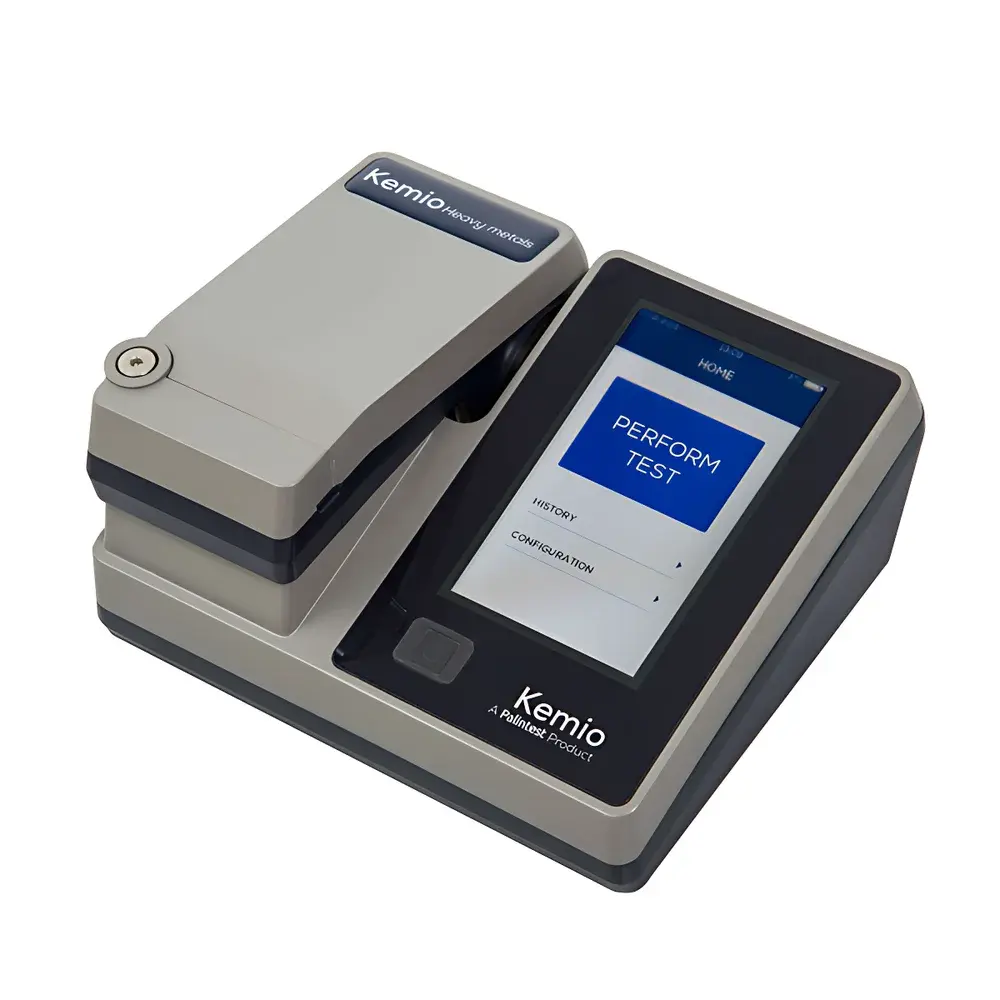
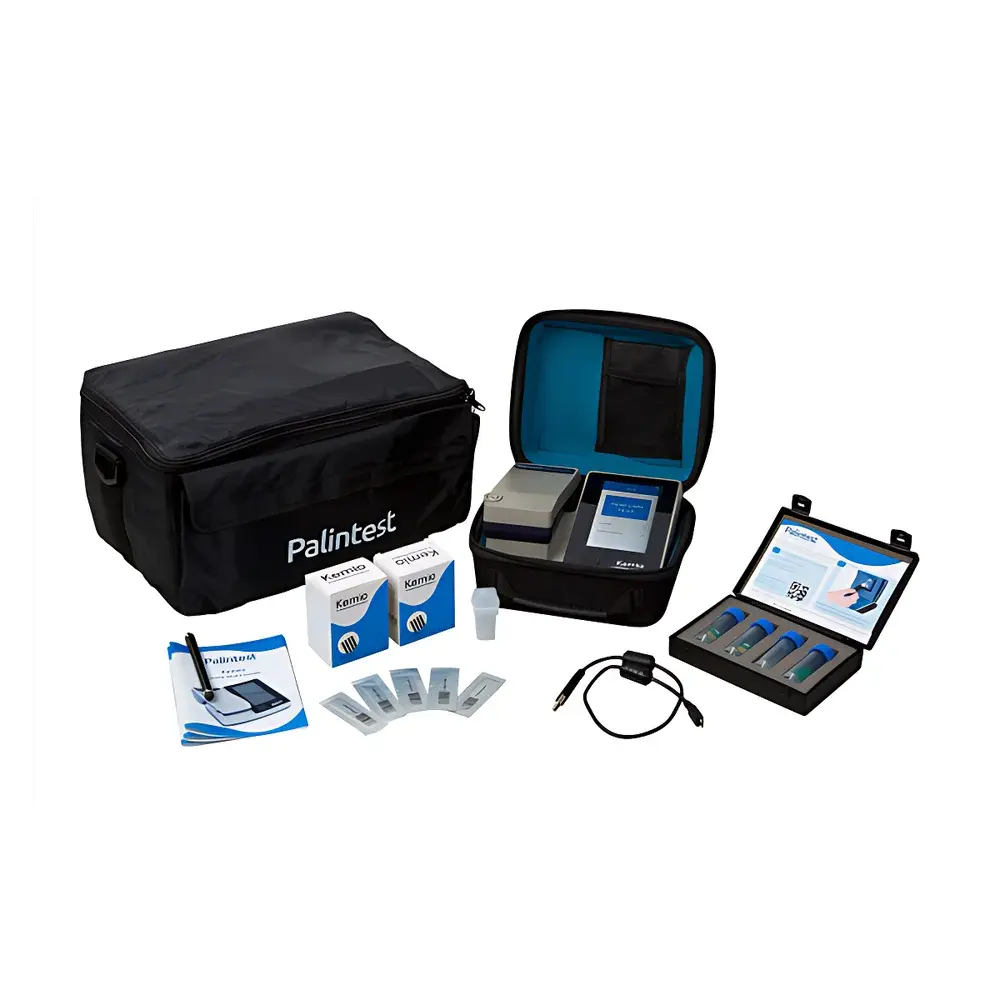
Palintest Kemio Heavy Metals Analyzer
| Brand | Palintest |
|---|---|
| Origin | United Kingdom |
| Model | Kemio |
| Instrument Type | Portable |
| Detection Principle | Anodic Stripping Voltammetry (ASV) |
| Detectable Metals | Lead (Pb), Cadmium (Cd), Copper (Cu), Arsenic(III), Arsenic(V), Total Arsenic |
| Analysis Time | ≤3 minutes per test |
| Accuracy | ±5% for aqueous samples |
| Resolution | 0.1 µg/L |
| Operating Temperature Range | 0°C–50°C |
| Display | High-contrast LCD touchscreen |
| Data Storage | 10,000 test records with full metadata |
| Dimensions & Weight | 156 mm × 180 mm × 95 mm, 1012 g |
| Battery | 2300 mAh NiMH rechargeable (Palintest-specified only) |
| Ingress Protection | IP67 |
| Compliance | US EPA Method 7000B (for Pb, Cd, Cu, As), GLP-compliant data logging, 21 CFR Part 11-ready audit trail |
Overview
The Palintest Kemio Heavy Metals Analyzer is a field-deployable electrochemical platform engineered for rapid, reliable quantification of priority toxic metals in water matrices. Utilizing patented anodic stripping voltammetry (ASV), Kemio delivers laboratory-grade precision without requiring centralized infrastructure. Unlike optical or colorimetric methods, ASV is inherently insensitive to sample turbidity, color, suspended solids, or moderate variations in temperature—enabling direct analysis of raw surface water, wastewater effluent, drinking water, and industrial process streams without filtration or digestion. Each measurement is performed using single-use, chip-integrated electrochemical sensors—eliminating cross-contamination, calibration drift, and electrode fouling. The system’s core architecture adheres to the fundamental electrochemical principles defined in ASTM D3559 and US EPA Method 7000B, ensuring regulatory alignment for environmental compliance monitoring.
Key Features
- Patented disposable sensor chips with integrated working, reference, and counter electrodes—pre-conditioned and ready for immediate use
- Touchscreen interface with multilingual support (English, French, Spanish, Simplified Chinese) and intuitive icon-driven workflow
- IP67-rated enclosure for dust-tight and immersion-resistant operation in harsh field environments
- No glass components, no hazardous reagents, and zero chemical waste generation—fully compliant with ISO 14001 environmental management requirements
- On-device QR code scanning for automated sample ID capture and traceability linkage
- Real-time temperature compensation across 5–35°C sample range, with ambient operating capability from 0°C to 50°C
- Built-in battery management system with 2300 mAh NiMH pack (Palintest-certified only), supporting ≥8 hours of continuous operation
Sample Compatibility & Compliance
Kemio is validated for use with potable water, groundwater, surface water, treated wastewater, and industrial discharge samples. It meets US EPA Method 7000B performance criteria for Pb, Cd, Cu, and As species (As(III), As(V), total As) in aqueous media. All measurements comply with GLP documentation standards: each result includes timestamp, operator ID (optional), sensor lot number, calibration status, and environmental conditions. Audit trails are exportable via USB and support 21 CFR Part 11 readiness when deployed with Palintest’s certified software suite. No sample pretreatment is required for most applications; high-solids or highly organic samples may benefit from optional centrifugation—but filtration is never necessary.
Software & Data Management
The Kemio firmware embeds a secure local database storing up to 10,000 complete test records—including analyte concentration, detection limit, sensor ID, test duration, temperature, and operator annotation. Data export is supported via USB mass storage mode in CSV format, compatible with LIMS integration and statistical process control platforms. Optional Palintest Connect desktop software enables batch reporting, trend visualization, method validation documentation, and electronic signature workflows aligned with ISO/IEC 17025 quality management systems. Firmware updates are delivered via encrypted USB key to maintain cybersecurity integrity.
Applications
- Regulatory compliance monitoring under the US Safe Drinking Water Act (SDWA) and EU Drinking Water Directive (DWD)
- Source water screening at intake points for municipal utilities and bottled water facilities
- Wastewater treatment plant effluent verification prior to discharge
- Industrial site remediation and leachate monitoring (e.g., mining, electroplating, battery manufacturing)
- Field-based emergency response for contamination events involving heavy metal spills
- Research-grade speciation studies of arsenic redox states in anaerobic aquifers
FAQ
Does Kemio require daily calibration?
No—each disposable sensor is factory-calibrated and contains embedded calibration constants. A single verification check with standard solution is recommended before first use of a new sensor batch.
Can Kemio distinguish between As(III) and As(V) in the same sample?
Yes—using sequential pH-controlled deposition steps, Kemio independently quantifies As(III) and As(V) within the same test sequence, with total arsenic derived as their sum.
Is sensor disposal regulated as hazardous waste?
No—the sensors contain trace metal deposits below RCRA-exempt thresholds and may be disposed of as non-hazardous solid waste per local jurisdictional guidelines.
What is the shelf life of unused sensors?
18 months from manufacture date when stored at 2–25°C in original sealed packaging.
Can Kemio operate while charging?
Yes—continuous operation is supported via USB-C power input or external 5 V DC supply without interrupting testing or data logging.
Related Products







