
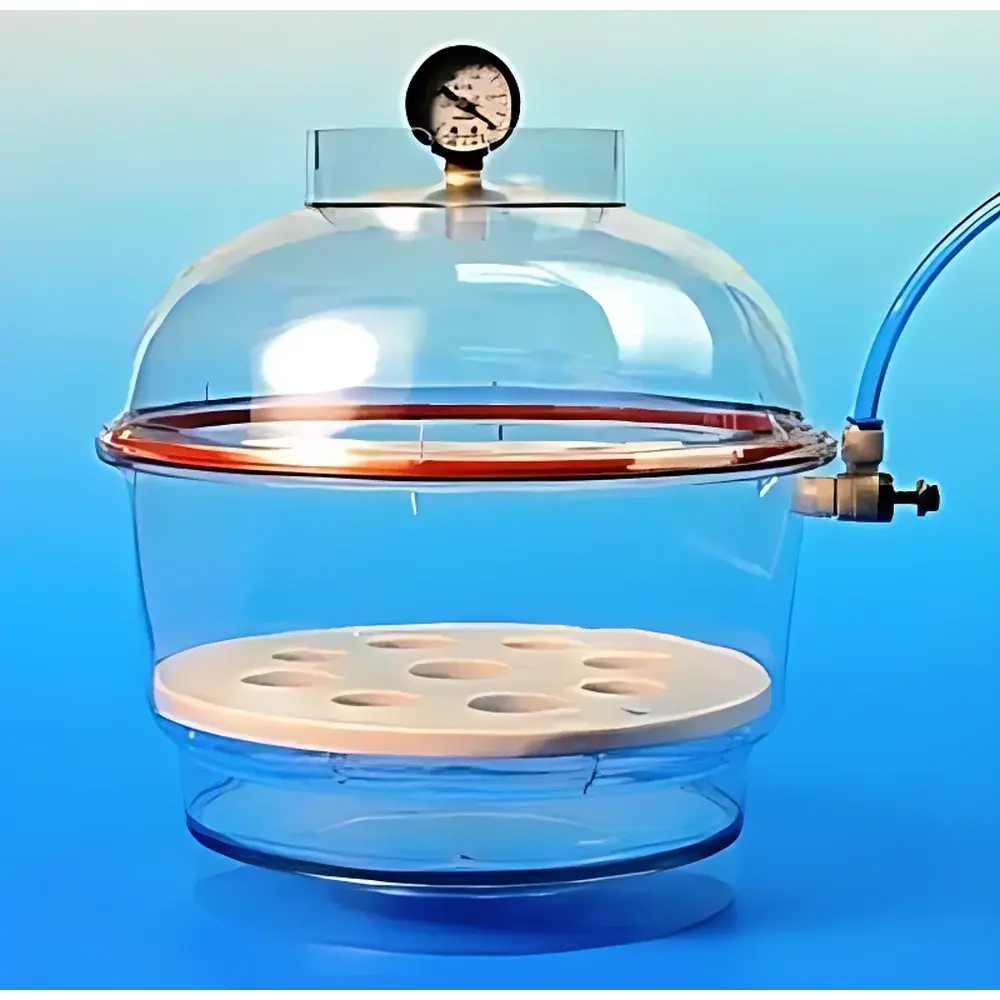
Tansi TS250III Vacuum Desiccator Chamber
| Brand | Tansi |
|---|---|
| Model | TS250III |
| Material | Polycarbonate Body with Silicone O-Ring Seal |
| Vacuum Retention | <3% pressure loss over 30 days |
| Vacuum Gauge | Integrated analog vacuum indicator (0–760 Torr / 0–101 kPa) |
| Operating Temperature Range | 0 °C to 80 °C |
| Sealing Method | Oil-free silicone O-ring |
| Gas Control | Precision needle valve with quick-connect fitting for pump/tubing interface |
| Optical Clarity | High-transparency polycarbonate (≥90% visible light transmission) |
| Chemical Resistance | Resistant to alcohols, acetone, dilute acids/bases, and common organic solvents |
| Weight | Approx. 1.8 kg (empty) |
| Internal Volume | 250 mL |
| Compliance | Designed per ISO 7493-2 (laboratory desiccators), compatible with GLP workflows requiring documented environmental isolation |
Overview
The Tansi TS250III Vacuum Desiccator Chamber is a precision-engineered laboratory containment system designed for controlled atmospheric isolation of sensitive samples under reduced pressure. Unlike conventional desiccators relying solely on desiccants, the TS250III integrates active vacuum management—enabling true low-pressure storage, accelerated solvent removal, and degassing of viscous media. Its operation is based on sealed chamber dynamics governed by Boyle’s law and vapor pressure depression principles: lowering ambient pressure reduces the boiling point of volatile components and accelerates moisture diffusion from hygroscopic or porous materials. This makes it particularly suitable for applications where inert-atmosphere preservation, thermal stability during drying, or mechanical integrity under pressure differential are critical—such as long-term archiving of reference standards, stabilization of moisture-sensitive pharmaceutical intermediates, or preparation of bubble-free polymer precursors prior to casting.
Key Features
- Extended vacuum retention: Demonstrates ≤3% pressure drift over 30 days at room temperature (23 °C ± 2 °C), verified per ISO 7493-2 leak-rate test protocol using calibrated digital manometers.
- Real-time vacuum monitoring: Integrated analog vacuum gauge (0–760 Torr range) with dual-scale calibration (kPa and mmHg) enables continuous visual assessment without external instrumentation.
- Robust polycarbonate construction: Top and base fabricated from medical-grade, UV-stabilized polycarbonate (ISO 10993-5 compliant), offering >90% optical clarity, impact resistance ≥60 J/m (notched Izod), and tolerance to rapid pressure transitions (0 → –95 kPa in <2 s).
- Oil-free sealing architecture: Dual-lip silicone O-ring (FKM-compatible, hardness 70 ± 5 Shore A) ensures repeatable, contaminant-free closure without lubricants—critical for analytical sample integrity and cleanroom-compatible workflows.
- Precision gas flow control: Stainless steel needle valve (0.05–2.0 mL/s adjustable flow range) allows stepless regulation of evacuation and backfill rates, preventing turbulence-induced particle resuspension or thermal shock to heated crucibles placed on internal ceramic support plates.
- Modular pneumatic interface: Push-to-connect fitting (6 mm OD tubing compatible) enables tool-free, leak-tight attachment to rotary vane pumps, diaphragm pumps, or nitrogen purge manifolds.
Sample Compatibility & Compliance
The TS250III accommodates heterogeneous sample formats—including glass vials, aluminum weighing boats, quartz crucibles (up to 60 mm diameter), and flat substrates—on its removable ceramic隔板 (alumina, 96% purity, rated to 1200 °C). Its operating envelope (0–80 °C) permits post-drying thermal conditioning without disassembly. The chamber complies with ISO 7493-2 requirements for dimensional stability and seal integrity under static vacuum. While not certified for explosion-proof use, its non-sparking construction and absence of metallic gasket interfaces make it appropriate for Class I, Division 2 environments when used with intrinsically safe vacuum sources. It supports audit-ready documentation per FDA 21 CFR Part 11 when integrated with validated pump controllers logging timestamped pressure profiles.
Software & Data Management
As a standalone passive vacuum platform, the TS250III does not include embedded electronics or firmware. However, it is fully interoperable with third-party vacuum monitoring systems (e.g., MKS Instruments Baratron controllers, Pfeiffer TPG300 series) via its standard 1/4″ NPT vacuum port. When paired with such devices, users can generate electronic logs meeting GLP/GMP traceability requirements—including pressure vs. time curves, cycle start/stop timestamps, and operator ID tagging. All mechanical components are serviceable without specialized tools; O-rings conform to ASTM D2000 classification AA714, ensuring batch-to-batch consistency.
Applications
- Long-term archival storage of hygroscopic reference standards (e.g., USP-grade sucrose, potassium hydrogen phthalate) under <10% RH equivalent conditions.
- Rapid dehydration of biological tissue sections prior to SEM mounting, minimizing structural collapse compared to ambient-air drying.
- Pre-polymer degassing of epoxy resins (e.g., Epon 828), silicone elastomers (e.g., PDMS Sylgard 184), and photoresists to eliminate microvoids affecting optical homogeneity.
- Stabilization of oxidation-prone catalysts (e.g., Pd/C, Raney nickel) and air-sensitive organometallics under nitrogen-purged low-pressure environments.
- Controlled drying of optical components (lenses, prisms, laser crystals) to prevent water-spot formation on anti-reflective coatings.
FAQ
Can the TS250III be used for vacuum drying at elevated temperatures?
Yes—the polycarbonate body is rated for continuous operation up to 80 °C, and the internal ceramic plate supports heated crucibles. However, sustained exposure above 60 °C may accelerate long-term O-ring compression set; we recommend periodic inspection after thermal cycling.
Is the vacuum gauge recalibratable?
The analog gauge is factory-calibrated to NIST-traceable standards and does not require user recalibration. For quantitative validation, connect a calibrated digital manometer to the auxiliary port during routine QC checks.
What maintenance is required to sustain vacuum integrity?
Inspect the silicone O-ring monthly for nicks or flattening; clean with isopropyl alcohol and re-lubricate only with FDA-approved silicone grease if surface tackiness diminishes—though oil-free operation remains optimal for most applications.
Does the chamber meet ISO/IEC 17025 requirements for accredited labs?
While the unit itself is not accredited, its design enables compliance: vacuum retention data, gauge calibration records, and usage logs constitute objective evidence satisfying ISO/IEC 17025 clause 6.4.6 (equipment verification) when maintained as part of a lab’s quality system.
Related Products



