
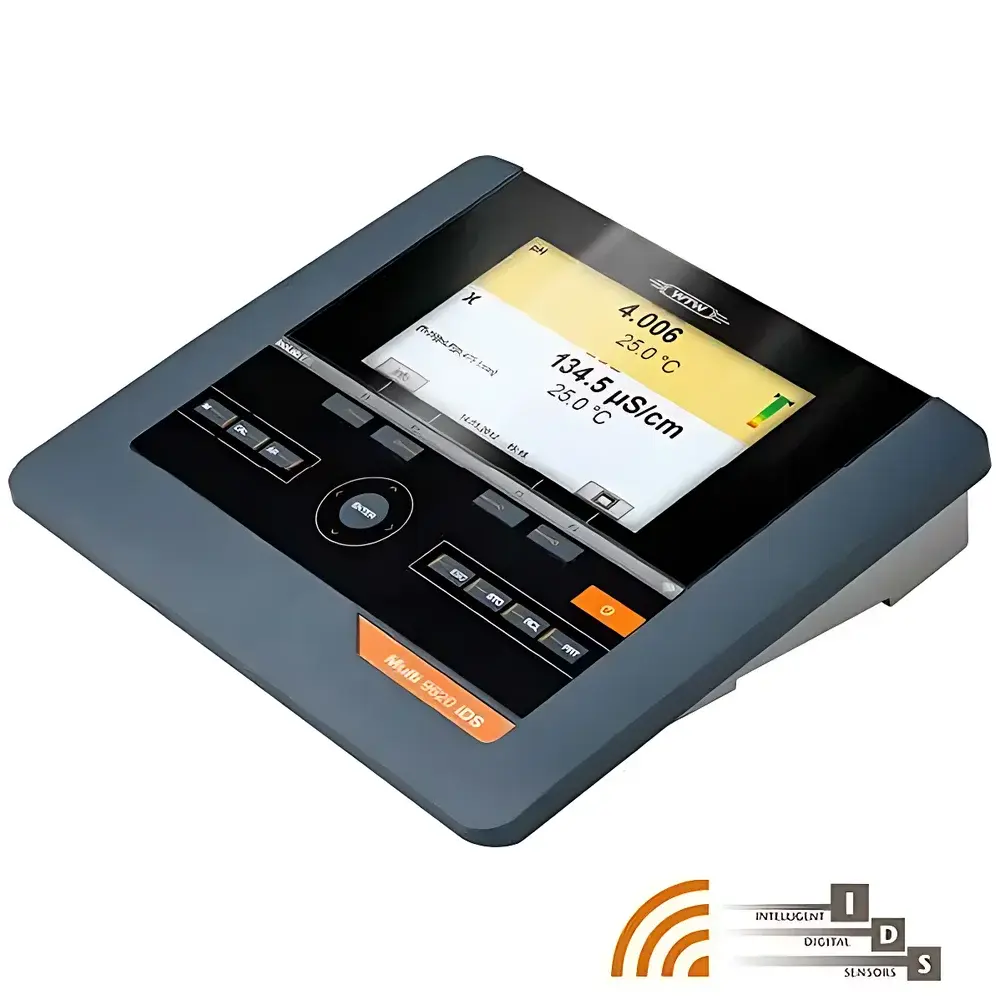
WTW inoLab Multi 9430 Digital Multiparameter Laboratory Analyzer
| Brand | WTW |
|---|---|
| Origin | Germany |
| Model | inoLab Multi 9430 |
| Instrument Type | Laboratory Water Quality Analyzer |
| Measurable Parameters | pH, mV (ORP), Conductivity, Resistivity, Salinity, Dissolved Oxygen (DO), Turbidity, Ion-Selective Electrode (ISE) Concentration |
| Connectivity | Digital Smart Probe Interface (No Cable Required) |
| Display | Backlit Graphic LCD with Antimicrobial Keypad |
| Probe Management | QSC (Quality Sensor Control) & CMC (Continuous Measurement Control) |
| Data Storage | Up to 10,000 measurement sets |
| Compliance | Designed for ISO/IEC 17025-compliant labs |
Overview
The WTW inoLab Multi 9430 is a high-precision digital multiparameter laboratory analyzer engineered for comprehensive water quality assessment in environmental monitoring, municipal water treatment, academic research, and industrial process control laboratories. Based on digital sensor communication architecture, it operates using the principle of direct digital signal acquisition from intelligent probes—eliminating analog interference and ensuring metrological traceability across all measured parameters. Unlike legacy analog meters, the inoLab Multi 9430 employs a probe-agnostic interface that accepts interchangeable digital sensors for pH/ORP, conductivity, dissolved oxygen (optical or electrochemical), turbidity (nephelometric), and ion-selective electrodes (e.g., Na⁺, K⁺, NH₄⁺, NO₃⁻, F⁻). Its core design adheres to fundamental electrochemical and optical measurement standards defined in ISO 7888 (conductivity), ISO 5814 (electrochemical DO), ISO 7027 (turbidity), and ASTM D1293 (pH of water), enabling reliable data generation under regulated testing environments.
Key Features
- Digital Smart Probe Interface: Eliminates analog cabling; enables plug-and-play connection with automatic probe identification, calibration history recall, and embedded sensor configuration storage.
- QSC (Quality Sensor Control): Continuously evaluates electrode impedance, response time, and offset stability—providing real-time diagnostic feedback to ensure sensor readiness prior to measurement.
- CMC (Continuous Measurement Control): Monitors signal drift, temperature compensation accuracy, and electrode polarization during measurement; flags deviations exceeding user-defined thresholds to prevent erroneous reporting.
- Backlit Graphic LCD Display (128 × 64 pixels): Supports multilingual UI (English, German, French, Spanish); displays trend graphs, calibration logs, and sensor diagnostics alongside primary readings.
- Antimicrobial Keypad: Complies with ISO 22196 for microbial resistance; reduces cross-contamination risk in shared lab environments.
- Expandable Architecture: Optional analog adapter module permits integration of conventional glass pH, ORP, or ISE electrodes—preserving legacy investment while transitioning to digital workflows.
Sample Compatibility & Compliance
The inoLab Multi 9430 is validated for aqueous matrices including drinking water, surface water, wastewater effluents, groundwater, and saline estuarine samples. It accommodates sample temperatures from 0 °C to 50 °C and supports automatic temperature compensation per DIN EN 27888 for conductivity and per NIST SRM 186 for pH. All digital probes comply with IP67 ingress protection and are CE-marked under the EU Electromagnetic Compatibility Directive 2014/30/EU and RoHS 2011/65/EU. When used with WTW-certified probes and calibrated per ISO/IEC 17025 procedures, the system meets data integrity requirements for regulatory submissions under EPA Method 150.1 (conductivity), EPA Method 300.0 (ion chromatography support), and USP (water conductivity for pharmaceutical use).
Software & Data Management
Data export is supported via USB 2.0 host port (to flash drive) or RS232 serial output. The instrument natively stores up to 10,000 timestamped datasets with metadata (operator ID, probe ID, calibration date, temperature, and measurement mode). For advanced traceability, optional connectivity to WTW LabStation PC software enables automated report generation compliant with 21 CFR Part 11 (electronic signatures, audit trail, user access levels). Raw data files are exported in CSV or XML format, supporting import into LIMS platforms such as Thermo Fisher SampleManager or LabWare LIMS. Calibration records include full parameter sets (e.g., two-point pH slope, asymmetry potential, ISFET offset) and are digitally signed upon completion.
Applications
- Environmental compliance monitoring per EU Water Framework Directive (WFD) Annex V parameters.
- Drinking water safety verification per WHO Guidelines for Drinking-water Quality and national standards (e.g., GB/T 5750, EN ISO 10523).
- Wastewater treatment plant influent/effluent QA/QC—especially for nutrient ion tracking (NH₄⁺, NO₃⁻) and salinity-driven corrosion assessment.
- Pharmaceutical water system validation (Purified Water, Water for Injection) per USP , , and .
- Academic hydrochemistry research requiring synchronized multi-analyte profiling under controlled temperature and ionic strength conditions.
FAQ
Does the inoLab Multi 9430 support GLP-compliant documentation?
Yes—when used with LabStation software and configured with electronic signatures, user roles, and audit-trail logging, it satisfies GLP requirements for nonclinical laboratory studies.
Can I use non-WTW digital probes with this instrument?
No—the inoLab Multi 9430 communicates exclusively with WTW-certified digital probes utilizing the proprietary SenTix® or TetraCon® digital interface protocol.
Is calibration verification traceable to national standards?
Calibration solutions must be certified reference materials (CRMs) traceable to NIST, BAM, or NPL; probe-specific calibration certificates are issued by WTW’s DAkkS-accredited calibration lab upon request.
What maintenance is required for long-term reliability?
Annual verification of probe performance against certified standards is recommended; no internal user-serviceable components exist—field service is performed by WTW-authorized technicians only.
How does CMC differ from traditional endpoint stability detection?
CMC continuously analyzes first-derivative signal behavior and thermal lag compensation residuals—not just endpoint convergence—thereby detecting slow drift or micro-fouling before it impacts result validity.
Related Products







