
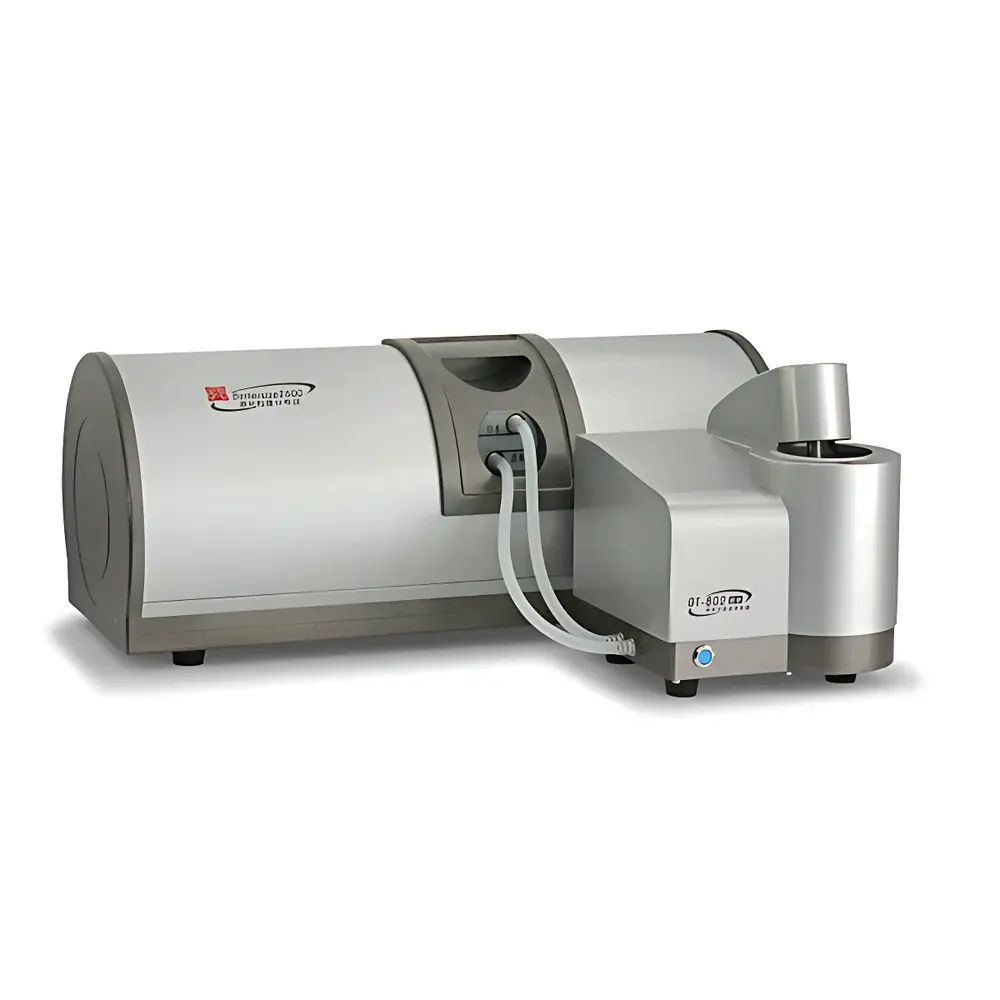
Bettersize BetterSize2600 Laser Particle Size Analyzer
| Brand | Bettersize |
|---|---|
| Origin | Liaoning, China |
| Manufacturer Type | Authorized Distributor |
| Country of Origin | China |
| Model | BetterSize2600 |
| Price Range | USD 21,000 – 28,000 (FOB) |
| Dispersion Method | Dry & Wet Dispersal |
| Instrument Type | Laboratory Laser Diffraction Particle Size Analyzer |
| Measurement Range | 0.02–2600 µm (wet), 0.1–2600 µm (dry) |
| Repeatability | ≤ 0.5% (D50, certified reference material, wet mode) |
| Measurement Time | ≤ 10 s per analysis |
| Optical Configuration | Dual-orientation Fourier optical system with inclined sample cell |
| Detection Angle Range | 0.016°–165° |
| Number of Photodetectors | 92 (72 forward, 14 side, 6 backward) |
| Laser Source | High-power polarized fiber laser |
| Alignment | Fully automated optical alignment |
| Software Interface | SOP-driven automation |
| Operating Systems | Windows XP/7/8/10 |
| Connectivity | USB 2.0 or 3.0 |
| Ultrasonic Power | 50 W |
| Circulation Tank Volume | 600 mL |
| Flow Rate (Wet) | 3000–8000 mL/min |
| Gas Pressure (Dry) | 0.1–0.8 MPa (adjustable) |
| Gas Flow Rate (Dry) | 400–6000 L/min |
| Sample Mass | 0.2–10 g |
| Resolution (Bimodal Separation) | ≥1.65 (ratio of nominal D50 values) |
| Accuracy | ≤ 0.5% (D50, NIST-traceable standard, wet mode) |
| Compliance | Meets ISO 13320:2020, ASTM E799-22, and GB/T 19077–2016 requirements for laser diffraction particle sizing |
Overview
The Bettersize BetterSize2600 Laser Particle Size Analyzer is a high-performance laboratory instrument engineered for precision particle size distribution (PSD) measurement across diverse industrial and research applications. It operates on the principle of Mie scattering theory—mathematically modeling light interaction with spherical particles suspended in liquid or dispersed in gas—enabling quantitative determination of volume-weighted particle size distributions from 0.02 µm to 2600 µm. Its dual-orientation Fourier optical architecture integrates forward, side, and backward angular detection (0.016°–165°) with an inclined sample cell design, a patented configuration that eliminates dead zones and enhances signal fidelity at both sub-100 nm and coarse ends of the range. This optical innovation directly supports accurate characterization of complex, multimodal samples—such as cathode and anode active materials used in lithium-ion battery manufacturing—where narrow PSD control is critical for slurry rheology, electrode coating uniformity, and electrochemical performance consistency.
Key Features
- Dual-orientation Fourier optical path with tilted sample cell: Enables full-angle scattering capture, improving resolution and sensitivity for fine particles (<0.1 µm) and extending dynamic range without compromise.
- Automated wet dispersion system: Includes anti-dry-burn ultrasonic disperser (50 W), centrifugal circulation pump, auto-fill/drain/overflow control, and programmable flow regulation (3000–8000 mL/min) for reproducible deagglomeration.
- Dry dispersion module: Equipped with adjustable compressed air or inert gas supply (0.1–0.8 MPa; 400–6000 L/min), ensuring gentle yet effective dispersion of fragile or moisture-sensitive powders.
- 92-channel photodetector array: Optimized spatial layout (72 forward, 14 side, 6 backward) delivers high signal-to-noise ratio and robust inversion stability under varying refractive index conditions.
- Full automation capability: SOP-based operation with automatic optical alignment, background subtraction, and real-time quality assurance metrics—including residual error monitoring and scatter intensity profiling.
- Compliance-ready data handling: Software logs all acquisition parameters, instrument status, and operator actions with timestamping, supporting GLP/GMP-aligned workflows and FDA 21 CFR Part 11 audit trails when deployed with validated configurations.
Sample Compatibility & Compliance
The BetterSize2600 accommodates a broad spectrum of particulate systems—from aqueous slurries of LiFePO₄ or NMC cathodes and graphite/silicon anodes, to organic solvent-based electrolyte suspensions and dry ceramic separator powders. Its wet dispersion system is compatible with water, ethanol, isopropanol, and other low-viscosity media; the dry module supports nitrogen or argon purging for oxygen-sensitive materials. The instrument conforms to ISO 13320:2020 (laser diffraction methodology), ASTM E799-22 (standard practice for reporting particle size analysis results), and Chinese national standard GB/T 19077–2016. Validation protocols include repeatability assessment using NIST-traceable silica standards (e.g., SRM 1963), with documented ≤0.5% RSD for D50 and bimodal resolution ≥1.65 per ISO-defined criteria.
Software & Data Management
The proprietary Bettersize Analysis Software provides intuitive workflow navigation, customizable report templates (PDF, CSV, Excel), and advanced data processing options including multi-sample statistical comparison, batch mode analysis, and user-defined PSD overlays. Raw scattering patterns are stored alongside processed distributions, enabling retrospective re-inversion with updated optical models or refractive index inputs. All measurement sessions generate immutable metadata logs—including laser power, detector gain, temperature, and dispersion settings—facilitating traceability and method verification. Optional software modules support IQ/OQ/PQ documentation packages compliant with pharmaceutical and battery-grade QC environments.
Applications
- Lithium-ion battery R&D and production: Quantitative PSD control of cathode (NMC, LFP), anode (natural/artificial graphite, Si/C composites), and separator materials to ensure consistent slurry viscosity, coating thickness, and interfacial ion transport.
- Pharmaceutical solid dosage development: Monitoring micronization efficiency, excipient blending homogeneity, and inhalable powder aerodynamic diameter distribution per USP & EP guidelines.
- Advanced ceramics and catalysts: Characterizing nanoparticle agglomerates, sintering precursors, and supported metal dispersions where surface area and packing density correlate strongly with PSD.
- Coatings and pigments: Validating pigment dispersion stability, predicting gloss, opacity, and film formation behavior based on D10/D50/D90 metrics.
- Environmental and geotechnical analysis: Silt/clay fraction quantification in soil sediments and aerosol filter extracts using standardized wet dispersion protocols.
FAQ
What particle size standards are recommended for routine calibration and verification?
Certified reference materials such as NIST SRM 1963 (silica, ~100 nm), SRM 2800 (alumina, ~10 µm), and ISO 13320 Annex B test powders are routinely employed. Bettersize provides application notes detailing protocol-specific validation procedures.
Does the instrument support refractive index correction for non-spherical or absorbing particles?
Yes—the software allows manual input of real and imaginary components of complex refractive index, and includes built-in libraries for common battery materials (e.g., graphite n=2.5–3.0, k=1.0–2.0; LiCoO₂ n≈2.3). Mie inversion remains valid for aspect ratios <3:1.
Can the BetterSize2600 be integrated into automated lab environments?
It supports external trigger signals via TTL I/O port and offers COM/DCOM API access for integration with LIMS, MES, or robotic sample-handling platforms.
Is dry dispersion suitable for heat-sensitive or electrostatic-prone materials?
Yes—gas pressure and flow rate are independently adjustable to minimize particle attrition and tribocharging; optional grounded stainless-steel pathways and antistatic nozzles are available upon request.
How is measurement uncertainty quantified and reported?
Uncertainty estimation follows ISO/IEC Guide 98-3 (GUM), incorporating contributions from optical alignment drift, detector noise, dispersion variability, and model assumptions. Typical expanded uncertainty (k=2) for D50 in optimized wet mode is ±0.8% relative.



