
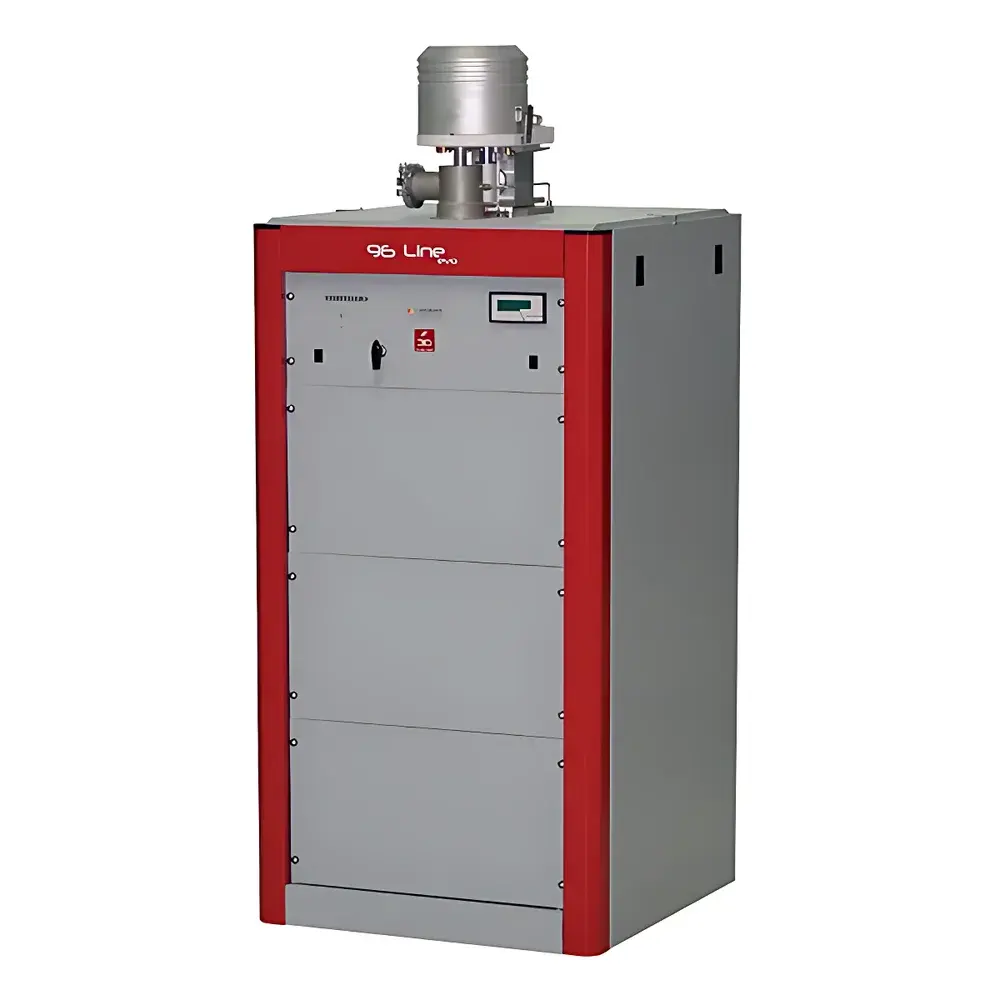
SETARAM 96line High-Temperature Thermomechanical Analyzer (TMA)
| Brand | SETARAM |
|---|---|
| Origin | France |
| Model | 96line TMA |
| Instrument Type | Thermomechanical Analyzer |
| Temperature Range | Ambient to 2100 °C |
| Displacement Range | ±2 mm |
| Maximum Force | 1.5 N (electromagnetically controlled) |
| Sample Dimensions | L = 50 mm, Ø = 18 mm (recommended Ø = 15 mm) |
| Displacement Resolution | 1.6 nm RMS |
| Displacement Noise | 10 nm RMS |
| Specific Noise | 0.2 × 10⁻⁶ |
| Probe Types | Al₂O₃ (up to 1750 °C), Graphite (≥1750 °C) |
| Probe Geometry | Spherical-tip compression probe |
Overview
The SETARAM 96line High-Temperature Thermomechanical Analyzer (TMA) is an engineered solution for precision dimensional change measurement of solid and refractory materials under controlled thermal and mechanical conditions—spanning ambient temperature up to 2100 °C. Unlike conventional horizontal or cantilever-based TMA systems, the 96line employs a vertically oriented, gravity-assisted load train combined with electromagnetic force regulation. This architecture minimizes parasitic bending moments and ensures near-zero initial contact stress on large-volume specimens—critical for accurate dilatometric and creep behavior assessment in ceramics, nuclear graphite, high-entropy alloys, and advanced composites. The system operates on the principle of controlled-force, constant-load thermomechanical displacement monitoring, where dimensional response (expansion, contraction, softening, or sintering) is resolved via a high-stability capacitive or optical displacement transducer referenced against a thermally invariant base. Its vertical design inherently decouples thermal drift from mechanical signal path, enhancing long-term baseline stability during multi-hour high-temperature holds.
Key Features
- Vertical dual-column mechanical architecture enabling true zero-initial-load operation for low-stress contact on fragile or porous samples
- Electromagnetically regulated force control system delivering precise, programmable loads from 0.01 N to 1.5 N with real-time feedback and auto-calibration capability
- High-resolution displacement sensing with 1.6 nm RMS resolution and sub-10 nm RMS noise floor, validated per ISO 11359-2 metrological requirements
- Dual-probe configuration: alumina-tipped spherical probe rated to 1750 °C; graphite-tipped probe for extended operation up to 2100 °C—both compliant with ASTM C372 for refractory testing
- Modular furnace options supporting three calibrated temperature ranges: ambient/1600 °C, ambient/1750 °C, and ambient/2100 °C—with independent thermocouple verification channels (Type B or C)
- Integrated thermal inertia compensation algorithm to correct for lag between furnace setpoint and actual sample surface temperature, especially critical above 1400 °C
Sample Compatibility & Compliance
The 96line accommodates cylindrical specimens up to 50 mm in length and 18 mm in diameter (15 mm recommended for optimal thermal homogeneity), making it uniquely suited for industrial-scale refractories, sintered carbides, and monolithic ceramic components—not just lab-scale powders or thin films. Sample mounting uses a self-centering, low-friction support stage with optional inert gas purging (Ar, He, N₂) to prevent oxidation or carburization during high-temperature runs. All thermal and mechanical calibrations are traceable to national standards (LNE, France) and fully documented for GLP/GMP environments. The instrument complies with ISO 11359-1 (general principles of TMA), ISO 11359-2 (determination of coefficient of linear thermal expansion), and supports audit-ready data generation aligned with FDA 21 CFR Part 11 requirements when paired with SETARAM’s certified acquisition software.
Software & Data Management
Acquisition and analysis are managed through SETARAM’s Calisto® TMA software suite—validated for use in regulated laboratories. Calisto provides full ICH Q5A-compliant instrument control, including multi-step force ramping, dynamic TMA modes (e.g., stress-relaxation, creep-recovery), and synchronized thermal profiling. All raw displacement, temperature, and force data are stored in encrypted, time-stamped binary archives with embedded metadata (operator ID, calibration certificate IDs, environmental logs). Export formats include ASTM E1985-compliant .csv, ISO-standard .tdf, and universal .xlsx—each preserving full traceability of processing history. Audit trails record every parameter modification, calibration event, and user login, satisfying internal QA and external regulatory review requirements.
Applications
- Linear thermal expansion coefficient (CTE) determination of nuclear-grade graphite and SiC composites across 25–2000 °C
- Sintering kinetics analysis of oxide and non-oxide ceramics under controlled uniaxial load
- Softening point and deformation onset detection in refractory linings used in metallurgical furnaces
- Creep compliance mapping of high-temperature superalloys under sustained load at 1200–1800 °C
- Thermal shock resistance evaluation via rapid thermal cycling with in-situ displacement monitoring
- Dimensional stability validation of additive-manufactured metal parts post-heat treatment
FAQ
What is the maximum recommended sample mass for stable thermal equilibration at 2100 °C?
For optimal temperature uniformity and minimal thermal lag, samples should not exceed 15 g when operating above 1800 °C. Larger masses require extended soak times and may necessitate custom furnace shielding.
Can the 96line perform dynamic mechanical measurements (e.g., modulus vs. temperature)?
No—the 96line is optimized for static and quasi-static thermomechanical displacement under constant or stepped load. Dynamic modulus characterization requires a dedicated high-temperature DMA system.
Is nitrogen purge sufficient for graphite probe operation above 1750 °C?
No. Graphite probes require high-purity argon (≥99.999%) with dew point < −60 °C to suppress oxidation and maintain probe integrity beyond 1800 °C.
How is force calibration verified during routine operation?
Calisto software initiates automated force nulling and span verification using internal reference weights prior to each test sequence—log files document pass/fail status and deviation values.
Does the system support simultaneous DTA or DSC signal acquisition?
The 96line is a dedicated TMA platform. However, SETARAM’s同期同步 (synchronous) integration option allows co-mounting with a compatible DSC module within the same furnace chamber—subject to separate configuration and validation.



