
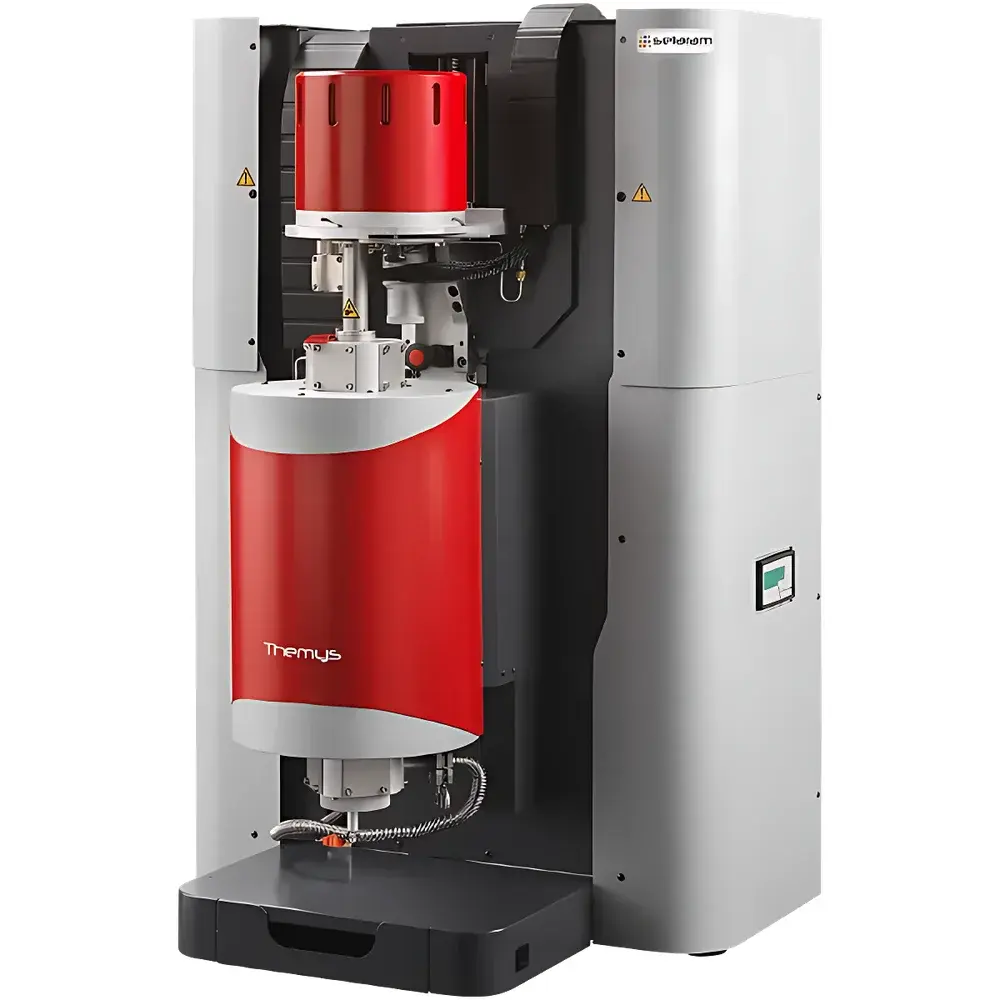
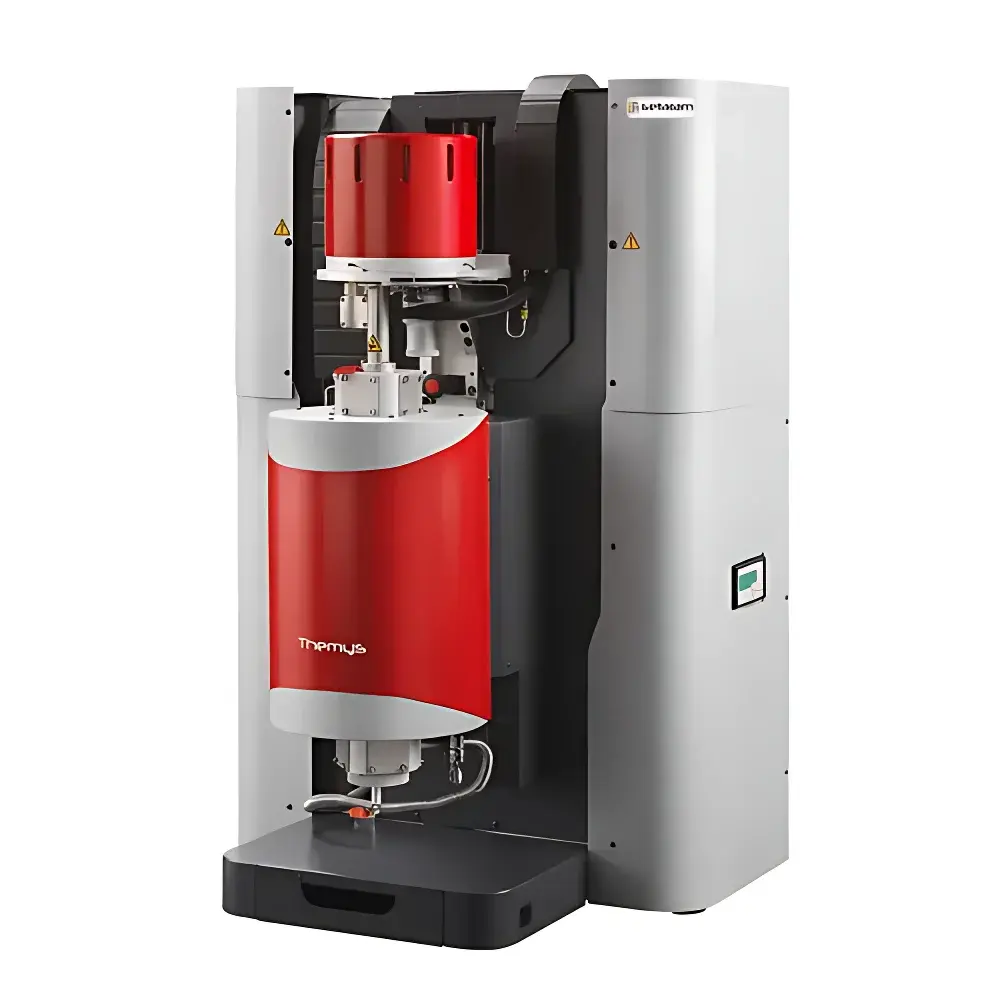
SETARAM Themys High-Temperature Comprehensive Thermal Analysis Platform
| Brand | SETARAM |
|---|---|
| Origin | France |
| Model | Themys |
| Temperature Range | 0–1750 °C (up to 2400 °C in optional configurations) |
| Temperature Accuracy | ±0.1 K |
| Balance Sensitivity | 0.00059 µg |
| Heating/Cooling Rate | 0.01–100 K/min |
| Maximum Sample Mass | 100 g |
| Baseline Drift | ±3 µg |
| Simultaneous Measurement Capability | TGA, DTA, DSC, STA, TMA, EGA |
| Atmosphere Options | Inert, oxidizing, reducing, corrosive (e.g., H₂, NH₃, SO₂, H₂S), vacuum (primary <5×10⁻² mbar |
| Gas Control | Up to 3 independent mass flow controllers (MFCs), programmable gas switching, heated EGA interfaces (4×, up to 300 °C) |
| Compliance | Designed for GLP/GMP environments |
Overview
The SETARAM Themys is a high-temperature modular thermal analysis platform engineered for precision measurement of mass change (TGA), heat flow (DSC/DTA), dimensional change (TMA), and evolved gas composition (EGA) under extreme thermal and atmospheric conditions. Operating on the principles of thermogravimetry, differential thermal analysis, and dilatometry, the Themys integrates multiple analytical techniques into a single, unified instrument architecture centered around a robust graphite furnace capable of stable operation up to 2400 °C. Its core design philosophy emphasizes experimental fidelity—achieving sub-microgram mass resolution, sub-kelvin temperature control accuracy, and exceptional baseline stability—even during prolonged high-temperature ramping or isothermal holds. The platform is purpose-built for research and industrial applications demanding rigorous thermal characterization across energy materials, advanced ceramics, nuclear fuels, metallurgical alloys, catalysts, and geochemical systems where decomposition kinetics, phase transitions, solid–gas reactivity, and thermal expansion behavior must be quantified under realistic process-relevant atmospheres.
Key Features
- Single graphite furnace architecture supporting TGA, DTA, DSC, STA, TMA, and EGA modules—enabling seamless technique interchange without hardware realignment or recalibration.
- Three balance options: high-sensitivity (±5 mg range, 0.00059 µg resolution), large-capacity (±3000 mg range, auto-balancing), and multi-purpose (±200 mg range, optimized for dynamic thermal events).
- Triple thermocouple DTA sensor system with Twist-and-Lock mounting—providing enhanced thermal symmetry, reduced thermal lag, and improved signal-to-noise ratio across all temperature zones.
- Programmable multi-gas delivery system with up to four independently controlled MFCs, enabling automated gas switching, blending, and pressure-compensated flow regulation during thermal protocols.
- Heated EGA interfaces (4×, up to 300 °C) with standardized flange connections—facilitating direct coupling to FTIR, quadrupole MS, GC-MS, or MS-FTIR systems for real-time molecular speciation of evolved gases.
- Integrated safety subsystems including H₂/O₂ concentration monitoring, N₂ purge lines, corrosion-resistant gas path components, and vacuum-rated seals compliant with ISO 27467 standards for reactive atmosphere handling.
Sample Compatibility & Compliance
The Themys accommodates solid, powdered, fibrous, and pelletized samples in crucibles ranging from 30 µL to 2.5 mL volume (e.g., Pt, Al₂O₃, W, sapphire, graphite). Its vertical TMA module employs low-force electromagnetic suspension and LVDT displacement sensing—minimizing mechanical interference and preserving intrinsic material response during compression, penetration, bending, tensile, or volumetric expansion measurements. The system meets essential regulatory expectations for traceable, auditable thermal data generation: it supports full electronic lab notebook (ELN) integration, audit trail logging, user access controls, and electronic signature workflows aligned with FDA 21 CFR Part 11 and EU Annex 11 requirements. All thermal calibrations—including temperature (In, Sn, Zn, Ag, Au, Cu melting points), enthalpy (KCl fusion), and dimensional (quartz standard) references—are traceable to NIST or PTB certified standards. Instrument qualification documentation (IQ/OQ/PQ) templates are provided per ASTM E1131, ISO 11357, and USP <1163> guidelines.
Software & Data Management
Themys is operated via CALISTO™—SETARAM’s proprietary, Windows-based acquisition and analysis suite. CALISTO enables fully automated method sequencing, including multi-step temperature ramps, isotherms, gas-switching events, and synchronized data acquisition across all detectors. Raw signals undergo real-time digital filtering, baseline subtraction, and derivative calculation (e.g., DTG, dH/dt). Quantitative analysis modules support kinetic modeling (e.g., Kissinger, Ozawa-Flynn-Wall, Friedman), component deconvolution (TGA-MS peak matching), and thermodynamic parameter extraction (ΔH, ΔS, activation energy). Data export conforms to ASTM E1447 and ASTM E1582 formats; time-stamped .csv and .tdf files are generated with embedded metadata (operator ID, instrument serial, calibration history, environmental logs). Optional 21 CFR Part 11 compliance packages include role-based permissions, biometric or token-based authentication, immutable audit trails, and encrypted database backups.
Applications
- Thermal stability assessment of battery cathode materials (e.g., LiNiₓMnᵧCo_zO₂) under O₂-rich or CO₂-containing atmospheres.
- Phase diagram construction for refractory metal alloys (Mo–Nb–Ti systems) via high-temperature DTA/TG-DTA under Ar/H₂ mixtures.
- Decomposition kinetics of MOFs and covalent organic frameworks under controlled humidity and CO₂ partial pressures.
- Oxidation resistance evaluation of SiC/Si₃N₄ composites at 1600 °C using simultaneous TGA–DTA–EGA to correlate mass loss with SiO(g) and NOₓ evolution.
- Thermal expansion coefficient (CTE) profiling of nuclear fuel cladding candidates (FeCrAl, Zr alloys) via TMA under He/Ar sweep with in situ stress compensation.
- Carbon capture sorbent regeneration studies involving cyclic TGA–DSC–EGA under simulated flue gas (N₂/CO₂/O₂/H₂O/SO₂).
FAQ
What is the maximum operating temperature for each technique module?
TGA, DTA, STA, and TMA modules operate up to 2400 °C; DSC and TG-DSC modules are rated to 1600 °C due to sensor thermal limits.
Can the Themys perform simultaneous TGA-DSC-EGA measurements?
Yes—when equipped with the STA configuration and heated EGA interfaces, the system acquires mass, heat flow, and evolved gas spectra synchronously with temporal alignment within ±100 ms.
Is vacuum operation supported, and what level is achievable?
Primary vacuum down to <5×10⁻² mbar is standard; secondary turbomolecular pumping (optional) achieves ≤10⁻⁵ mbar for ultra-high-purity inert or reactive gas purging.
How is baseline stability maintained during extended high-temperature experiments?
The suspended symmetric top-loading balance design, combined with active furnace temperature homogenization and dual-stage thermal shielding, limits baseline drift to ±3 µg over 24-hour isotherms at 2000 °C.
Are corrosion-resistant gas paths available for H₂S or SO₂ testing?
Yes—the Corrosive Atmosphere Kit includes Hastelloy C-276 tubing, ceramic-sealed valves, and passivated stainless-steel manifolds rated for continuous exposure to 100% H₂S, SO₂, NH₃, or HCl at temperatures up to 1200 °C.



